
Ultimate No Equipment Strength Training: 5 Key Moves
No gym? No problem. Build serious strength at home with 5 foundational moves and a 12-week progressive plan that actually works.
# No Equipment Strength Training: The Ultimate Guide to Building Real Muscle at Home
Over 50 million Americans pay for gym memberships they rarely use — but the people quietly getting stronger at home have figured out a secret the fitness industry doesn't want you to know. You don't need a single piece of equipment to build serious, functional strength.
No equipment strength training isn't a compromise or a beginner's placeholder. It's a proven, scalable method used by gymnasts, military personnel, and elite athletes worldwide. This guide gives you everything: the five foundational movements, a progressive weekly plan, and the exact strategy to keep getting stronger month after month — all without spending a dollar on gear.
---
Why No Equipment Strength Training Works (And Why Most People Do It Wrong)
The biggest mistake people make with bodyweight training is treating it like a fixed routine. They do the same 20 push-ups and 30 squats every day, plateau after two weeks, and conclude that "bodyweight training doesn't build real muscle."
That conclusion is wrong. The approach was wrong.
Muscle grows in response to progressive overload — consistently increasing the demand placed on it. With no equipment strength training, you achieve this by:
- Increasing reps or sets over time
- Slowing down the tempo (a 4-second descent on a push-up is dramatically harder)
- Progressing to harder exercise variations (from knee push-ups → standard → archer → one-arm)
- Reducing rest periods to increase density
- Adding pauses at the hardest point of the movement
Once you understand that your bodyweight is a tool you can manipulate — not a fixed resistance — everything changes.
bodyweight-progressive-overload-guide
---
The 5 Foundational Movements for a Full-Body No Equipment Workout
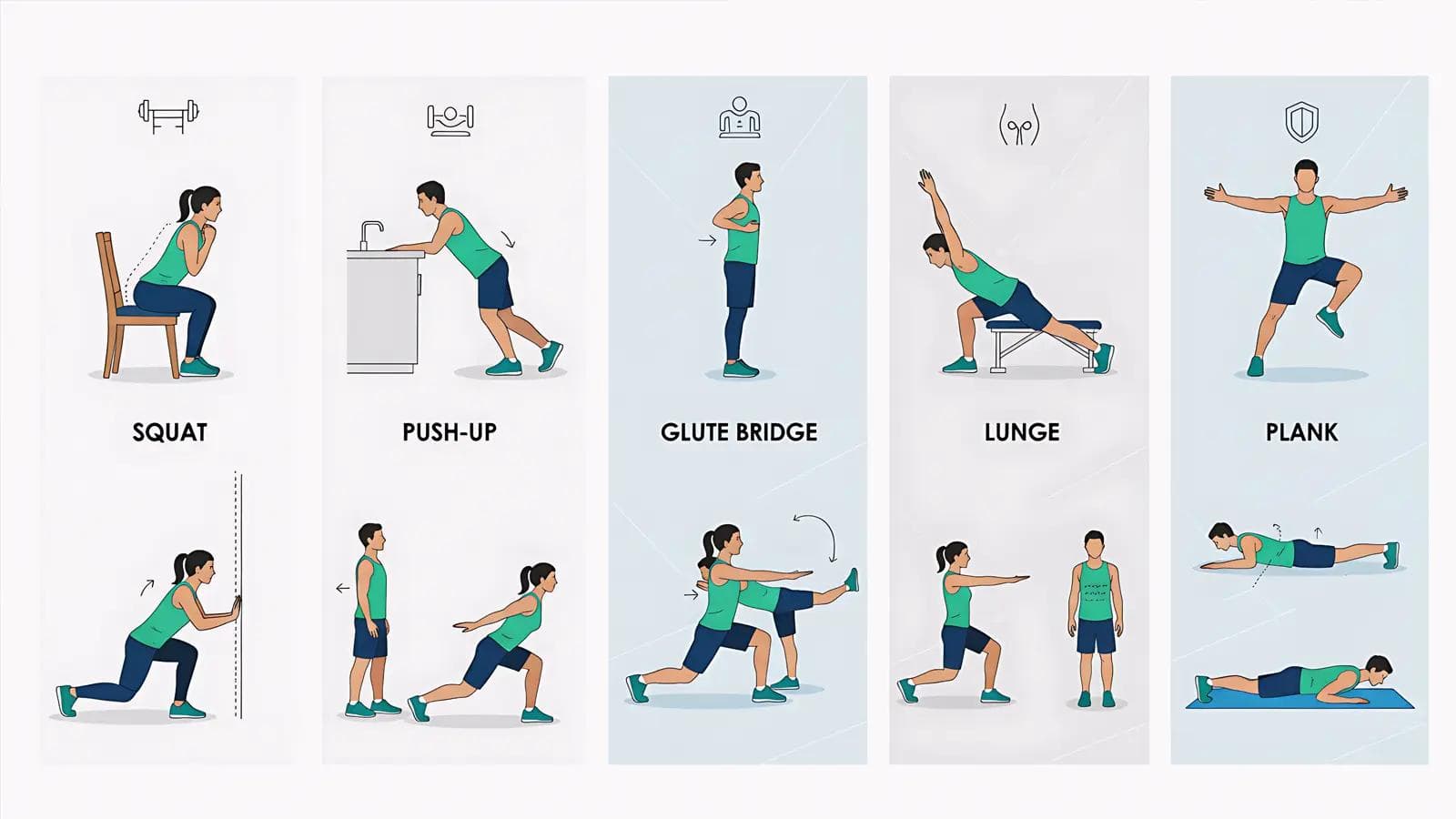
Every effective no equipment strength training program is built on five movement patterns. Master these, and you have a complete system for training every major muscle group.
1. The Push Pattern — Push-Up Progressions
The push-up is the most underrated strength exercise in existence. Done correctly, it trains your chest, shoulders, triceps, and core simultaneously.
The progression ladder (easiest to hardest):
- Wall push-up
- Incline push-up (hands on a chair or step)
- Knee push-up
- Standard push-up
- Wide-grip push-up
- Diamond push-up
- Decline push-up (feet elevated)
- Archer push-up
- One-arm push-up
How to do a perfect standard push-up:
- Place hands slightly wider than shoulder-width
- Form a straight line from head to heels — no sagging hips
- Lower your chest to within an inch of the floor (full range of motion matters)
- Press back up explosively
- Keep your core braced the entire time
The tempo trick: Try a 3-1-1 tempo (3 seconds down, 1-second pause at the bottom, 1 second up). Ten reps this way is harder than 25 sloppy reps.
---
2. The Pull Pattern — Bodyweight Rows and Alternatives
This is where most home trainers have a gap. Without a bar, pulling movements are harder to program — but not impossible.
No-equipment pull options:
- Table rows: Lie under a sturdy table, grip the edge, and row your chest up to it. This is a legitimate lat and bicep exercise.
- Towel rows: Loop a towel around a door handle, lean back, and row yourself toward the door.
- Superman holds: Lie face down, lift arms and legs off the ground simultaneously. Builds the posterior chain.
- Reverse snow angels: Lie face down, arms at your sides, and sweep them overhead while keeping them off the ground.
Pro tip: If you can access any low bar, railing, or sturdy branch, a bodyweight row is one of the most effective no equipment strength training exercises for your back. Prioritize finding one.
---
3. The Squat Pattern — Lower Body Strength Without Weights
Your legs contain the largest muscle groups in your body. Training them without equipment is entirely achievable through smart progressions.
The squat progression ladder:
- Assisted squat (holding a doorframe)
- Box squat (sitting to a chair, then standing)
- Bodyweight squat
- Pause squat (3-second hold at the bottom)
- Jump squat
- Bulgarian split squat (rear foot elevated on a chair)
- Shrimp squat
- Pistol squat (single-leg)
How to do a perfect bodyweight squat:
- Stand with feet shoulder-width apart, toes slightly out
- Brace your core and keep your chest tall
- Push your hips back and bend your knees simultaneously
- Lower until your thighs are parallel to the floor (or deeper if mobility allows)
- Drive through your heels to stand, squeezing glutes at the top
The single-leg advantage: Bulgarian split squats and pistol squat progressions load each leg independently, which means they can generate significant muscle-building stimulus even without added weight. A bodyweight pistol squat requires as much quad strength as a barbell squat at roughly 70% of your bodyweight.
---
4. The Hinge Pattern — Posterior Chain Power
The hip hinge is the movement pattern most people completely ignore in no equipment strength training — and it's the reason many home trainers develop weak hamstrings and glutes.
Hinge exercises without equipment:
- Glute bridge: Lie on your back, feet flat on the floor, drive hips up and squeeze glutes hard at the top. Hold 2 seconds.
- Single-leg glute bridge: Same movement, one leg extended. Dramatically harder.
- Good morning: Stand with hands behind your head, hinge at the hips until your torso is parallel to the floor, return to standing.
- Nordic hamstring curl: Kneel on a soft surface, anchor your feet under a sofa or heavy furniture, and lower your torso toward the floor by bending at the knee. One of the most effective hamstring exercises in existence.
- Single-leg Romanian deadlift: Balance on one leg, hinge forward reaching toward the floor, keep your back flat.
Why this matters: Your posterior chain — glutes, hamstrings, and lower back — is your body's power center. Neglecting it leads to imbalances, poor posture, and injury risk. Program at least one hinge movement every session.
---
5. The Core Pattern — Functional Stability, Not Just Crunches
Forget endless crunches. Effective core training in a no equipment workout means training the core's real function: resisting movement while your limbs do work.
The core exercise hierarchy:
- Plank: Build to 60-second holds before progressing
- Dead bug: Lie on your back, arms and legs extended upward, slowly lower opposite arm and leg toward the floor without letting your lower back arch
- Hollow body hold: The gymnast's secret. Lie on your back, press your lower back into the floor, and hold arms and legs a few inches off the ground. Start with 10 seconds.
- Side plank: Targets the obliques and lateral stability
- Bear crawl: On hands and knees, lift knees 2 inches off the floor and crawl forward. Brutally effective.
- Mountain climbers: Plank position, drive knees toward your chest alternately at speed
---
How to Structure Your No Equipment Strength Training Routine
Knowing the exercises is step one. Knowing how to arrange them into a program is what actually produces results.
The 3-Day Full-Body Split (Best for Beginners)
Train Monday, Wednesday, Friday. Rest or do light walking on other days.
Each session includes:
- 1 push exercise
- 1 pull exercise
- 1 squat variation
- 1 hinge exercise
- 1 core exercise
Example Session A:
- Push-ups: 3 sets of 8-12 reps
- Table rows: 3 sets of 8-12 reps
- Bodyweight squats: 3 sets of 15 reps
- Glute bridges: 3 sets of 15 reps
- Plank: 3 sets of 30-45 seconds
Rest periods: 60-90 seconds between sets. As you get stronger, reduce rest to 45 seconds before moving to a harder variation.
The 4-Day Upper/Lower Split (Intermediate)
Once you can do 15+ clean push-ups and 20+ squats, shift to:
- Monday/Thursday: Upper body (push + pull focus)
- Tuesday/Friday: Lower body (squat + hinge focus)
- Core work integrated into every session
The Progressive Overload Rule
Every single week, you must do at least one of these:
- Add 1-2 reps to at least one set
- Add one additional set
- Reduce rest by 10 seconds
- Slow your tempo by 1 second
- Progress to a harder variation
If you're not tracking this, you're not progressing. Use a notes app, a journal, or even a sticky note. What gets measured gets improved.
home-workout-tracking-template
---
No Equipment Strength Training vs. Gym Training: An Honest Comparison
This isn't about declaring a winner. It's about helping you make an informed choice.
Where no equipment training wins:
- Zero cost, zero commute, zero intimidation
- Develops superior body control and coordination
- Builds functional strength that transfers to real-life movement
- Easier to stay consistent — the barrier to starting is almost nonexistent
- Joint-friendly progressions are easier to control
- Can be done anywhere in the world
Where gym training has an edge:
- Easier to add precise, incremental resistance (adding 2.5 lbs to a barbell)
- More direct isolation of specific muscles
- Potentially faster hypertrophy at advanced levels
- Better for certain goals like powerlifting or Olympic lifting
The honest verdict: For the vast majority of people — especially those building a consistent fitness habit — no equipment strength training delivers 90% of the results with a fraction of the friction. The best workout program is the one you actually do.
---
The "Progression Map" Framework: Your 12-Week Blueprint
This is the proprietary framework we use to take someone from zero to genuinely strong in 12 weeks using nothing but their bodyweight.
Weeks 1-4: Foundation Phase
- Goal: Perfect form on all five movement patterns
- Rep target: 3 sets of 8-10 reps on beginner variations
- Focus: Slow, controlled reps. Feel the target muscle working.
- Weekly check: Can you add 1-2 reps to each exercise?
Weeks 5-8: Build Phase
- Goal: Increase volume and introduce intermediate variations
- Rep target: 4 sets of 10-15 reps
- Introduce: Decline push-ups, Bulgarian split squats, single-leg glute bridges, dead bugs
- Weekly check: Are rest periods getting shorter? Are you progressing variations?
Weeks 9-12: Strength Phase
- Goal: Maximum effort on advanced variations
- Rep target: 5 sets of 5-8 reps on hard variations (archer push-ups, pistol squat progressions, Nordic curls)
- Focus: Intensity over volume. Each set should be genuinely challenging.
- Weekly check: Can you do something today you couldn't do 8 weeks ago?
At week 12, take a deload week (reduce volume by 50%), then reassess and restart the cycle with harder variations.
---
Common Mistakes That Kill Progress in Bodyweight Training
Mistake 1: Skipping the pull pattern Most people do push-ups and squats and wonder why their posture gets worse. You must train pulling movements. Find a table, a door, a railing — anything.
Mistake 2: Never progressing the difficulty If you've been doing the same 3 sets of 15 push-ups for a month, you're maintaining, not building. Progress the variation.
Mistake 3: Ignoring the hinge Glute bridges and single-leg deadlifts aren't optional. Your posterior chain is half your body. Train it.
Mistake 4: Training through pain (not discomfort) Muscle burn and fatigue are fine. Sharp joint pain is a signal to stop. Learn the difference.
Mistake 5: Inconsistency disguised as "listening to your body" Some days you won't feel like training. That's normal. Do a shorter session rather than skipping entirely. Consistency compounds.
---
How to Stay Motivated When Training Alone at Home
This is where most home fitness plans quietly die — not from lack of knowledge, but from lack of motivation. Training alone, with no coach and no gym environment, requires a different psychological strategy.
What actually works:
- Anchor your workout to a fixed time. "After morning coffee" or "before dinner" works better than "sometime today."
- Make your environment work for you. Keep a clear space ready. Friction kills habits.
- Track visible progress. Write down every session. Watching numbers improve is genuinely motivating.
- Use visual motivation daily. Many people find that having a motivational image or quote as their phone or desktop wallpaper creates a small but consistent psychological nudge. If you want to make your own, try this motivational wallpaper generator to turn your personal fitness goals into a custom daily reminder.
- Find your "why" and keep it visible. Is it energy for your kids? Confidence? Health at 60? Write it down and put it somewhere you'll see it.
home-workout-motivation-tips
---
What Results Can You Realistically Expect?
Let's be specific, because vague promises don't help anyone.
After 4 weeks of consistent no equipment strength training (3x per week):
- Noticeable improvement in push-up and squat form
- 20-30% increase in reps on most exercises
- Improved core stability and posture
- Better sleep quality (well-documented benefit of resistance training)
After 8 weeks:
- Visible muscle definition, especially in arms, shoulders, and legs
- Ability to perform intermediate variations (decline push-ups, split squats)
- Significantly stronger core — planks that felt impossible now feel manageable
After 12 weeks:
- Genuine functional strength that translates to everyday life
- Ability to perform advanced movements like pike push-ups, single-leg squats, and Nordic curls
- Established habit — training feels automatic, not forced
The honest caveat: Results depend on consistency, sleep, and nutrition. You cannot out-train a poor diet or chronic sleep deprivation. Aim for 7-9 hours of sleep and sufficient protein (0.7-1g per pound of bodyweight daily) to support muscle building.
---
Your First Week: A Day-by-Day No Equipment Workout Plan
Stop planning and start doing. Here's your exact first week.
Monday (Session A):
- Incline push-ups: 3 × 10
- Table rows or towel rows: 3 × 10
- Bodyweight squats: 3 × 15
- Glute bridges: 3 × 15
- Plank: 3 × 20 seconds
- Total time: ~25 minutes
Tuesday: Rest or 20-minute walk
Wednesday (Session B):
- Standard push-ups (or incline if needed): 3 × 8
- Superman holds: 3 × 10 (2-second hold at top)
- Pause squats (3-second hold at bottom): 3 × 10
- Single-leg glute bridges: 3 × 10 per side
- Dead bugs: 3 × 8 per side
- Total time: ~25 minutes
Thursday: Rest or 20-minute walk
Friday (Session C):
- Diamond push-ups: 3 × 8
- Reverse snow angels: 3 × 12
- Jump squats: 3 × 10
- Good mornings: 3 × 12
- Hollow body hold: 3 × 15 seconds
- Total time: ~25 minutes
Saturday/Sunday: Rest, light activity, or mobility work
Record every session. Next week, add 1-2 reps to each exercise or reduce rest by 10 seconds. That's the entire system.
---
The Bottom Line on No Equipment Strength Training
Building real strength without a gym is not a myth, a shortcut, or a compromise. It's a legitimate, scientifically supported training method that has produced strong, capable bodies for centuries — long before commercial gyms existed.
The five movement patterns — push, pull, squat, hinge, and core — give you a complete system. Progressive overload gives you a mechanism for continuous improvement. Consistency gives you results.
Your only job right now is to start. Do the Monday session above. Write down what you did. Come back Wednesday and do slightly more. Repeat for 12 weeks.
Strength is built one session at a time. You already have everything you need.
Frequently Asked Questions
Yes. Muscle growth requires progressive overload — consistently increasing the challenge placed on your muscles. With bodyweight training, you achieve this by advancing to harder exercise variations, slowing your tempo, adding sets, or reducing rest periods. Studies show bodyweight training produces comparable muscle and strength gains to free-weight training, especially for beginners and intermediate trainees.
3 days per week is the sweet spot for most people, especially beginners. A Monday-Wednesday-Friday full-body split allows adequate recovery between sessions. More advanced trainees can progress to 4 days using an upper/lower split. Training more than 5 days per week without proper programming increases injury risk and reduces recovery quality.
There is no single best exercise, but the push-up and its progressions are the most versatile. A proper push-up trains chest, shoulders, triceps, and core simultaneously. The key is progressing through variations — from incline to standard to decline to archer to one-arm — to keep challenging your muscles over time. For lower body, the Bulgarian split squat and pistol squat progressions are exceptionally effective without any equipment.
Most people notice improved strength and endurance within 2-4 weeks of consistent training. Visible muscle definition typically appears between weeks 6-10, depending on body composition and diet. After 12 weeks of progressive, consistent training 3 times per week, most people can perform significantly harder exercise variations and have measurably more functional strength than when they started.
Yes, though the mechanism is indirect. Strength training builds muscle, and muscle tissue increases your resting metabolic rate — meaning you burn more calories at rest. Compound bodyweight movements like squats, push-ups, and burpees also elevate heart rate and burn significant calories during the session. Combined with a modest calorie deficit, no equipment strength training is an effective strategy for fat loss while preserving or building muscle.
Written by Daily Motivation Team
Sharing motivational content to inspire your journey to success.
Related Articles
 Creativity
Artistic Inspiration: A Complete Guide
Artistic inspiration isn't luck — it's a trainable skill. Learn 7 daily practices that keep ideas flowing.
 stoic
stoicStoic Quotes on Discipline: Where Stoicism Meets Self-Mastery
Discover powerful stoic quotes on discipline from Marcus Aurelius, Seneca, and Epictetus — plus how to apply them today.
 stoic
stoicBest Stoic Quotes for Hard Times: Wisdom for Modern Struggles
Powerful Stoic quotes for hard times from Marcus Aurelius, Seneca & Epictetus — wisdom that turns adversity into strength.
 stoic
stoicBest Stoic Quotes for Beginners: Where to Start Your Practice
Discover the best stoic quotes for beginners and a simple 7-day plan to turn ancient wisdom into daily practice.