
How to Build a Workout Habit: A Sustainable Fitness Routine
Tired of starting and stopping? Learn the simple, science-backed framework to build a workout habit that becomes automatic, even when you have no m...
How to Build a Workout Habit That Lasts (Even If You've Failed Before)
Up to 80% of new gym memberships are abandoned within five months. If you've ever started a fitness journey with intense enthusiasm only to quit weeks later, the problem isn't your willpower—it's your strategy. You've been trying to run on motivation, a fuel that always runs out.
A truly sustainable workout habit isn't built on feeling good; it's built on a system that works even when you're tired, busy, or uninspired. This guide will teach you a science-backed, three-step framework to make exercise feel as automatic as brushing your teeth. Forget motivation; we're building a system.
Why Is It So Hard to Form a Workout Habit?
Before building a new system, we must understand why the old one failed. It's not about being lazy; it's about fighting human psychology. Most fitness plans are accidentally designed to fail.
The Motivation Myth: Motivation is a powerful spark, but a terrible long-term fuel. It's an emotion, and emotions are fleeting. A successful workout habit is what you do when motivation is nowhere to be found.
The "All-or-Nothing" Trap: This is the most common pitfall. You commit to an intense, 60-minute workout five days a week. You do it once, maybe twice. You're sore, exhausted, and the thought of doing it again is overwhelming. You miss one day, feel like a failure, and quit. The key isn't perfection; it's consistency, even if it's imperfect.
Our goal is to shift from a high-intensity, low-consistency model to a low-intensity, high-consistency model. That's how you build a habit that sticks.
The 3-S Framework: Your Blueprint for a Sustainable Fitness Routine
I've spent years helping people (and myself) overcome the start-stop cycle. The solution is a simple, repeatable system I call the 3-S Framework for building a workout habit: Simple, Scheduled, and Satisfying.
By focusing on these three pillars, you remove the friction and willpower required to get started, making your new fitness routine feel effortless over time. Let's break down each step.
Step 1: How Do You Make a Workout Habit Simple?
The biggest mistake is making the initial habit too difficult. Your brain is wired to conserve energy and avoid discomfort. If your new habit is hard, your brain will find any excuse to avoid it. The solution is to make it so easy you can't say no.
The 2-Minute Rule: Shrink Your Habit
Popularized by James Clear in Atomic Habits, the 2-Minute Rule states that any new habit should take less than two minutes to do. The goal isn't to get in shape with a two-minute workout; the goal is to master the art of showing up.
- "Go for a run" becomes "Put on my running shoes and walk out the door."
- "Do 30 minutes of yoga" becomes "Roll out my yoga mat."
- "Go to the gym" becomes "Change into my workout clothes."
Action Step: Choose your desired workout and scale it down to a two-minute version. For the first two weeks, your only goal is to perform that tiny, simple version of the workout habit every single day.
Reduce Friction: Prepare Everything in Advance
Friction is any step that stands between you and doing your habit. The more friction there is, the less likely you are to do it. You need to make your workout the path of least resistance.
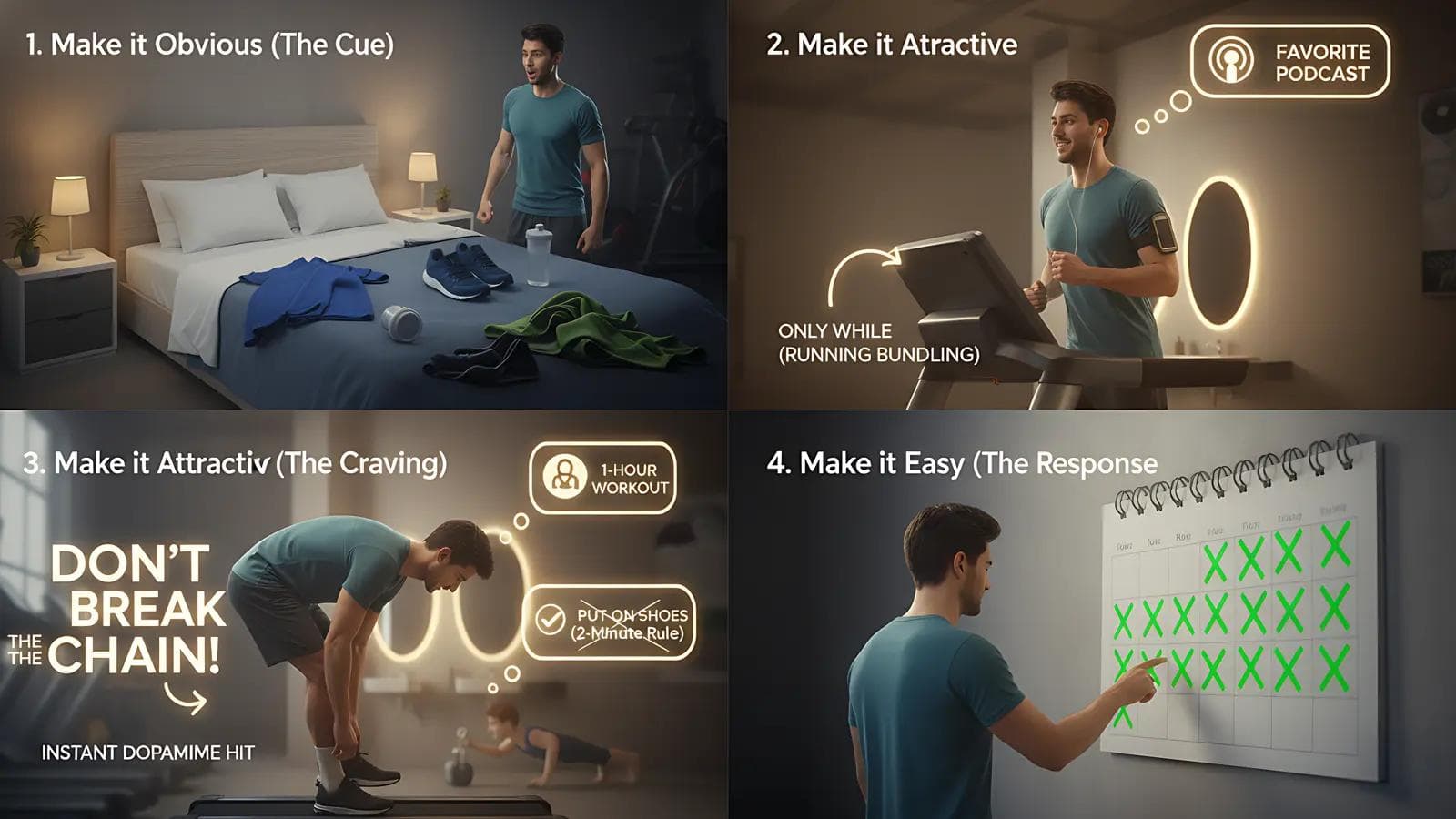
- Lay out your workout clothes the night before. When you wake up, they are the first thing you see.
- Pack your gym bag and leave it by the door or in your car.
- Create your workout playlist in advance so you don't waste time scrolling.
- If you work out at home, designate a specific space and keep your equipment (e.g., yoga mat, dumbbells) there permanently.
Choosing the Right "First" Workout
Your first workout shouldn't be the "best" workout for fat loss or muscle gain. It should be the workout you dislike the least. Enjoyment is a powerful driver of consistency. If you hate running, don't make it your habit. Try dancing, hiking, or a beginner bodyweight routine. beginner-bodyweight-workouts
Step 2: How Do You Schedule Exercise to Make it Automatic?
A habit needs a reliable trigger. Vague goals like "I'll work out more" are useless. Your habit needs a specific time and place in your daily routine so it can become an automatic part of your day.
The Power of Habit Stacking
Habit stacking is the most effective way to integrate a new exercise habit into your life. The formula is simple:
After [Current Habit], I will [New Workout Habit].
The key is to anchor your new workout to an existing, rock-solid habit you already do without thinking.
- "After I pour my morning coffee, I will do 10 minutes of stretching."
- "After I take off my work shoes, I will immediately change into my workout clothes."
- "After I brush my teeth at night, I will do 10 push-ups."
This method uses the momentum of your existing behaviors to carry you into your new one, requiring far less willpower.
Time Blocking: Treat Your Workout Like an Appointment
If it's not on the calendar, it doesn't exist. Schedule your workout like you would a doctor's appointment or an important meeting. This isn't just a reminder; it's a commitment to yourself.
Be specific. Don't just block out "Workout." Block out "30-Minute Walk at 12:30 PM" or "Gym Session: Upper Body at 5:45 PM." This removes the mental debate about what to do and when.
Morning vs. Evening Workouts: Which is Better for Habit Formation?
There's no single right answer, but for habit formation, morning often has a slight edge. Here’s a quick comparison:
- Morning Workouts
- Pro: Fewer scheduling conflicts can arise during the day.
- Pro: Your willpower is typically at its highest.
- Pro: It can boost your energy and mood for the rest of the day.
- Con: It can be difficult if you're not a morning person.
- Evening Workouts
- Pro: Can be a great way to de-stress after a long day.
- Pro: Your body is fully warmed up, potentially leading to better performance.
- Con: You're more likely to be tired or have your plans derailed by other obligations.
The best time to work out is the time you can do it most consistently. Experiment and see what works for your life. A consistent B+ workout is infinitely better than an inconsistent A+ workout.
Step 3: How Can You Make Your New Workout Habit Satisfying?
Habits stick when they feel good. The problem with exercise is that the ultimate rewards (weight loss, better health) are delayed. Your brain, however, craves immediate gratification. To make a workout habit stick, you must find a way to reward yourself immediately after completing it.
The Critical Role of Immediate Rewards
This reward doesn't have to be big. It just has to be something you genuinely enjoy and experience right after your workout.
- Enjoy a delicious, healthy smoothie you only drink post-workout.
- Listen to your favorite podcast or audiobook only while you exercise.
- Take a relaxing hot shower immediately after your routine.
- Watch one episode of your favorite Netflix show, guilt-free.
The brain will start to associate the workout with this immediate, positive feeling, creating a craving loop that makes you want to do it again.
Track Your Habit, Not Your Results
In the beginning, forget the scale. Forget your mile time. Forget how much you can lift. These metrics fluctuate and can be discouraging. The only thing you should track is your consistency.
Get a calendar and draw a big 'X' on every day you complete your habit, no matter how small. This is known as "Don't Break the Chain." Seeing the visual evidence of your streak is incredibly satisfying and motivating. Your goal is not to get fit in a week; it's to build a chain of consistency.
What Happens When You Fall Off Track? (The "Never Miss Twice" Rule)
You will miss a day. It's inevitable. Life happens. The difference between someone who succeeds and someone who fails is not that they never miss; it's how quickly they get back on track.
Embrace the "Never Miss Twice" rule. Missing one day is an accident. Missing two days is the start of a new, undesirable habit. No matter what, make sure you do something the next day, even if it's just your two-minute version. This prevents a single slip-up from spiraling into quitting altogether.
How Long Does It Really Take to Build a Workout Habit?
The old myth of "21 days" is misleading. A landmark study from University College London found that it takes, on average, 66 days for a new behavior to become automatic. The range in the study was from 18 to 254 days.
Don't fixate on a number. Focus on the process. The goal isn't to hit a magic number of days; it's to reach the point where starting your workout requires little to no conscious decision-making. That's when you know you've successfully built a workout habit.
Advanced Strategies for a Lifelong Fitness Habit
Once you've established consistency with your small, simple habit for a few months, you can begin to scale and solidify it for the long term.
Identity-Based Habits: Becoming an "Active Person"
True behavior change is identity change. Instead of thinking "I'm trying to work out more," start thinking "I am an active person." Every time you complete your workout, you are casting a vote for this new identity.
This subtle mental shift is powerful. An active person doesn't have to force themselves to exercise; it's just who they are and what they do.
Progressive Overload for Habits: How to Scale Up
Once your two-minute habit feels automatic, it's time to slowly increase the difficulty. This is the principle of progressive overload, applied to habits.
- If you were doing a 5-minute walk, try a 10-minute walk.
- If you were doing 10 squats, try 15 squats.
- If you were rolling out your yoga mat, now try doing one sun salutation.
Increase the duration or intensity by just 5-10% each week. The change should feel small and manageable, never shocking to your system.
Find a Community or Accountability Partner
Humans are social creatures. Sharing your journey can make it more enjoyable and keep you accountable. This could be a friend you text after each workout, a group fitness class, or an online community. finding-a-gym-partner Knowing someone else is expecting you to show up can be the push you need on a tough day.
Your Journey to a Sustainable Workout Habit Starts Now
Building a workout habit isn't about a sudden burst of superhuman motivation. It's about using a smart system to make consistency inevitable. By following the 3-S Framework—making your habit Simple, Scheduled, and Satisfying—you can create a fitness routine that becomes a permanent, positive part of your life.
Start small. Start today. Your future self will thank you.
Frequently Asked Questions
While the old myth says 21 days, scientific research shows it takes an average of 66 days for a new behavior like exercise to become automatic. However, this can range from 18 to 254 days depending on the person and the difficulty of the habit.
The easiest way is to use the '2-Minute Rule.' Scale your desired workout down to a version that takes less than two minutes to complete. For example, instead of 'go for a 30-minute run,' your habit is 'put on my running shoes.' This makes it easy to be consistent, which is the key to habit formation.
The key is to not rely on motivation. Instead, build a system. Reduce friction by laying out your clothes beforehand. Use habit stacking by linking your workout to an existing habit (e.g., 'After my morning coffee, I'll do 5 minutes of stretching'). A system works even when motivation is low.
The best workout for building a habit is one you genuinely enjoy (or dislike the least). Consistency is more important than intensity in the beginning. Choose an activity like walking, dancing, or simple bodyweight exercises that you can stick with, rather than a grueling routine you'll quit after a week.
Written by Daily Motivation Team
Sharing motivational content to inspire your journey to success.
Related Articles
 Creativity
Artistic Inspiration: A Complete Guide
Artistic inspiration isn't luck — it's a trainable skill. Learn 7 daily practices that keep ideas flowing.
 stoic
stoicStoic Quotes on Discipline: Where Stoicism Meets Self-Mastery
Discover powerful stoic quotes on discipline from Marcus Aurelius, Seneca, and Epictetus — plus how to apply them today.
 stoic
stoicBest Stoic Quotes for Hard Times: Wisdom for Modern Struggles
Powerful Stoic quotes for hard times from Marcus Aurelius, Seneca & Epictetus — wisdom that turns adversity into strength.
 stoic
stoicBest Stoic Quotes for Beginners: Where to Start Your Practice
Discover the best stoic quotes for beginners and a simple 7-day plan to turn ancient wisdom into daily practice.