
Macros for Fat Loss: Your Proven 3-Step How-To Guide
Stop guessing your diet. Learn how to calculate macros for fat loss and find your perfect protein carbs fat ratio using our simple TDEE guide.
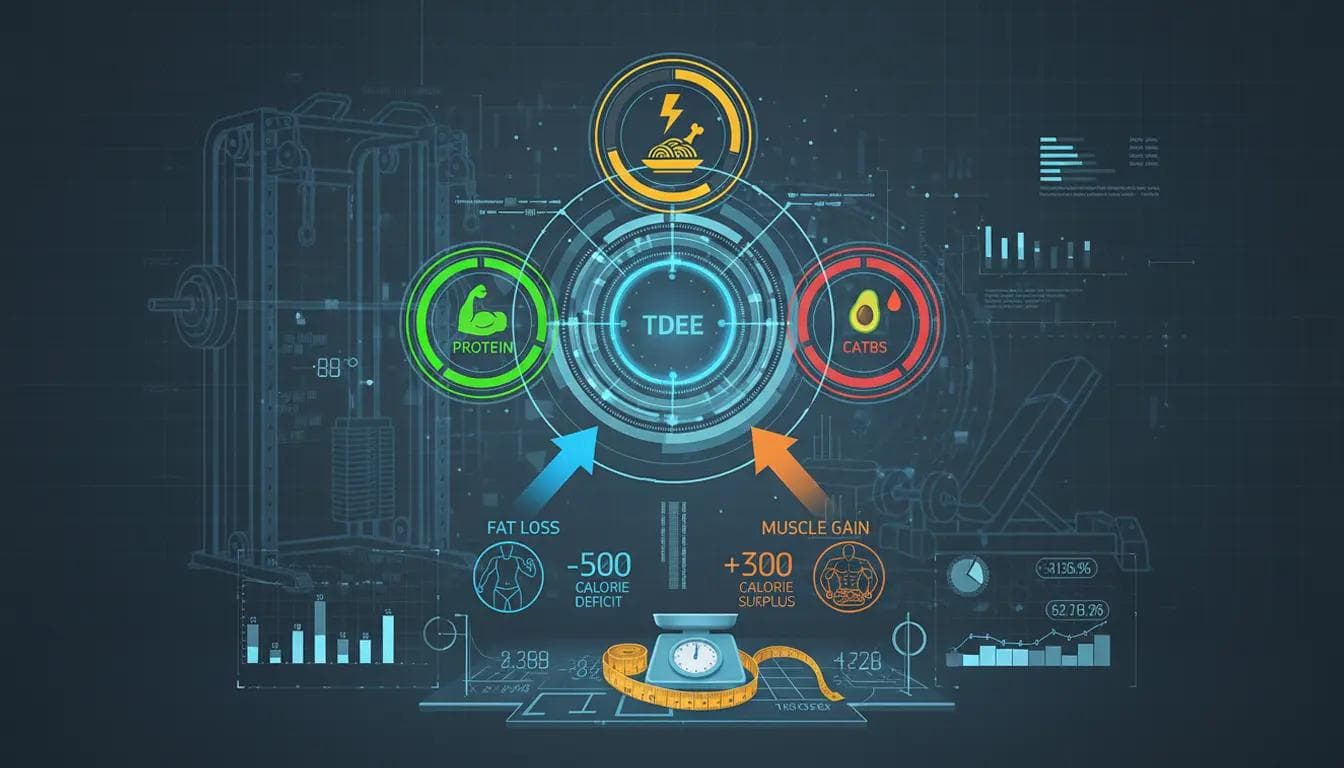
Introduction: You've read the advice. You know protein is for "repair," carbs are for "energy," and fats are for "hormones." You know you need to be in a "calorie deficit" to lose fat and a "calorie surplus" to build muscle. But this is all "what" and "why." You're stuck on the "how."
How many calories? How much protein?
"Eat less, move more" is the most useless advice in fitness. The secret to real, measurable progress isn't just "eating clean"—it's understanding your numbers. This guide will walk you through the simple process of finding your TDEE (your unique energy number) and setting your macros (protein, carbs, and fat) to build a plan that is guaranteed to work.
What is a Calorie (and CICO)?
Before we get to macros, we must respect the "law of thermodynamics," or Calories In vs. Calories Out (CICO). This is the non-negotiable foundation.
- A calorie is a unit of energy.
- Calories In: The food you eat.
- Calories Out: The energy you burn.
To lose fat, you must consume fewer calories than you burn (a deficit). To gain muscle, you must consume slightly more (a surplus). Your first step is to find your "baseline."
Step 1: Find Your 'Maintenance' Calories (TDEE)
Your Total Daily Energy Expenditure (TDEE) is the total number of calories your body burns in a 24-hour period, including sleeping, eating, working, and exercising. This is your "maintenance" number—if you eat this many calories, your weight will stay the same.
You could use complex formulas, but the easiest way is to use a free, reputable online TDEE calculator (just search "TDEE calculator").
You will be asked for 4 things:
- Age, Height, Weight: Easy.
- Body Fat %: (Optional) If you don't know it, just leave this blank.
- Activity Level: This is the most important part, and the one everyone gets wrong.
Be honest with your activity level:
- Sedentary: Desk job, very little or no exercise.
- Lightly Active: 1-3 days/week of light exercise.
- Moderately Active: 3-5 days/week of moderate exercise.
- Very Active: 6-7 days/week of hard exercise.
- Extremely Active: Physical job and hard exercise 6-7 days/week.
Rule of Thumb: Whatever you think your activity level is, choose one level below that. Most people dramatically overestimate how many calories they burn.
Let's say the calculator tells you your TDEE (maintenance) is 2,300 calories.
Step 2: Set Your Goal (Deficit or Surplus)
Now that you have your 2,300-calorie baseline, you can set your goal.
- For Fat Loss: Create a deficit of 300-500 calories.
- Example: 2,300 (TDEE) - 500 (Deficit) = 1,800 calories per day.
- For Muscle Gain (Lean Bulk): Create a surplus of 200-300 calories.
- Example: 2,300 (TDEE) + 300 (Surplus) = 2,600 calories per day.
For this guide, let's use the Fat Loss goal of 1,800 calories.
Step 3: What Are 'Macros'?
"Macros" is short for "macronutrients." This is how your total calories are divided. There are three macros:
- Protein: 4 calories per gram. The "repair" crew.
- Carbohydrates: 4 calories per gram. The "energy" crew.
- Fats: 9 calories per gram. The "hormone" crew.
"Tracking your macros" simply means you are tracking where your 1,800 calories are coming from. This is crucial. 1,800 calories of potato chips is not the same as 1,800 calories of chicken and rice.
Step 4: How to Set Your Macros (The Simple 3-Step Formula)
This is the core of the guide. Here is the easiest, most effective way to set your macros. We'll use our 1,800-calorie goal.
Macro #1: Set Your Protein (The Priority)
Protein is your most important macro for fitness. It builds muscle and is the most satiating (it makes you feel full).
- The Rule: Aim for 0.8g to 1.2g of protein per pound of your *goal* body weight.
- A simple target: 1 gram per pound of goal weight.
- Example: Our person's TDEE is 2,300, so let's say they weigh 180lbs but their goal weight is 150lbs.
- Protein Goal: 150g of protein.
- Calories: 150g (Protein) x 4 (Calories/g) = 600 calories from Protein.
Macro #2: Set Your Fats (The Regulator)
Fats are essential for hormone production and vitamin absorption. Don't go "low-fat"—it's a trap.
- The Rule: Aim for 20% to 30% of your total calories from fat. 25% is a great sweet spot.
- Fat Goal: 25% of our 1,800 calorie target.
- Calories: 1,800 (Total) x 0.25 (25%) = 450 calories from Fat.
- How many grams? 450 (Fat Cals) / 9 (Cals/g) = 50g of Fat.
Macro #3: Set Your Carbs (The 'Filler')
Carbs are your energy source. You've set your Protein and Fat; carbs are simply "what's left over."
- The Rule: Fill the rest of your daily calories with carbohydrates.
- Calorie Math:
- Total: 1,800 calories
- - 600 calories (from Protein)
- - 450 calories (from Fat)
- = 750 calories remaining for Carbs.
- How many grams? 750 (Carb Cals) / 4 (Cals/g) = ~188g of Carbs.
Your Final Plan (The 'Goal')
You've done it. You now have a clear, actionable daily goal:
- Total Calories: 1,800
- Protein: 150g
- Fats: 50g
- Carbs: 188g
This is your starting point. You are no longer "guessing." You are no longer "just eating clean." You have a data-driven plan.
Conclusion: This is a 'Start Point,' Not a 'Finish Line'
These numbers are not perfect. They are a hypothesis. The real magic happens in Step 5: Consistency and Adjustment.
Your job now is to hit these numbers as consistently as possible for 2-3 weeks. Then, assess:
- Is the scale moving in the right direction?
- Is your gym performance improving?
- Is your energy good?
If "yes," don't change anything! If "no," make a small adjustment (e.g., subtract 100 calories from carbs) and test for another 2 weeks. This is the process. You've just learned how to be the architect of your own fitness.
Frequently Asked Questions
Yes. For the first 2-4 weeks, you must use a food scale. You are currently "data-gathering." You have no idea what "4oz of chicken" or "1 tablespoon of peanut butter" actually looks like. A scale is your tool for learning, not a life sentence.
Alcohol is the "4th macro." It has 7 calories per gram. It's best to limit it during a fat-loss phase. If you do drink, you must track it. You can track it as either a "carb" or a "fat."
It's "front-loading" the work. It takes 10-15 minutes of planning per day for the first few weeks. But it saves you months of frustration, "spinning your wheels," and wondering why your "diet" isn't working.
Written by Daily Motivation Team
Sharing motivational content to inspire your journey to success.
Related Articles
 Creativity
Artistic Inspiration: A Complete Guide
Artistic inspiration isn't luck — it's a trainable skill. Learn 7 daily practices that keep ideas flowing.
 stoic
stoicStoic Quotes on Discipline: Where Stoicism Meets Self-Mastery
Discover powerful stoic quotes on discipline from Marcus Aurelius, Seneca, and Epictetus — plus how to apply them today.
 stoic
stoicBest Stoic Quotes for Hard Times: Wisdom for Modern Struggles
Powerful Stoic quotes for hard times from Marcus Aurelius, Seneca & Epictetus — wisdom that turns adversity into strength.
 stoic
stoicBest Stoic Quotes for Beginners: Where to Start Your Practice
Discover the best stoic quotes for beginners and a simple 7-day plan to turn ancient wisdom into daily practice.