
How to Find Your Niche: Content Creator Tips & Marketing Examples
Feeling paralyzed by 'niche down' advice? Discover a step-by-step framework to find a unique, profitable niche at the intersection of your passions.
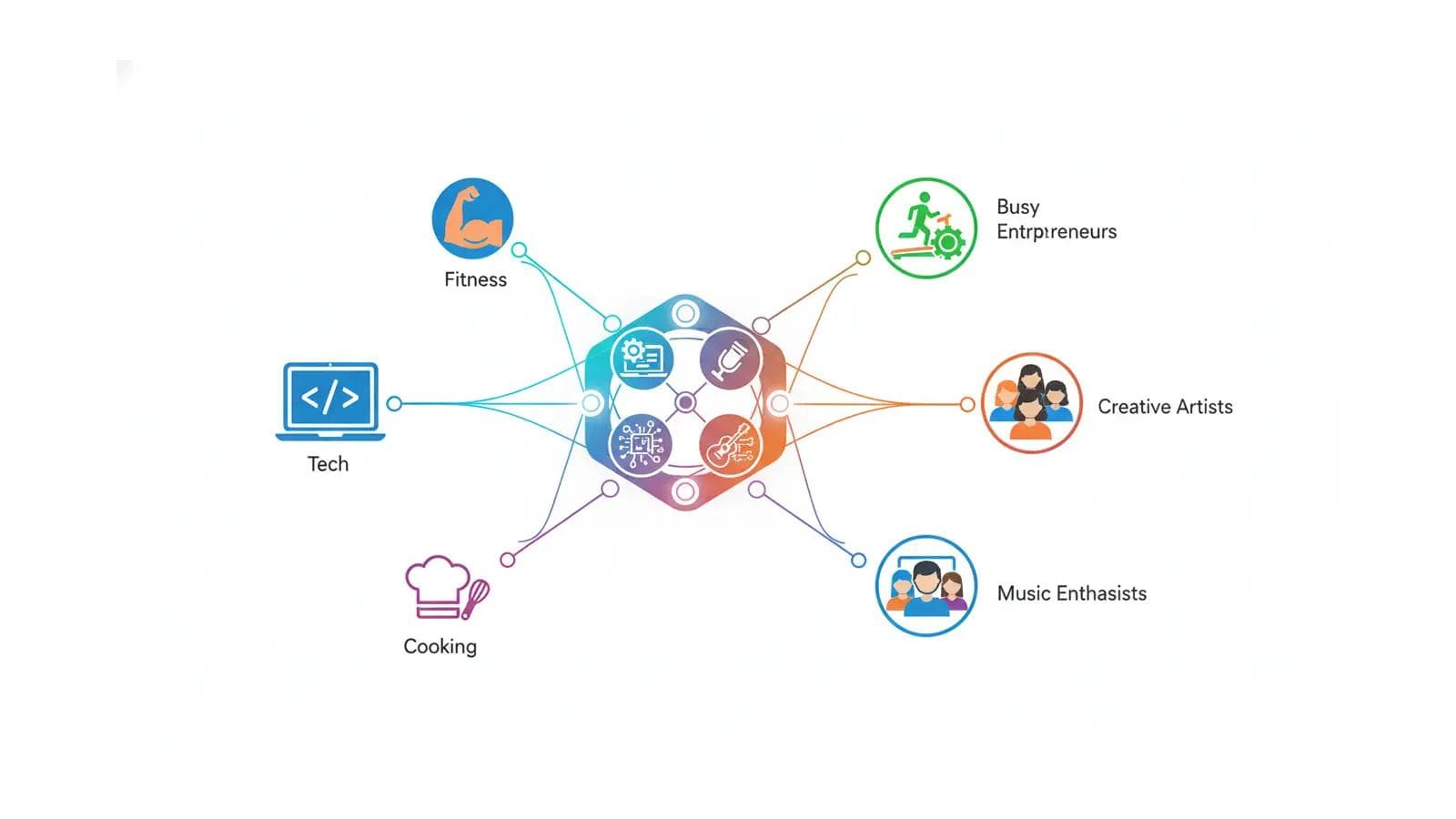
How to Find Your Niche: A 5-Step Guide for Creators
Did you know that an estimated 90% of new creators quit within their first year? The number one culprit isn't a lack of passion or talent—it's choosing a niche that's too broad, too competitive, or simply a bad fit, leading to burnout and zero traction.
If you've ever felt paralyzed by the advice to "find your niche," you're not alone. You're told to be a "Fitness Creator" or a "Tech Creator." But what if you love fitness, and tech, and vintage film cameras? This is the Niche Paradox, and it stops countless talented people from ever starting.
The solution is to stop thinking of a niche as a topic and start thinking of it as your unique position in the market. This guide will walk you through the exact process of how to find your niche—one that feels authentic, attracts a loyal audience, and has real potential for growth.
What is a Niche and Why is it So Important?
Let's be blunt: nobody on the internet is looking for "a random person's thoughts." People follow creators and brands for a specific reason. A niche is simply a clear promise you make to your audience.
- "Follow me, and I promise I'll help you learn Python for data analysis."
- "Follow me, and I promise I'll show you how to bake sourdough bread, even in a tiny apartment kitchen."
If your promise is "I post... stuff," nobody clicks "follow" because they don't know what they're getting. A well-defined niche is your most powerful marketing tool. It builds trust, establishes authority, and tells Google exactly who your content is for, which is critical for ranking.
Think of it this way: a general practitioner knows a little about everything, but you go to a cardiologist for a heart problem. Your niche makes you the specialist.
The Biggest Mistake When Choosing a Niche: Broad vs. Specific
The most common trap is choosing a topic instead of a niche. A topic is a broad category, while a niche is a focused segment of that category designed for a specific audience.
Trying to compete in a broad category like "Travel" as a new creator is nearly impossible. You're competing against massive brands with huge budgets. But a niche like "Travel for solo female hikers over 50"? Now you have a dedicated audience you can truly serve.
Here’s how to spot the difference:
- Broad Topic: Fitness
- Specific Niche: Bodyweight fitness routines for busy parents who work from home.
- Broad Topic: Personal Finance
- Specific Niche: Investing basics for Canadian millennials paying off student debt.
- Broad Topic: Cooking
- Specific Niche: 30-minute, gluten-free meal prep recipes for one person.
See the pattern? The magic happens at the intersection of a topic, an audience, and a specific problem or outcome.
How to Find Your Niche: The 3P Framework (Passion, Proficiency, Profitability)
To discover a niche that is sustainable and uniquely you, we need to move beyond just listing your interests. I call this the 3P Framework. Your ideal niche lies at the intersection of your Passion, your Proficiency, and the market's Profitability.
Grab a notebook or open a document. We're going to build your niche from the ground up.
Step 1: Uncover Your Passions (The 'What')
This is the foundation. If you aren't genuinely interested in your niche, you will burn out. Content creation is a marathon, and passion is your fuel.
Don't just list topics. Dig deeper with these prompts:
- What could you talk about for 30 minutes with zero preparation?
- What blogs, YouTube channels, or magazines do you consume on a Saturday morning?
- What problems have you solved in your own life that others might share (e.g., overcoming shyness, learning a complex software, navigating a career change)?
- What do your friends and family come to you for advice about?
- If you had a free afternoon, what would you search for online?
Action Step: Write down 10-15 answers. Don't filter yourself. Include everything from 1980s sci-fi movies to homebrewing kombucha to minimalist home organization.
Step 2: Identify Your Proficiency (The 'How')
Passion gets you started, but proficiency—your skills and expertise—is what makes people listen. This isn't about being the #1 world expert. It's about being one step ahead of your audience and having a unique way of helping them.
Your proficiency can be a hard skill, a soft skill, or a unique life experience. Consider these categories:
- Professional Skills: What do you do for a living? (e.g., graphic design, project management, nursing, coding in React, SEO writing).
- Learned Skills: What have you taught yourself to do? (e.g., video editing, playing guitar, public speaking, building spreadsheets).
- Unique Experiences: What have you been through? (e.g., moved to a new country, paid off $50k in debt, trained for a marathon, raised twins).
Action Step: Next to your list of passions, write down 3-5 skills or experiences you have. Think about how you can deliver value. Are you a great writer? A clear teacher on video? An empathetic storyteller?
Step 3: Analyze the Profitability (The 'Who')
This is the step most creators skip. A niche is only viable if there's an audience that needs help and is willing to invest time (and eventually, money) to solve a problem. Profitability doesn't just mean money; it means there's an active, engaged audience.
Here's how to research market demand:
- Google Trends: Go to trends.google.com and compare your niche ideas. Is there consistent, stable, or growing interest over the past 5 years?
- Keyword Research: Use a free tool like Google Keyword Planner or paid tools like Ahrefs/Semrush. Are people searching for terms related to your niche? High search volume indicates strong demand.
- Community Search: Look for your niche on Reddit, Facebook Groups, and Quora. Are there active communities? Are people asking questions and complaining about problems? Problems are business opportunities.
- Competitor Analysis: Search for your niche on YouTube and Google. If you find other creators, that's a good sign. It proves the market exists. The key is to find a gap you can fill. For more on this, check out our personal-branding-guide.
Action Step: Research your top 3-5 niche ideas from the previous steps. Look for signs of life: search traffic, active communities, and existing creators.
How to Combine Your 3Ps into a Powerful Niche Statement
Now it's time to bring it all together. The goal is to create a clear, concise statement that defines your niche. This will become your bio, your elevator pitch, and the guiding star for all your content.
Use this simple template:
"I help [TARGET AUDIENCE] achieve [DESIRED OUTCOME] through [MY UNIQUE METHOD/SKILL]."
Let's see it in action with a few examples:
- (Passion: Home Cooking, Proficiency: Clear Writing, Profitability: Busy Professionals)
- "I help busy professionals (audience) cook healthy 30-minute meals (outcome) with simple, visual recipe guides (method)."
- (Passion: Vintage Video Games, Proficiency: Video Editing, Profitability: Nostalgic Millennials)
- "I help nostalgic millennials (audience) rediscover the magic of classic games (outcome) through deep-dive video essays (method)."
- (Passion: Personal Finance, Proficiency: Public Speaking/Teaching, Profitability: Freelancers)
- "I help freelance creatives (audience) manage their unpredictable income (outcome) through simple budgeting workshops (method)."
This statement makes it instantly clear who you are, who you serve, and what value you provide. This is the core of finding your niche successfully.
How Do You Know if a Niche is Profitable?
Validating the monetization potential of your niche before you go all-in is a critical step. A passionate audience is great, but a profitable niche ensures you can sustain your work long-term.
1. Check for Commercial Intent Keywords
Are people searching for solutions they're willing to pay for? Look for keywords that include modifiers like:
- "best" (best running shoes for flat feet)
- "vs" (Airtable vs Notion)
- "review" (Canva Pro review)
- "course" (beginner python course)
These searches indicate that users are in a buying mindset, which is a strong signal for profitability.
2. Look for Existing Products and Services
Competition is validation. If no one is selling anything in your niche, it might be a sign that people aren't willing to pay for solutions. Look for:
- Affiliate Products: Are there products on Amazon, ShareASale, or other networks that you could promote?
- Online Courses: Are other creators selling courses on platforms like Teachable or Kajabi?
- Books: Are there popular books written for your target audience?
- Coaching/Consulting: Are people offering 1-on-1 services in this space?
The presence of these things confirms that money is already being spent in this niche. This is a key part of developing your content-monetization-strategies.
3. Analyze the 'Value Ladder' Potential
Can you imagine multiple ways to serve your audience at different price points? A strong niche has potential for a full value ladder:
- Free: Blog posts, YouTube videos, social media content.
- Low-Cost: Ebook, templates, mini-workshop ($10 - $50).
- Mid-Tier: Signature online course, paid community ($100 - $500).
- High-Ticket: 1-on-1 coaching, consulting, live mastermind ($1000+).
If you can easily brainstorm products/services at each level, you've likely found a highly profitable niche.
What if I Choose the Wrong Niche?
This is the biggest fear that holds people back, but it's largely unfounded. Your niche is not a life sentence. It's a starting point.
No niche is perfect from day one. The best creators allow their niche to evolve based on audience feedback and their own changing interests. Amazon started by selling books online. Now it sells everything. Your brand can pivot too.
Here are 5 signs it might be time to adjust or pivot your niche:
- You're Consistently Bored: You dread creating content and feel no excitement about the topic anymore.
- Your Audience Isn't Growing: Despite consistent effort, you're seeing zero traction or engagement.
- You Attract the Wrong Audience: The people who follow you aren't the ones you intended to help, and their needs don't align with your goals.
- There's No Monetization Path: You've discovered there's little to no willingness to pay for solutions in your niche.
- You've Outgrown It: Your own skills and interests have evolved, and your current niche feels too restrictive.
If you experience these, don't see it as a failure. See it as data. You've learned what doesn't work, which is just as valuable as learning what does. Take what you've learned and apply it to the 3P Framework again.
Your Next Step
The most important part of how to find your niche is to take action. You can't discover the perfect fit through theory alone. You have to get in the game.
Use the 3P Framework to create your best-guess niche statement. Then, create 5-10 pieces of content around that niche. See what resonates with you and what gets a response from an audience.
Stop waiting for perfect clarity. Start creating, start listening, and let your perfect niche find you.
Frequently Asked Questions
You can find your niche for free by using the 3P Framework: Passion, Proficiency, and Profitability. Brainstorm your interests, identify your skills, and then use free tools like Google Trends, Reddit, and Quora to research audience demand and existing problems without any financial investment.
Historically, the most profitable niches fall into three main categories: Health, Wealth, and Relationships. Sub-niches within these, such as personal finance for millennials, fitness for new moms, or career coaching for tech professionals, are often highly profitable because they solve urgent and significant life problems.
While it's possible for an established brand to have multiple niches, it's highly recommended for new creators to focus on just one. A single, clear niche helps you build authority and a loyal audience much faster. You can always expand or pivot once you have established a strong foundation.
Your niche should be specific enough to attract a dedicated audience but broad enough to have room for growth. A good rule of thumb is the 'barbecue test': could you talk about your niche with a small group of interested people at a barbecue for an hour? If it's too narrow for that, it might be a topic, not a niche. 'Kettlebell workouts for dads over 40' is a great level of specificity.
Written by Daily Motivation Team
Sharing motivational content to inspire your journey to success.
Related Articles
 stoic
stoicStoic Quotes on Discipline: Where Stoicism Meets Self-Mastery
Discover powerful stoic quotes on discipline from Marcus Aurelius, Seneca, and Epictetus — plus how to apply them today.
 stoic
stoicBest Stoic Quotes for Hard Times: Wisdom for Modern Struggles
Powerful Stoic quotes for hard times from Marcus Aurelius, Seneca & Epictetus — wisdom that turns adversity into strength.
 stoic
stoicBest Stoic Quotes for Beginners: Where to Start Your Practice
Discover the best stoic quotes for beginners and a simple 7-day plan to turn ancient wisdom into daily practice.
 manifestation
3 6 9 Method: A Complete Guide
Learn how the 3 6 9 method rewires your focus and turns daily journaling into a powerful manifestation ritual.