
How to Read Nutrition Labels: Essential Guide
Confused by food labels? The front is marketing; the back is facts. Learn our 5-step method to decode the Nutrition Facts panel and take control of...
How to Read Nutrition Labels: A Guide to Smarter Food Choices
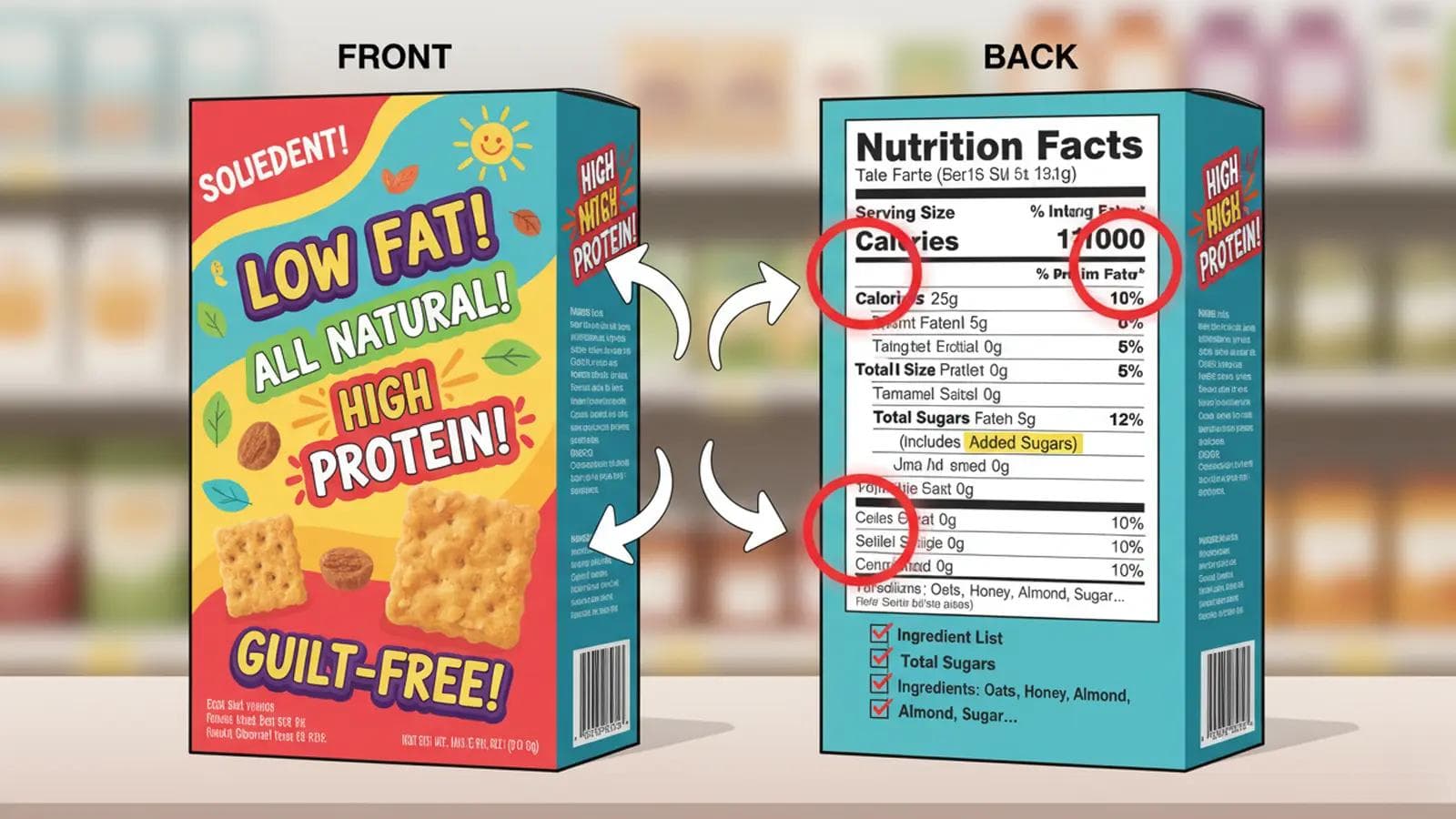
Ever felt paralyzed in a grocery aisle, caught between a yogurt screaming "Low Fat!" and another boasting "High Protein!"? You're not alone. A recent study found that while 80% of Americans use nutrition labels, over half find them confusing. The front of the box is designed to sell you a story; the back is where you find the facts.
Learning how to read nutrition labels is the single most powerful skill for taking control of your health. It transforms you from a passive consumer into an informed expert on your own diet. This guide will teach you a simple, 5-step method to decode any food label with confidence, turning confusing data into clear, healthy choices.
The 5-Step Label Scan: Your Framework for Success
Forget trying to analyze everything at once. To make reading nutrition labels fast and effective, I use a proprietary framework I call the "5-Step Label Scan." It's the exact process I use personally and teach to my clients. It prioritizes the most impactful information first, allowing you to make a quick, informed decision in under 30 seconds.
The 5-Step Label Scan:
- Serving Size & Servings Per Container
- Calories
- The "Limit These" Nutrients (Added Sugar, Sodium, Saturated Fat)
- The "Get Enough Of" Nutrients (Fiber, Protein)
- The Ingredient List
Let's break down each step.
Step 1: What is the First Thing to Look at on a Nutrition Label?
Always, always, always start with the serving size. This is the foundation for all other information on the label and the most common trap people fall into.
Serving Size and Servings Per Container
This tells you the amount of food the nutritional information is based on. The numbers for calories, fat, and sugar are not for the entire package.
The Deception: You grab a medium-sized bag of pretzels. The front says "100 Calories." Great! But the Nutrition Facts panel reveals the truth:
- Serving Size: 6 pretzels
- Servings Per Container: About 10
The Reality: If you eat the whole bag—a common scenario—you're consuming 1,000 calories, not 100. Always check the 'Servings Per Container' first. If you plan to eat the whole package, you must multiply every number on the label by this number.
Look for Dual-Column Labels: The FDA now requires dual-column labels for products that could be consumed in one or multiple sittings (like a pint of ice cream or a 20-ounce soda). One column shows the nutrition per serving, and the other shows the nutrition for the entire package. This is a huge help for understanding the true impact of what you're eating.
Step 2: How Do You Understand Calories on a Food Label?
Once you know your true serving size, look at the calories. A calorie is simply a unit of energy. This number tells you how much energy you get from one serving of that food.
The General 'Per Serving' Guide:
- 40 Calories is considered low.
- 100 Calories is considered moderate.
- 400+ Calories is considered high.
This guide is useful for quick comparisons, but remember that context matters. A 300-calorie snack of almonds and fruit provides fiber, protein, and healthy fats, while a 100-calorie snack pack of cookies offers little more than sugar and refined flour. Nutrient density is just as important as the calorie count. For more on this, check out our guide to understanding-macronutrients.
Step 3: What Are the Key Nutrients to Check on a Label?
This is where we separate the nutrients you want to limit from those you want to get more of. A key part of how to read nutrition labels is knowing what to avoid.
Focus on Limiting These Three:
1. Added Sugars
This is arguably the most important number to check on the new FDA labels. It separates sugars naturally occurring in food (like lactose in milk) from sugars added during processing (like high-fructose corn syrup or cane sugar).
- Why it Matters: Diets high in added sugar are linked to obesity, type 2 diabetes, and heart disease.
- The Goal: The American Heart Association recommends no more than 36 grams (9 teaspoons) of added sugar per day for men, and 25 grams (6 teaspoons) for women.
- Example: A popular brand of vanilla yogurt can have 16 grams of added sugar per serving. That's over half the daily recommended limit for women in one small cup!
2. Sodium
Sodium is an essential mineral, but most Americans consume far too much of it, primarily from processed and restaurant foods. High sodium intake is a major contributor to high blood pressure.
- The Goal: Aim for less than 2,300 milligrams (mg) per day.
- Watch Out For: Canned soups, frozen meals, deli meats, and sauces are often loaded with sodium. A single can of chicken noodle soup can contain over 800mg of sodium per serving.
3. Saturated & Trans Fats
Not all fats are bad, but you want to limit these two.
- Saturated Fat: Found in animal products like red meat, butter, and cheese. High intake can raise LDL ("bad") cholesterol.
- Trans Fat: This is the worst type of fat for your heart. The Goal: 0 grams.
- The '0g Trans Fat' Loophole: Be a detective! The FDA allows companies to claim "0g trans fat" if the product contains less than 0.5 grams per serving. If you eat multiple servings, this adds up. To find it, scan the ingredient list for the words "partially hydrogenated oil." If you see this, the product contains trans fat, regardless of what the label says.
Focus on Getting Enough of These:
1. Dietary Fiber
Fiber is a carbohydrate your body can't digest. It's crucial for digestive health, blood sugar control, and feeling full, which can aid in weight management.
- The Goal: Aim for 25-30 grams per day.
- Look For: Foods with at least 3-5 grams of fiber per serving are a good source.
2. Protein
Protein is essential for building muscle, repairing tissue, and keeping you full and satisfied. When choosing between products, a higher protein count is often a good sign, especially for snacks. Check out our list of healthy-high-protein-snacks for ideas.
Step 4: How Do You Interpret Percent Daily Value (%DV)?
The %DV column tells you what percentage of the recommended daily amount of a nutrient is in one serving of that food. It's based on a 2,000-calorie diet.
This is a powerful tool for quick comparisons. You don't need to be a math whiz; just use the 5/20 Rule.
- The 5/20 Rule of Thumb:
- 5% DV or less of a nutrient per serving is considered low.
- 20% DV or more of a nutrient per serving is considered high.
How to Use It:
- For nutrients you want to limit (saturated fat, sodium, added sugar), look for foods with a low %DV (5% or less).
- For nutrients you want to get more of (fiber, vitamin D, potassium), look for foods with a high %DV (20% or more).
Example in Action: You're comparing two cans of soup. Soup A has 40% DV for sodium, while Soup B has 15% DV. Using the 5/20 rule, you can instantly see that Soup B is the healthier choice for your blood pressure.
Step 5: What Should You Look for in an Ingredient List?
If the numbers on the Nutrition Facts panel look good, your final check is the ingredient list. This is where you find out what the food is actually made of. This final step is essential for a complete understanding of how to read nutrition labels.
The Rule of Weight: Ingredients are listed in descending order by weight. The first 3-5 ingredients make up the vast majority of the product.
Red Flags vs. Green Flags
Here's a quick cheat sheet for scanning ingredients:
- Red Flag Ingredients to Avoid:
- Sugar is in the top 3: If sugar (or one of its many aliases like high-fructose corn syrup, dextrose, sucrose, or cane juice) is a primary ingredient, it's likely a dessert, not a health food.
- Partially Hydrogenated Oils: This is code for trans fat. Put it back on the shelf.
- Enriched Wheat Flour: This means the whole grain has been stripped of its nutrients and then a few were artificially added back in. Look for "whole wheat flour" instead.
- Artificial Sweeteners, Flavors, or Colors: Words like aspartame, sucralose, Red 40, or Yellow 5.
- A long list of chemical names you can't pronounce: Simpler is almost always better.
- Green Flag Ingredients to Look For:
- Whole foods as the first ingredient: Things like "whole wheat," "oats," "quinoa," "apples."
- A short, simple ingredient list: The fewer ingredients, the less processed the food tends to be.
Decoding Common Health Claims on the Front of the Box
Food marketers are clever. They use specific terms to make products sound healthier than they are. Here’s what they actually mean:
- "Multigrain" vs. "100% Whole Grain"
- Multigrain: Simply means the product contains more than one type of grain. These grains are often refined (stripped of their nutrients). It's a common marketing trap.
- 100% Whole Grain: This means all parts of the grain kernel have been used, preserving the fiber and nutrients. Always choose 100% Whole Grain over Multigrain.
- "Low-Fat" or "Fat-Free"
- When companies remove fat, they often add sugar and salt to make the food taste good. A fat-free salad dressing can have more sugar than a regular version. Always compare the labels.
- "Natural" or "All-Natural"
- This term is largely unregulated by the FDA. It generally means nothing has been artificially or synthetically added, but the product can still be loaded with sugar, sodium, and unhealthy fats. Ignore this claim and read the label.
Putting It All Together: Cereal A vs. Cereal B
Let's use the 5-Step Label Scan to compare two popular breakfast cereals.
Cereal A: "Honey Nut Puffs"
- Step 1 (Serving Size): 1 cup. Okay, that's a realistic serving.
- Step 2 (Calories): 140 calories. Seems reasonable.
- Step 3 (Limit These): 12g Added Sugar, 180mg Sodium, 1g Saturated Fat. Red Flag: That's 24% of the daily value for added sugar!
- Step 4 (Get Enough): 2g Fiber, 3g Protein. Pretty low.
- Step 5 (Ingredients): Corn, Sugar, Honey, Brown Sugar Syrup... Sugar is the second ingredient.
Cereal B: "Shredded Oats"
- Step 1 (Serving Size): 1 1/4 cup. A generous serving.
- Step 2 (Calories): 200 calories. A bit higher, but let's see why.
- Step 3 (Limit These): 0g Added Sugar, 0mg Sodium, 1g Saturated Fat. Excellent!
- Step 4 (Get Enough): 7g Fiber, 6g Protein. Great numbers!
- Step 5 (Ingredients): Whole Grain Oats. That's it. One ingredient.
The Verdict: Cereal B is the clear winner. While slightly higher in calories, it provides a powerful dose of fiber and protein with zero added sugar, making it a much more nutritious and filling choice that will keep you energized all morning. This is the power of reading nutrition labels correctly.
Your New Supermarket Superpower
Learning how to read nutrition labels isn't about being perfect; it's about being informed. By using the 5-Step Label Scan, you can quickly cut through the marketing noise and understand the real nutritional value of your food. Start by practicing on a few items each time you shop. Soon, it will become a fast, automatic habit—a superpower that empowers you to build a healthier life, one smart choice at a time. For more tips on building healthy habits, see our guide on simple-diet-changes.
Frequently Asked Questions
The 5/20 rule is a quick guide for Percent Daily Value (%DV). If a nutrient has 5% DV or less, it's considered low in that nutrient. If it has 20% DV or more, it's considered high. Use it to find foods low in things like sodium and added sugar, and high in things like fiber and vitamins.
First, always check the 'Added Sugars' line. Then, scan the first few ingredients. Sugar has many names, including high-fructose corn syrup, dextrose, sucrose, cane juice, agave nectar, and molasses. If any of these are in the top three ingredients, the product is high in sugar.
No, they are very different. 'Multigrain' simply means a product contains more than one type of grain, but these are often refined (stripped of nutrients). '100% Whole Grain' means the entire grain kernel is used, preserving all the natural fiber and nutrients. Always choose '100% Whole Grain' for the most health benefits.
Both are important, but many experts argue the ingredient list is more critical. A food with a short list of whole-food ingredients is generally more nutritious than a highly processed food with a long list of chemicals, even if they have the same number of calories. Focus on nutrient quality from ingredients first, then consider calories in the context of your overall diet.
Written by Daily Motivation Team
Sharing motivational content to inspire your journey to success.
Related Articles
 Creativity
Artistic Inspiration: A Complete Guide
Artistic inspiration isn't luck — it's a trainable skill. Learn 7 daily practices that keep ideas flowing.
 stoic
stoicStoic Quotes on Discipline: Where Stoicism Meets Self-Mastery
Discover powerful stoic quotes on discipline from Marcus Aurelius, Seneca, and Epictetus — plus how to apply them today.
 stoic
stoicBest Stoic Quotes for Hard Times: Wisdom for Modern Struggles
Powerful Stoic quotes for hard times from Marcus Aurelius, Seneca & Epictetus — wisdom that turns adversity into strength.
 stoic
stoicBest Stoic Quotes for Beginners: Where to Start Your Practice
Discover the best stoic quotes for beginners and a simple 7-day plan to turn ancient wisdom into daily practice.