
Stoic vs Buddhist Quotes: Two Paths to Inner Peace Compared
Compare Stoic and Buddhist quotes side by side — two ancient paths, one destination: inner peace and a mind that cannot be shaken.
# Stoic vs Buddhist Quotes: Two Paths to Inner Peace Compared
Two thousand years ago, on opposite sides of the world, philosophers were quietly solving the same problem: how do we find peace in a chaotic, painful, unpredictable life?
In Athens and Rome, Stoics like Marcus Aurelius, Seneca, and Epictetus taught that virtue and reason could free us from suffering. In India and later across Asia, the Buddha and his followers taught that awakening to the true nature of mind and attachment could end suffering entirely.
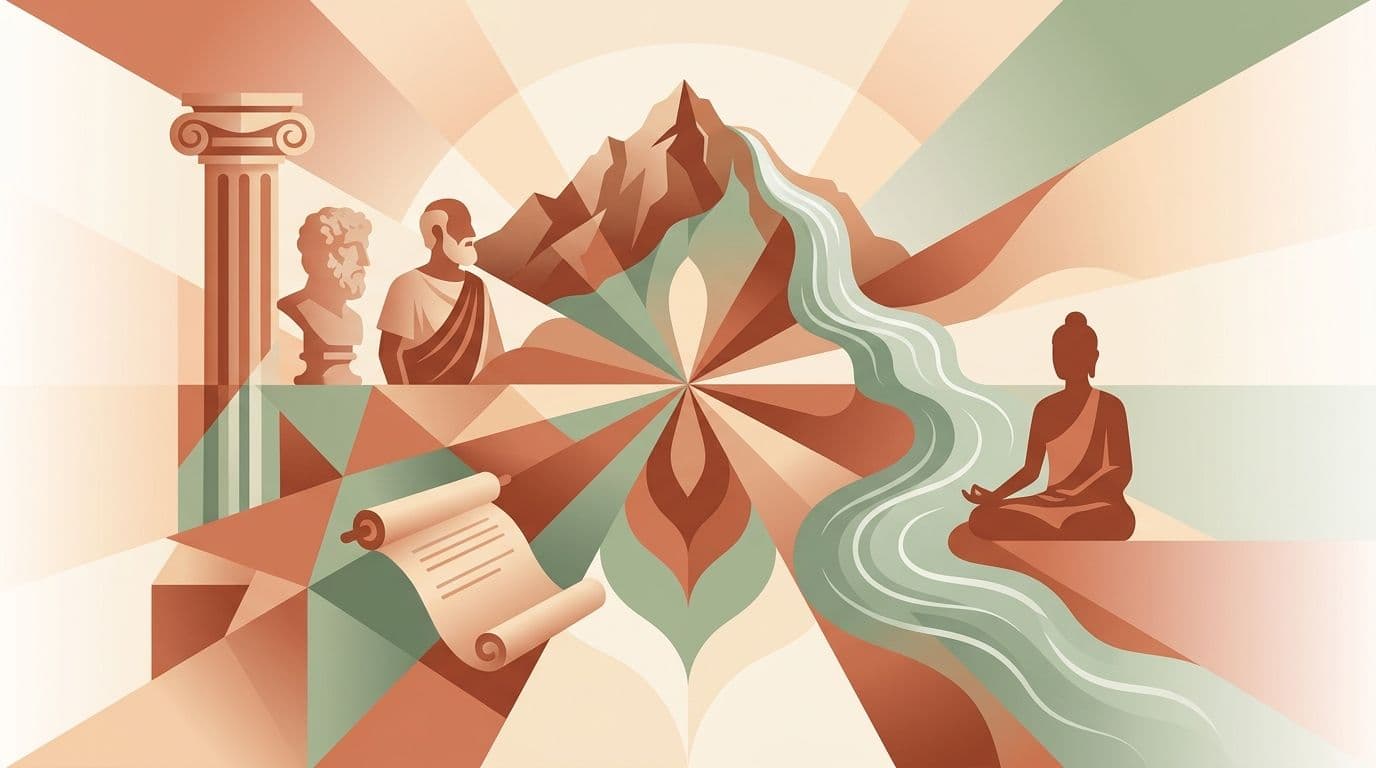
When we explore stoicism vs buddhism, we're not comparing rivals — we're comparing two brilliant maps to the same mountaintop. Their vocabularies differ, their metaphysics diverge, but their destination is remarkably similar: a mind that is calm, clear, and free.
In this guide, we'll compare Stoic and Buddhist quotes side by side, uncover the surprising stoicism buddhism similarities, explore where they part ways, and help you decide which path — or which blend — might serve you best.
The Shared Foundation: Suffering Comes From the Mind
Both traditions begin with the same radical insight: external events don't cause our suffering — our judgments about them do.
Epictetus (Stoic):
"Men are disturbed not by the things which happen, but by the opinions about the things."
The Buddha (Buddhist):
"We are shaped by our thoughts; we become what we think. When the mind is pure, joy follows like a shadow that never leaves."
Read those together slowly. Two men, separated by centuries and continents, arrived at the identical diagnosis: the mind is the workshop of suffering, and also the workshop of peace.
This is the core of any serious inner peace philosophy. Before you can change how you feel, you must change what you think — or more precisely, your relationship to what you think.
Practical takeaway
The next time you feel anger, anxiety, or frustration rising, pause and ask: Is this situation causing my pain, or is it my interpretation of it? This single question is the doorway both traditions walk through.
Impermanence vs Acceptance of Nature
Here the two philosophies use different language for a nearly identical truth.
Buddhism speaks of anicca — impermanence. Everything arises and passes: thoughts, feelings, relationships, empires, stars.
The Buddha:
"All conditioned things are impermanent. Work out your own salvation with diligence."
Stoicism speaks of living according to Nature — accepting the flow of the cosmos and the inevitability of change.
Marcus Aurelius:
"Time is a river of passing events, and strong is its current; no sooner is a thing brought to sight than it is swept by and another takes its place."
Both teachings ask you to loosen your grip. To love what you have without clinging to it. To grieve what you lose without being destroyed by it.
Want to keep a reminder of impermanence on your phone or desktop? Turn any of these lines into a daily visual cue with our motivational wallpaper generator — it takes about 30 seconds and can quietly reshape your morning.
Detachment vs Non-Attachment: A Crucial Nuance
Here's where western vs eastern philosophy starts to diverge in interesting ways.
Stoicism teaches detachment through preferred indifferents — you can prefer health, wealth, and love, but your happiness cannot depend on them. External things are "indifferent" to your virtue.
Epictetus:
"Wealth consists not in having great possessions, but in having few wants."
Buddhism teaches non-attachment through insight into emptiness — clinging itself (tanha) is the root of suffering, and liberation comes from seeing that all phenomena lack a permanent, independent self.
The Buddha:
"You only lose what you cling to."
The practical outcome looks similar: don't build your happiness on things that can be taken from you. But the reasoning differs. The Stoic says, "External things are outside my control, so I'll focus on virtue." The Buddhist says, "External things — and even the self that grasps them — are empty of inherent existence, so grasping is confusion."
One is ethical. The other is metaphysical. Both work.
Virtue vs Compassion: The Ethical Heart
Every deep philosophy needs a moral compass. Stoicism and Buddhism each have one, and comparing them reveals their character.
Stoic ethics revolve around four cardinal virtues: wisdom, courage, justice, and temperance. To live virtuously is to live rationally, in harmony with your nature as a thinking being.
Marcus Aurelius:
"Waste no more time arguing what a good man should be. Be one."
Buddhist ethics revolve around compassion (karuna) and loving-kindness (metta), extended to all sentient beings without exception.
The Buddha:
"Radiate boundless love towards the entire world — above, below, and across — unhindered, without ill will, without enmity."
Stoicism can sometimes feel austere — a philosophy of the disciplined individual mastering himself. Buddhism can feel more relational — a philosophy of interconnectedness, where your peace is inseparable from the peace of others.
But don't overstate this. Marcus Aurelius wrote extensively about our duty to fellow humans: "We are made for cooperation, like feet, like hands." And Buddhist monastic discipline is famously rigorous. The overlap is enormous.
If you want to go deeper into the Stoic side of this ethical vision, the marcus-aurelius-meditations-top-30-quotes-decoded breakdown and the epictetus-top-30-quotes-the-discourses-made-accessible collection are excellent starting points.
Where They Truly Differ: Metaphysics and the Self
So far the stoicism buddhism similarities have dominated. Let's be honest about the real differences.
The Self
- Stoicism affirms the self. You have a rational soul, a guiding faculty (hegemonikon), a character to develop. Self-improvement is the game.
- Buddhism teaches anatta — non-self. What we call "I" is a stream of ever-changing processes, not a fixed entity. Liberation involves seeing through the illusion of a solid self.
The Goal
- Stoicism aims at eudaimonia — a flourishing life of virtue, lived fully in this world.
- Buddhism aims at nirvana — the extinguishing of craving and the end of the cycle of rebirth.
The Cosmos
- Stoicism sees a rational, providential universe (Logos) that we participate in.
- Buddhism generally avoids metaphysical claims about a creator, focusing instead on the practical path out of suffering.
These are not small differences. But notice: they matter more to philosophers than to practitioners. If you're using either tradition to become less reactive, more present, and more kind, the metaphysics fades into the background.
How to Practice Both: A Modern Synthesis
You don't have to choose. Many modern seekers weave both traditions together, and the result is powerful.
Here's a simple daily framework that draws from both:
- Morning (Stoic): Begin with a premeditation. Ask, "What is in my control today? What virtues will I need?" This is classic Stoic preparation. A daily-stoic-meditation-guide-10-minutes-each-morning gives you a structured way to do this.
- Midday (Buddhist): Take three mindful breaths. Notice sensations, thoughts, emotions arising and passing. No judgment. Just awareness.
- When challenged (Stoic): Remember Epictetus. "It's not the event, it's my judgment." Choose your response.
- When grasping (Buddhist): Notice the clinging. Ask, "Can I hold this more lightly?"
- Evening (Both): Review the day with honesty and compassion. Where did you act with virtue? Where did you cling? What can you release before sleep?
For a deeper structure that fits contemporary life, modern-stoicism-how-to-apply-ancient-wisdom-in-2026 offers concrete practices you can layer with mindfulness meditation.
Quotes to keep close
Print these, screenshot them, or make them your lock screen:
- "You have power over your mind — not outside events. Realize this, and you will find strength." — Marcus Aurelius
- "Peace comes from within. Do not seek it without." — The Buddha
- "The happiness of your life depends upon the quality of your thoughts." — Marcus Aurelius
- "Do not dwell in the past, do not dream of the future, concentrate the mind on the present moment." — The Buddha
If discipline is the piece you're missing, the stoic-quotes-on-discipline-build-unshakeable-willpower collection pairs beautifully with a mindfulness practice — Stoic grit plus Buddhist softness is a rare and powerful combination.
Which Path Is Right for You?
There's no wrong answer in the stoicism vs buddhism conversation. But here are some honest guiding questions:
- Choose Stoicism if you're action-oriented, resonate with rational analysis, love clear principles, and want a philosophy that thrives in the marketplace, the boardroom, and the battlefield. Start with best-stoic-quotes-for-beginners-where-to-start-your-practice.
- Choose Buddhism if you're drawn to meditation, want to explore the nature of mind directly, resonate with compassion as a core practice, and are willing to sit with difficult experiences without needing to fix them immediately.
- Choose both if you're like most modern practitioners — pragmatic, curious, and unwilling to pledge tribal loyalty to any one tradition when both have so much to offer.
When life gets genuinely hard — grief, illness, failure — you'll want every tool you can find. The best-stoic-quotes-for-hard-times-wisdom-for-modern-struggles collection and Buddhist teachings on suffering can be read as companion volumes, not rivals.
Your Path to Inner Peace Starts Today
The great gift of comparing stoicism vs buddhism isn't picking a winner. It's discovering that two of humanity's wisest traditions independently arrived at the same core insight: your peace is an inside job.
Events will keep coming. Losses will happen. Bodies will age. Plans will fail. Neither Marcus Aurelius nor the Buddha could stop any of that — and neither can you.
But both showed, with clarity and love, that a mind trained in wisdom can meet all of it without breaking. That's not a Western idea or an Eastern idea. It's a human one.
Start small. Pick one quote from this article that struck you. Sit with it for a week. Let it work on you. Then pick another.
The mountain has many paths. What matters is that you're walking.
Frequently Asked Questions
The biggest difference is metaphysical: Stoicism affirms a rational self that develops virtue in a providential universe, while Buddhism teaches non-self (anatta) and aims to extinguish craving to end suffering. Practically, though, both train the mind to find peace independent of external events.
Yes, and many modern practitioners do. Stoic morning premeditation pairs naturally with Buddhist mindfulness meditation. Stoicism gives you rational tools for action, while Buddhism deepens your awareness and compassion. They complement rather than contradict each other.
Both help significantly. Stoicism offers quick cognitive reframing — 'it's not the event, it's my judgment' — which resembles modern CBT. Buddhism offers mindfulness meditation, which research shows reduces anxiety over time. Many people benefit most from combining both approaches.
Written by Daily Motivation Team
Sharing motivational content to inspire your journey to success.
Related Articles
 manifestation
O Method Manifestation: A Complete Guide
Learn how the O Method manifestation works, why it's so effective, and exactly how to practice it for real results.
 Creativity
Artistic Inspiration: A Complete Guide
Artistic inspiration isn't luck — it's a trainable skill. Learn 7 daily practices that keep ideas flowing.
 manifestation
3 6 9 Method: A Complete Guide
Learn how the 3 6 9 method rewires your focus and turns daily journaling into a powerful manifestation ritual.
 manifestation
Manifestation Techniques: A Complete Guide
Discover the most powerful manifestation techniques — from the 369 Method to scripting — and learn how to actually turn thoughts into reality.