
Minimum Viable Product (MVP): Lean Startup Guide + 5 Types & Examples
A complete guide to the Minimum Viable Product (MVP) — what it is, the 5 main types (concierge, wizard of oz, landing page, single-feature, pre-order), classic examples, and how to build one in 4 weeks.
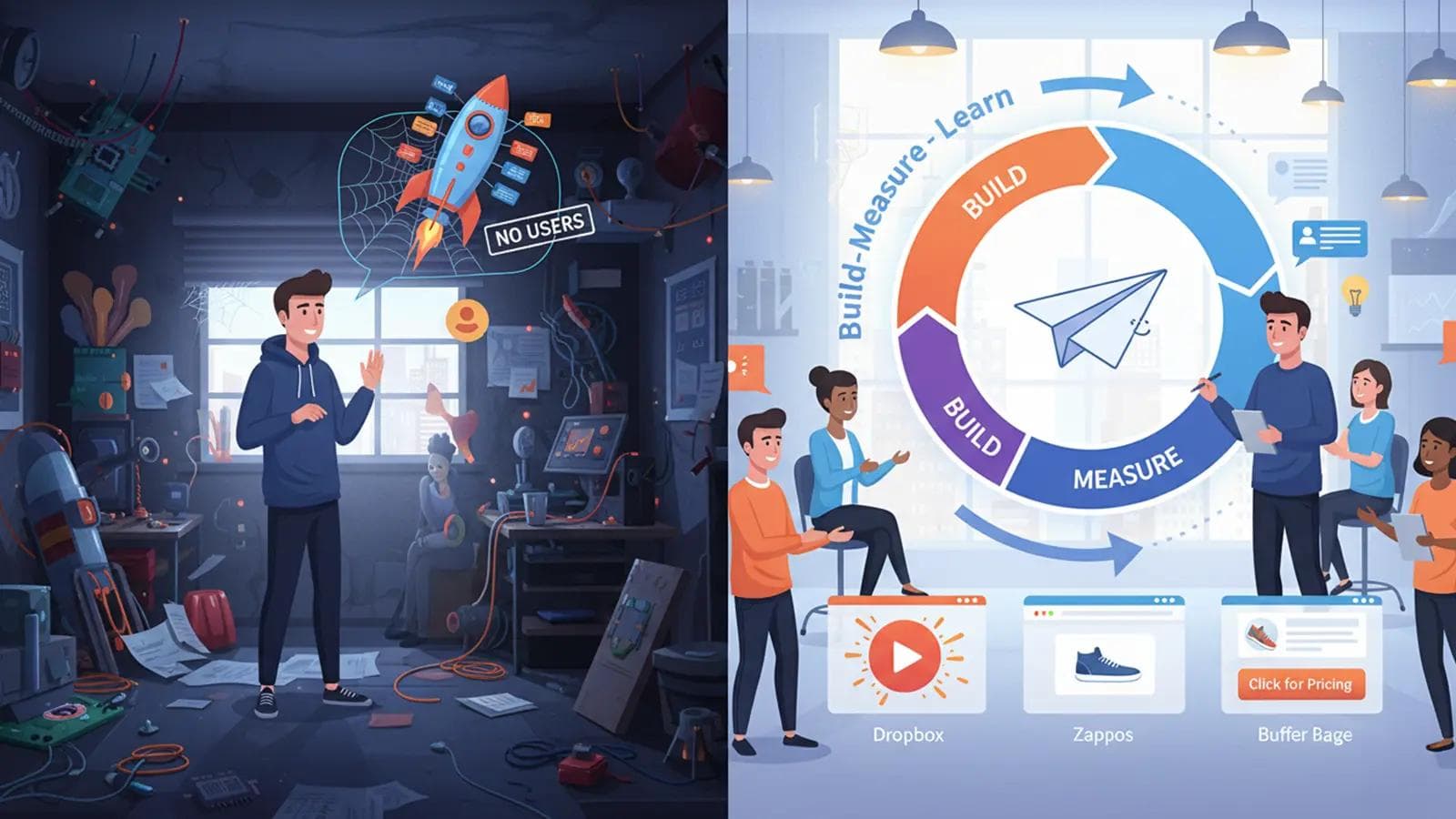
Introduction: Every entrepreneur has "The Idea." Many will spend the next 6, 12, or even 18 months in a garage, building it in secret. They perfect every feature, polish every pixel, and spend thousands of dollars. Then, they launch... to the sound of crickets.
Why? Because they built a perfect solution to a problem *nobody actually had*.
This is the fatal flaw that the Lean Startup methodology, pioneered by Eric Ries, was designed to solve. The core tool to prevent this failure is the Minimum Viable Product (MVP) — and the version most founders learn is wrong. This guide covers what an MVP actually is, the five distinct types you can choose from, four legendary case studies, how to build one in four weeks, and the common mistakes that turn an MVP into a slow-motion disaster.
What is a Minimum Viable Product (MVP)?
An MVP is *not* your "Version 1.0." It is not a "buggy or cheap version" of your final product. It is not a beta. It is not a prototype.
A Minimum Viable Product is the smallest, simplest version of your product that allows you to test your single most critical assumption and start learning from real users. Its goal is not to make money — its goal is to *learn*.
The word that matters most in "Minimum Viable Product" is Viable. Minimum means the smallest scope possible. Product means something a real user can use. Viable is the bridge between those two: the thing has to actually solve the core problem, even if everything else is missing. A bicycle is a viable way to get across town. A single wheel is not. Build the bicycle, not the Ferrari, but also not the unicycle.
The other thing to understand is that an MVP is a learning instrument, not a product launch. You are not introducing your company to the world. You are running an experiment. The output of an MVP is not revenue — it is data that tells you whether your assumption was right or wrong. Build that distinction into your brain before you write the first line of code, and you will save yourself months of work.
The 5 Types of MVP (And When to Use Each)
The biggest mistake founders make is assuming an MVP has to be software. It doesn't. There are five well-established MVP types, and the right one depends on the assumption you're trying to test.
1. The Landing Page MVP
A single web page describing your product, with a "Sign Up" or "Get Pricing" button. No product exists yet. The metric is conversion rate — how many visitors click the button.
Use when: You want to test demand before building anything. Cheapest possible MVP. Buffer famously used this to validate that people would pay for tweet scheduling.
Risk: Conversion intent does not equal purchase intent. A click is interest, not commitment. Pair with a pre-order option to make the signal stronger.
2. The Wizard of Oz MVP
The user thinks they're interacting with a product. Behind the scenes, you're doing every step manually. The "machinery" doesn't exist yet — you are the machinery.
Use when: You want to test whether the product *experience* works before automating it. Zappos is the canonical example — Nick Swinmurn took photos of shoes from local stores and bought them by hand when someone ordered online.
Risk: Doesn't scale. The whole point is that it shouldn't scale yet — you're proving the concept before investing in automation.
3. The Concierge MVP
Similar to Wizard of Oz, but the user *knows* you're doing it manually. You provide the service personally, one customer at a time. The point is to learn what the automated version should eventually do.
Use when: Your product is a service or process you don't yet fully understand. Food on the Table, an early meal-planning startup, started this way — the founder personally built weekly meal plans for one customer, then five, until he understood the pattern enough to automate it.
Risk: Founders fall in love with the manual service and never automate. The concierge MVP is a phase, not a destination.
4. The Single-Feature MVP
You build one feature — the single thing your product must do — and nothing else. No settings, no profile, no extra screens. Just the one core action.
Use when: Your idea has a clear "killer feature" and you want to test whether that single feature is compelling enough to drive use. Instagram launched this way — it started life as a complex location-check-in app called Burbn, then stripped everything away except photo filters.
Risk: Picking the wrong feature. Spend more time deciding which feature than building it.
5. The Pre-Order MVP
You announce the product, take pre-orders (with real money), and only build it if enough people commit. This works especially well for physical products and creative projects.
Use when: You want the strongest possible signal of demand — money. Pebble used this on Kickstarter, raising over 10 million dollars in pre-orders for a smartwatch that didn't exist yet. The Coolest Cooler raised 13 million dollars the same way.
Risk: Refunds and reputational damage if you fail to deliver. Only use this when you're confident you can build it; just not yet confident anyone wants it.
Genius MVP Examples That Built Billion-Dollar Companies
The point of studying MVP examples isn't to copy them — it's to understand the *thinking* behind them. Every one of these founders chose creativity over expense.
Airbnb (The Concierge MVP). In 2007, Brian Chesky and Joe Gebbia couldn't pay rent for their San Francisco apartment. A design conference was coming to town, hotels were sold out, so they bought three air mattresses, set them up in their living room, and built a single-page site called airbedandbreakfast.com. Three guests booked. They served breakfast personally. The MVP wasn't a marketplace — it was three air mattresses and a host who took their guests out for coffee. The assumption they validated: "Strangers will pay to sleep in someone else's home." Everything else — the global platform, the reviews, the listings — came later.
Dropbox (The Video MVP). In 2008, file-syncing across operating systems was technically brutal. Drew Houston knew the engineering would take years, so before writing the production code, he made a 3-minute video walking through what Dropbox *would* do. He posted it on Hacker News. Overnight, his beta waitlist grew from 5,000 to 75,000. The MVP wasn't a product — it was a video. The assumption he validated: "People want this enough to wait for it." Only then did he start building the real thing.
Zappos (The Wizard of Oz MVP). Founder Nick Swinmurn wanted to know if people would buy shoes online — a wild idea in 1999. He didn't build a warehouse. He didn't sign deals with manufacturers. He walked into local shoe stores, took photos of their inventory, and put the photos on a barebones website. When someone bought a pair, he ran back to the store, bought it at retail, and shipped it himself. He lost money on every sale by design. The assumption he validated: "People *will* buy shoes without trying them on first." Once that was proven, Amazon bought Zappos for 1.2 billion dollars.
Buffer (The Landing Page MVP). Joel Gascoigne wanted to build a social media scheduling tool but didn't want to spend months coding it for nothing. He built a one-page website explaining the product and a "Plans and Pricing" button. Clicking the button led to a second page that said "Hello! You caught us before we're ready. Leave your email and we'll let you know when Buffer is live." Enough people clicked "Pricing" — not just the sign-up button, but the *paid* button — that he knew he had a business. The assumption he validated: "People will *pay* for this, not just use it." Buffer is now a profitable company with millions in annual revenue.
The common thread isn't tech, money, or talent. It is the willingness to look ridiculous in service of a real answer.
How to Build an MVP in 4 Weeks: Step-by-Step
You don't need a co-founder, funding, or a roadmap to build an MVP. You need 4 weeks and the discipline to cut.
Week 1 — Identify the single critical assumption. Every startup idea is built on a stack of assumptions. Write yours down. Now circle the one that, if wrong, kills the whole idea. For most products this is *demand* ("Will anyone want this?"), not *feasibility* ("Can I build it?"). The single critical assumption is the only thing your MVP should test.
Week 2 — Define one success metric. Decide in advance what counts as validation. "100 sign-ups in two weeks." "10 paying customers." "20% click-through rate on the pricing page." Without this, you'll rationalize whatever happens. Founders who skip this step always conclude their MVP "kind of worked."
Week 3 — Build the smallest possible version that tests the assumption. Now pick your MVP type from the five above. If you're testing demand, use a Landing Page or Pre-Order MVP. If you're testing experience, use Wizard of Oz or Concierge. If you're testing a killer feature, use Single-Feature. Resist scope creep aggressively. Every feature you add is one more reason to delay launch.
Week 4 — Get it in front of real users, then decide. Not friends. Not family. Not Reddit (usually). Find the *exact* people who experience the problem your product solves — early adopters who are already searching for a solution. Spend a week measuring against your metric. Then compare: did the data clear your bar, or didn't it? Persevere or pivot. The answer is rarely ambiguous.
If you find yourself adding a fifth week, you are no longer building an MVP. You are building a startup.
The 'Build-Measure-Learn' Loop
The MVP is the key component of a cycle called the Build-Measure-Learn loop — Eric Ries's most enduring contribution to startup thinking.
1. Build: You build the *fastest, cheapest* possible version of your idea (the MVP).
2. Measure: You get it in front of *real users* (your "first 10 customers") and measure their actual behavior. Do they use it? Do they pay for it? Do they ignore it?
3. Learn: You take this real-world data and learn. Your assumption was either Validated ("Yes, people will pay for this") or Invalidated ("No, nobody cares about this feature").
4. Repeat: Based on what you learned, you either Persevere (keep going on the same hypothesis) or Pivot (change your idea) and start the loop over, building a new, slightly better MVP.
Most founders treat MVP as a one-time event. The real power is that it's a loop. You will run it 5, 10, 20 times before you find product-market fit.
What Comes After MVP? (PMF, Iteration, Pivot)
The MVP is the start of the journey, not the end. Once your MVP runs, you face one of three outcomes:
Outcome 1 — Strong validation. Users love it. They pay. They tell their friends. This is the rarest result, and even when it happens, it's often partial. You now move from MVP to building toward product-market fit (PMF) — the point at which demand pulls product out of you, not the other way around. Marc Andreessen's classic test: PMF feels like a fire you can't put out.
Outcome 2 — Mixed signals. Some users engage. Some don't. The metric was close but didn't clear the bar. Now you iterate — usually 5-10 mini-MVPs in succession, each testing one tweak. Different pricing. Different audience. Different onboarding. This is the longest, dullest, and most important phase of a startup, and most failures happen here, not at the launch.
Outcome 3 — Clear invalidation. Nobody clicked. Nobody paid. Nobody cared. This is the most useful result, even though it doesn't feel like it. You now pivot — change a core element of the idea (the customer, the problem, the value proposition) and run a new MVP. Slack pivoted from a failed video game. Instagram pivoted from Burbn. YouTube pivoted from a dating site. The pivot is not a failure; it's the system working.
If you can't tell which outcome you're in, you didn't define your success metric clearly enough in Week 2. Go back and decide what you would have considered "validation" before you saw the data.
5 Common MVP Mistakes That Kill Startups
These are the mistakes that turn what should be a 4-week experiment into a 12-month slow death.
1. Treating the MVP as a product launch. Founders inflate scope because they think the MVP is their first impression. It isn't. Almost nobody will remember your MVP. The customers who do remember it will respect you more for shipping than for polishing. Ship.
2. Building for an imaginary user. You designed the MVP for "people like you." Real early adopters are a specific, narrow group with a specific, painful problem. If you can't name five real people who will use the MVP the moment it launches, you don't have an audience yet — you have a hypothesis about an audience. Find five real people first.
3. Polishing instead of shipping. The opposite of perfect is not bad. The opposite of perfect is *shipped*. Every additional week of polishing is a week of not learning. Cut features until shipping in a week feels reasonable, then cut more.
4. Ignoring qualitative feedback. Numbers tell you whether — they don't tell you why. The first 10 users of your MVP should each get a 20-minute conversation, not a survey. Watch them use it. Listen to what they don't say. Most of your real learning will come from one offhand comment in a user interview, not from your dashboard.
5. Confusing 'no usage' with 'wrong product.' Sometimes the product is right and the audience is wrong. Sometimes the product is right and the messaging is wrong. Sometimes the product is right and you launched at the wrong time. Before you pivot the *product*, test the *audience* and the *positioning*. A pivot is a big move; save it for when you're sure.
Stop "Building," Start "Learning"
Your idea is just a guess — a hypothesis. The MVP mindset forces you to stop acting like a builder and start acting like a scientist. Your job is to test your guess as fast and cheap as possible.
Stop asking "Can this be built?" Start asking "Should this be built?"
Conclusion: Fail Fast, Learn Faster
You can spend 6 months building your "perfect" product in a cave, or you can spend 4 weeks building an MVP and learning the truth. The MVP mindset is about embracing humility — accepting that your initial idea is probably wrong and that your customers are the only ones with the right answers.
If you take only one thing from this guide, take this: the goal is not to build a startup. The goal is to learn fast enough to discover a startup worth building. The MVP is how you do that. Pick a type, define a metric, ship in four weeks, and let real users tell you what to build next. They almost always know better than you do — and they always know better than your spreadsheet.
Frequently Asked Questions
A prototype is for you — it helps you visualize and refine the product internally. An MVP is for users — it tests a real assumption with real people. A prototype answers "what could this look like?" An MVP answers "does anyone actually want this?" They serve different purposes at different stages.
4 weeks is a healthy target for most software MVPs. Two weeks if it's a landing-page or pre-order MVP. If you find yourself in month three, you are no longer building an MVP — you are building a startup. Cut scope until 4 weeks feels achievable.
A concierge MVP is one where you provide the service personally, manually, one customer at a time. The user knows you're doing it by hand. The goal is to learn what the automated version should eventually do. Food on the Table, an early meal-planning startup, ran this way — the founder built weekly meal plans by hand until he understood the pattern well enough to automate it.
Under 5,000 dollars is a good ceiling for most software MVPs. Some of the most famous MVPs cost less than 500 dollars — Dropbox's was a 3-minute video, Zappos's was a website and a camera. If you're spending more than 10,000 dollars, you're probably building too much. The point of an MVP is to test cheaply, not to launch a startup.
Yes — in fact, many of the best MVPs are services. The concierge and Wizard of Oz models are both services masquerading as products. If you can deliver the value of your product manually, you should — at least at first. Service first, product later, is one of the most underused strategies in early-stage startups.
No. The "V" in MVP stands for Viable. It must solve the core problem. It can be simple, but it can't be broken. A bicycle is a viable way to get across town; a single wheel is not. Build the bicycle, not the Ferrari, and not the unicycle.
Do not show it to your friends and family. They will lie to protect your feelings. Show it to your target audience — the early adopters who feel the pain of the problem you're trying to solve. Five real users in your target audience are worth a hundred well-wishers.
Written by Daily Motivation Team
Sharing motivational content to inspire your journey to success.
Related Articles
 stoic
stoicStoic Quotes on Discipline: Where Stoicism Meets Self-Mastery
Discover powerful stoic quotes on discipline from Marcus Aurelius, Seneca, and Epictetus — plus how to apply them today.
 stoic
stoicBest Stoic Quotes for Hard Times: Wisdom for Modern Struggles
Powerful Stoic quotes for hard times from Marcus Aurelius, Seneca & Epictetus — wisdom that turns adversity into strength.
 stoic
stoicBest Stoic Quotes for Beginners: Where to Start Your Practice
Discover the best stoic quotes for beginners and a simple 7-day plan to turn ancient wisdom into daily practice.
 manifestation
3 6 9 Method: A Complete Guide
Learn how the 3 6 9 method rewires your focus and turns daily journaling into a powerful manifestation ritual.