
How Muscles Grow: Why Rest Is Your Secret Weapon
Stuck in a workout plateau? The secret to muscle growth isn't more gym time—it's smarter recovery. Here's the science-backed process to unlock gains.
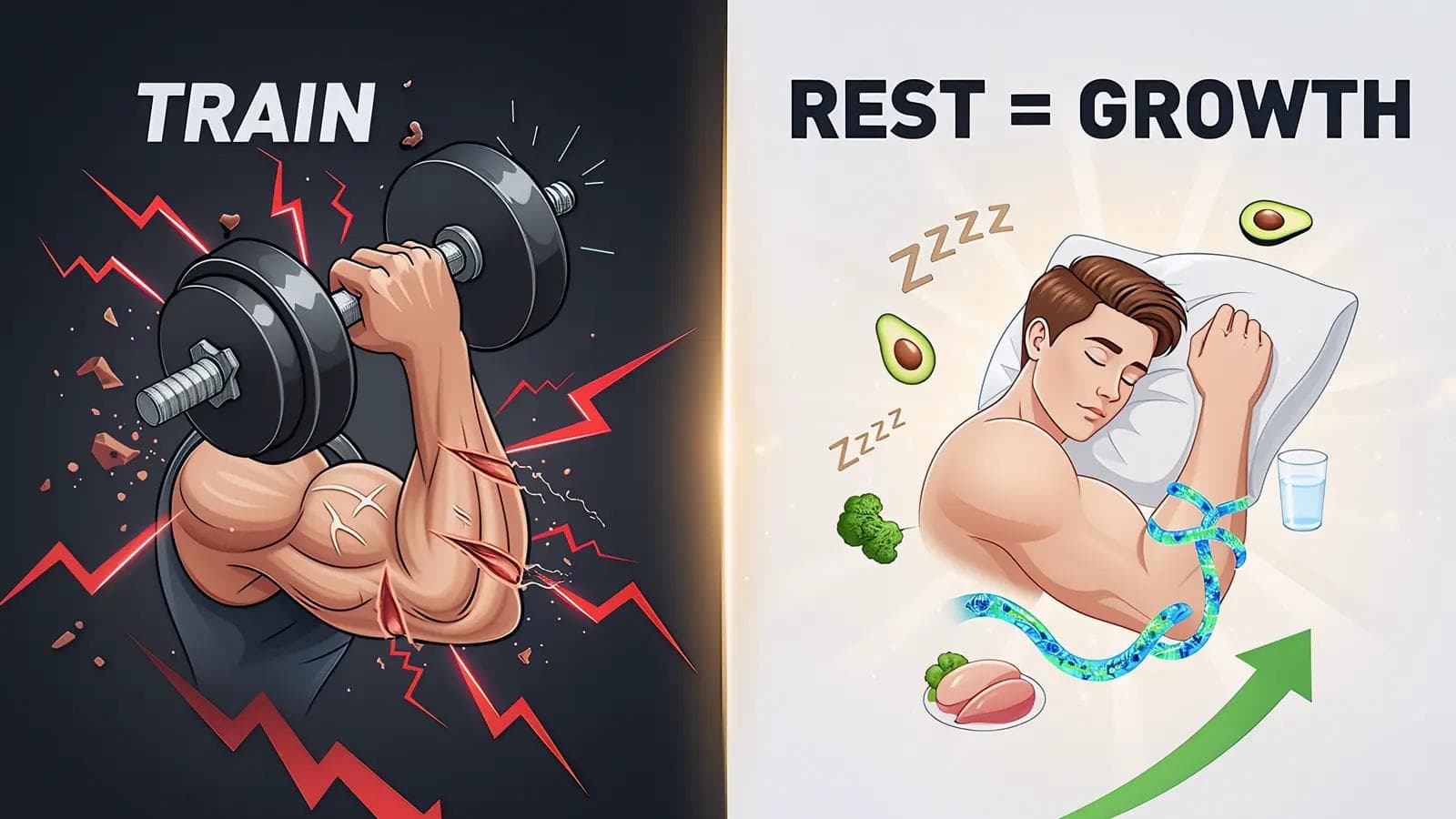
How Muscles Grow: The Scientific 3-Step Process for Building Strength
Ever feel like you're putting in the hours at the gym, but the results just aren't showing up on the scale or in the mirror? You're not alone. The fitness world is full of 'no days off' motivation, but this overlooks the most critical, science-backed element of how muscles grow: strategic rest.
Contrary to popular belief, muscle isn't built while you're lifting weights. The gym is where you start the process, but the real growth happens when you're recovering. Understanding this process is the key to unlocking consistent, long-term gains and breaking through frustrating plateaus.
This guide will break down the exact science of muscle growth, from the initial stimulus in the gym to the crucial repair phase that happens while you sleep. We'll give you a simple, actionable framework to ensure every workout counts.
What Actually Happens When You Lift Weights? The Science of Muscle Growth
To understand how muscles grow, you first need to understand what a workout actually does to your body. Lifting weights places your muscles under a specific type of stress they aren't used to. This stress is the catalyst for a process called muscle hypertrophy, which is the scientific term for an increase in muscle cell size.
This process is driven by three primary mechanisms:
- Mechanical Tension: This is the force generated by your muscles when they contract against a heavy weight. Think of the tension on a cable as it's being stretched. This is the single most important factor for signaling muscle growth. You create high mechanical tension by lifting challenging weights through a full range of motion.
- Muscle Damage: When you lift weights, especially during the eccentric (lowering) phase of a lift, you create microscopic tears in your muscle fibers. This isn't a bad thing; it's a necessary part of the process. This damage triggers an inflammatory response, which signals your body's repair crew to come in and fix the problem.
- Metabolic Stress: Ever feel that 'burn' or 'pump' during a high-rep set? That's metabolic stress. It's the buildup of metabolic byproducts like lactate and hydrogen ions within the muscle. This cellular swelling is believed to contribute to muscle growth by signaling the cells to reinforce themselves.
The key takeaway is this: Your workout is the signal, not the growth itself. You are breaking your muscles down to signal to your body that it needs to adapt and become stronger.
The 3-Pillar Framework for Muscle Growth
To make this process easy to understand and apply, we can break down the entire muscle growth process into three distinct pillars: Provoke, Permit, and Protect.
Pillar 1: Provoke (The Workout Stimulus)
This is the active, in-the-gym part. Your goal is to create a strong enough stimulus (the 'provocation') to force your body to adapt. Here’s how to do it right.
##### The Principle of Progressive Overload: The Only Rule That Matters
Your body is incredibly efficient. It will not build new, metabolically expensive muscle tissue unless it absolutely has to. To force it to adapt, you must consistently increase the demand placed upon it. This is called progressive overload.
It means that over time, you must do more than you've done before. This can be achieved in several ways:
- Increase Weight: Lifting heavier loads is the most direct way to increase mechanical tension.
- Increase Reps: Doing more repetitions with the same weight.
- Increase Sets: Adding an extra set to your exercises.
- Decrease Rest Time: Reducing the time between sets increases metabolic stress.
- Improve Form: Increasing your range of motion puts the muscle under tension for longer.
Actionable Tip: Track your workouts. Write down your exercises, the weight you used, and the sets/reps you completed. Each week, aim to improve on one of those variables for most of your exercises. That is the essence of the muscle growth process.
##### How Much Volume is Enough? Sets & Reps Explained
Volume (sets x reps x weight) is a key driver of hypertrophy. While there's no single magic number, scientific consensus points to a general range:
- For Strength & Hypertrophy: Aim for 3-5 sets per exercise.
- Rep Ranges: The 6-12 rep range is often called the 'hypertrophy range' as it provides a great blend of mechanical tension and metabolic stress. However, lifting heavier in the 4-6 rep range and lighter in the 15-20 rep range can also effectively stimulate muscle growth.
- Weekly Volume: A good starting point is 10-20 hard sets per muscle group per week, spread across 1-2 sessions.
Pillar 2: Permit (The Recovery & Raw Materials)
This is where the magic happens. You've provoked a response; now you must permit your body to recover and grow stronger. Without this pillar, your efforts in the gym are wasted.
##### Supercompensation: Turning Repair into Growth
After a workout, your muscle's performance capacity is temporarily decreased. During recovery, your body repairs the damaged muscle fibers. But it doesn't just repair them back to their original state. It anticipates future stress by rebuilding them slightly bigger and stronger.
This adaptive response is called supercompensation. It's your body's way of saying, "That was tough. I need to be better prepared for next time." This is the fundamental science of muscle building.
This entire cycle can take anywhere from 24 to 72 hours, depending on the intensity of the workout and the muscle group trained. This is why rest is non-negotiable.
##### How Much Protein Do You Actually Need for Muscle Growth?
Protein provides the amino acids that are the literal building blocks for new muscle tissue. Without enough protein, your body cannot effectively repair the damage from your workouts.
- The Myth: You don't need to chug a protein shake within 30 seconds of your last rep.
- The Reality: Your total daily protein intake is far more important.
Actionable Numbers: For optimal muscle growth, research consistently shows you should consume 1.6 to 2.2 grams of protein per kilogram of body weight (or about 0.7 to 1.0 grams per pound). For a 180lb person, this is 126-180 grams of protein per day. Spread this intake across 3-5 meals to maximize muscle protein synthesis. high-protein-meal-plan-for-beginners
##### The Anabolic Power of Sleep: Why 7-9 Hours is Non-Negotiable
Sleep is the most powerful performance-enhancing tool you have. During deep sleep, your body releases Human Growth Hormone (HGH), a key hormone in repairing tissues and, you guessed it, building muscle.
Skimping on sleep crushes your recovery. Studies show that sleeping 5.5 hours per night compared to 8.5 hours can reduce the amount of lean muscle mass gained by up to 60% and increase fat gain.
Actionable Tip: Aim for 7-9 hours of quality sleep per night. Create a consistent sleep schedule, make your room dark and cool, and avoid screens an hour before bed. This is a critical step in how muscles grow.
Pillar 3: Protect (The Long-Term Strategy)
Finally, you need a smart strategy to protect your body from burnout, injury, and overtraining. This ensures you can stay consistent for months and years, which is what it takes to see real results.
##### What is a Rest Day? Active vs. Passive Recovery
A rest day doesn't have to mean sitting on the couch all day. There are two main types of recovery, and both have their place in a smart training program.
- Passive Recovery:
- What it is: Complete rest from structured exercise.
- Best for: After extremely demanding workouts (like a heavy leg day) or when you're feeling mentally and physically drained.
- Examples: Getting extra sleep, relaxing, reading a book.
- Active Recovery:
- What it is: Low-intensity activity or movement.
- Best for: Promoting blood flow to sore muscles, which can help clear out metabolic waste and deliver nutrients for repair.
- Examples: A 20-30 minute walk, light cycling, stretching, foam rolling, or yoga.
##### How Many Rest Days Do You Need Per Week?
This depends entirely on your training intensity and split. There is no one-size-fits-all answer, but here are some evidence-based guidelines:
- For Beginners (Full Body 3x/week): You will have 4 rest days built into your program. For example, you train Monday, Wednesday, and Friday, with rest days on Tuesday, Thursday, Saturday, and Sunday.
- For Intermediates (Upper/Lower Split 4x/week): You will typically have 3 rest days. A common schedule is training Monday, Tuesday, Thursday, and Friday, with Wednesday and the weekend off.
- For Advanced Lifters (Push/Pull/Legs 6x/week): Even with this high frequency, you still have one full rest day, and each muscle group gets several days of rest before being trained directly again.
The golden rule: You should take at least 1-2 full rest days per week, and ensure you are not training the same muscle group on back-to-back days.
How Long Does It Take for Muscles to Grow?
This is the million-dollar question. The rate of muscle growth depends on several factors, including genetics, age, training experience, and—most importantly—consistency with your training and nutrition.
- Beginners: Can expect to see noticeable changes within 8-12 weeks. In the first year of proper training, men can potentially gain 10-25 lbs of muscle, and women can gain 5-12 lbs. This is often referred to as 'newbie gains.'
- Intermediates (1-3 years of training): The rate of gain slows considerably. Expect gains to be about half of what they were in your first year.
- Advanced (3+ years of training): Gains become very slow and require meticulous attention to detail. Gaining a few pounds of lean muscle in a year is a huge success.
Remember, this is a marathon, not a sprint. Focus on consistency, not perfection.
Common Mistakes That Are Killing Your Muscle Growth
If you're not seeing the results you want, you might be making one of these common mistakes that directly interfere with what makes muscles grow.
- Ego Lifting: Using a weight that is too heavy, forcing you to use poor form. This reduces mechanical tension on the target muscle and dramatically increases injury risk.
- Inconsistent Nutrition: You can't out-train a bad diet. Hitting your protein and calorie targets is just as important as hitting your workouts. nutrition-guide-for-muscle-building
- Program Hopping: Changing your workout routine every week. You need to stick with a program for at least 4-8 weeks to allow progressive overload to work.
- Ignoring Sleep: As discussed, this is the ultimate recovery killer. Prioritize your sleep like you prioritize your training.
- Skipping Rest Days: Constantly breaking down muscle without giving it time to supercompensate will lead to burnout, fatigue, and potential injury, not growth.
Your Blueprint for Building Muscle
Understanding how muscles grow isn't about complicated biology; it's about mastering the fundamentals. By focusing on the 3-Pillar Framework, you can ensure every aspect of your fitness journey is optimized for results.
- Provoke: Challenge your muscles with consistent, progressive overload in the gym.
- Permit: Fuel your body with adequate protein and calories, and prioritize 7-9 hours of sleep per night.
- Protect: Integrate 1-2 strategic rest days per week to allow supercompensation to occur.
Stop thinking of rest as a weakness. Start seeing it for what it is: the most crucial step in the entire muscle-building process. Train hard, recover harder, and watch your results transform.
Frequently Asked Questions
You'll know your muscles are growing through a few key indicators: increased strength (lifting heavier weights or for more reps), visible changes in the mirror or photos, clothes fitting differently (tighter sleeves, looser waist), and an increase in body weight on the scale that isn't accompanied by a significant increase in body fat.
No, it's virtually impossible for muscles to grow without an adequate supply of protein. Protein provides the essential amino acids that are the building blocks for repairing and creating new muscle tissue. While the body can recycle some amino acids, it's not enough to support the growth stimulated by resistance training.
It depends on the severity. If you have mild soreness (known as DOMS), performing light activity or working a different muscle group is generally fine and can even help with recovery. However, if the soreness is severe and limits your range of motion or causes sharp pain, you should rest that muscle group completely to avoid injury and allow for proper repair.
The fastest way to build muscle is to consistently apply the principles of progressive overload in your training, consume a calorie surplus with adequate protein (1.6-2.2g per kg of body weight), and get 7-9 hours of quality sleep per night. For beginners, focusing on compound exercises like squats, deadlifts, and bench presses will yield the quickest results.
Written by Daily Motivation Team
Sharing motivational content to inspire your journey to success.
Related Articles
 Creativity
Artistic Inspiration: A Complete Guide
Artistic inspiration isn't luck — it's a trainable skill. Learn 7 daily practices that keep ideas flowing.
 stoic
stoicStoic Quotes on Discipline: Where Stoicism Meets Self-Mastery
Discover powerful stoic quotes on discipline from Marcus Aurelius, Seneca, and Epictetus — plus how to apply them today.
 stoic
stoicBest Stoic Quotes for Hard Times: Wisdom for Modern Struggles
Powerful Stoic quotes for hard times from Marcus Aurelius, Seneca & Epictetus — wisdom that turns adversity into strength.
 stoic
stoicBest Stoic Quotes for Beginners: Where to Start Your Practice
Discover the best stoic quotes for beginners and a simple 7-day plan to turn ancient wisdom into daily practice.