
How to Study Literature & History: Active Recall Without Flashcards
Active Recall isn't just for STEM. Discover specific history study techniques and learn how to study literature using active recall without flashcards.
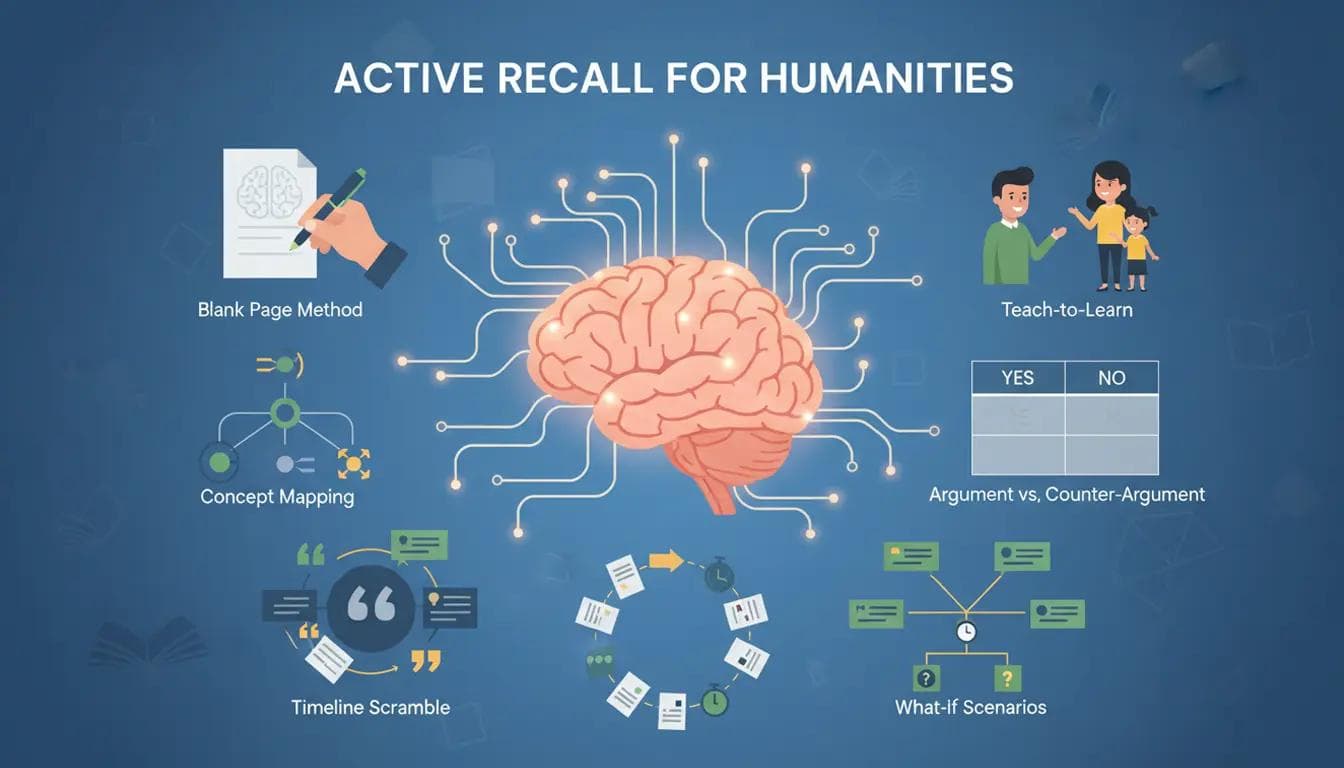
Introduction: When students hear "Active Recall," they immediately think of flashcards for biology terms or math formulas. This makes sense for STEM, where you have clear-cut questions and answers. But what about humanities? How do you use Active Recall for a subject that isn't about "right" answers, but about arguments, themes, and "the big picture"?
If you're a history, literature, or law student, you've probably been stuck re-reading your notes and textbook, hoping the information will stick. This is passive review, and it's why you draw a blank on the exam.
The truth is, Active Recall is even more critical for humanities. Exams in these fields don't ask you to "define" a term; they ask you to "compare and contrast," "analyze," or "argue." These skills require a deep, flexible understanding, which can only be built by actively retrieving and connecting information.
Here are 7 Active Recall strategies designed specifically for the humanities.
1. The 'Blank Page' Method (The Classic)
This is the most direct and powerful method. After you finish a reading or a lecture, close the book. Take out a blank sheet of paper and write down everything you can remember.
- For History: What were the key events? Who were the main actors? What were the causes and effects?
- For Literature: What was the plot? Who were the main characters? What were the key themes or symbols?
- The Power: After you've exhausted your brain, open the book. The gaps in your knowledge will be painfully obvious. This is what you need to study.
2. Concept Mapping (Connecting the Dots)
Humanities are all about connections, not isolated facts. A concept map is a visual way to practice this.
- How to do it: Start with a central theme (e.g., "The Causes of WWI" or "Symbolism in The Great Gatsby").
- Draw branches to main ideas (e.g., "Militarism," "Alliances," "Imperialism").
- Draw smaller branches from those ideas, connecting specific facts, dates, or quotes.
- The 'Active' Part: Do this from memory. Don't just copy your notes. Force your brain to reconstruct the web of connections. This is exactly what you'll have to do when writing an exam essay.
3. The 'Teach-to-Learn' (Feynman Technique)
This is the ultimate test of understanding. Can you explain a complex, nuanced idea in simple terms?
- How to do it: Pick a concept (e.g., "Post-Modernism" or "The legal concept of 'Negligence'").
- Pretend you are explaining it to a 10-year-old (or just a friend who isn't in your class).
- The 'Stuck' Point: The moment you use jargon or say, "...you know, that thing..." you've found a gap in your knowledge. Go back to your notes, simplify, and try again.
4. 'Argument vs. Counter-Argument' Tables
Humanities exams are often about defending a position. You need to know the other side of the argument as well as your own.
- How to do it: Create a simple two-column table.
- Topic: "Was the New Deal a Success?"
- Column 1: Argument FOR: (List all the evidence, acts, and historical interpretations).
- Column 2: Argument AGAINST: (List all the evidence, criticisms, and counter-interpretations).
- The 'Active' Part: Fill this table out from memory. This single sheet is now a perfect study guide for a potential essay question.
5. 'Quote-Splosion' (For Literature)
In literature, you need to connect themes to specific evidence (quotes).
- How to do it:
- Write a major theme on a blank page (e.g., "The Corrupting Influence of Power" in Macbeth).
- Set a timer for 10 minutes.
- From memory, write down every quote, scene, or character interaction you can think of that supports this theme.
- Why it works: You are training your brain to instantly link abstract themes to concrete textual evidence, which is the core skill of literary analysis.
6. 'Timeline Scramble' (For History)
History is built on "cause and effect." If you don't know the order of events, you can't understand the "why."
- How to do it:
- Write down 10-15 key events from a specific period on small, separate pieces of paper (e.g., "Assassination of Ferdinand," "Germany invades Belgium," "Zimmermann Telegram," "US Enters War").
- Shuffle them.
- Your task: Put them in the correct chronological order and explain the "cause and effect" link between each one.
7. 'What-If' Scenarios (For Law & Political Science)
Law and poly-sci are about applying principles to new fact patterns.
- How to do it:
- Take a known case or historical event.
- Change one fact. (e.g., "What if the defendant had not been read his Miranda rights?" or "What if the 1960 election had been decided by the House?").
- Write out your answer, applying the legal principles or political theories you've learned.
- Why it works: This is exactly what professors do on exams. You are practicing the skill of application, not just the facts of memorization.
Conclusion: Stop Re-Reading, Start Thinking
The biggest mistake humanities students make is believing that "studying" means "reading." The truth is that "studying" means "thinking."
Active Recall is the process of forcing your brain to think, connect, argue, and retrieve. It's harder. It's more tiring. And it's infinitely more effective. Pick one or two of these techniques for your next study session and watch your understanding (and your grades) transform.
Frequently Asked Questions
It's more effortful, but it takes less total time. One hour of high-intensity Active Recall is more effective than 5 hours of low-intensity passive re-reading. You will learn the material faster and retain it for longer.
That's a good thing! You have just received a perfect, clear signal that your current study method (e.g., just listening in class) is not working. It's a diagnosis. The solution: After your lecture, review your notes once (passively), then immediately try the blank page method.
Don't make "definition" cards. Make "concept" cards. Bad Card: Front: "Thomas Hobbes" / Back: "Wrote Leviathan..." Good Card: Front: "Compare and contrast the views of Hobbes and Locke on the 'state of nature'." / Back: (3-4 bullet points summarizing the core argument).
Written by Daily Motivation Team
Sharing motivational content to inspire your journey to success.
Related Articles
 Creativity
Artistic Inspiration: A Complete Guide
Artistic inspiration isn't luck — it's a trainable skill. Learn 7 daily practices that keep ideas flowing.
 stoic
stoicStoic Quotes on Discipline: Where Stoicism Meets Self-Mastery
Discover powerful stoic quotes on discipline from Marcus Aurelius, Seneca, and Epictetus — plus how to apply them today.
 stoic
stoicBest Stoic Quotes for Hard Times: Wisdom for Modern Struggles
Powerful Stoic quotes for hard times from Marcus Aurelius, Seneca & Epictetus — wisdom that turns adversity into strength.
 stoic
stoicBest Stoic Quotes for Beginners: Where to Start Your Practice
Discover the best stoic quotes for beginners and a simple 7-day plan to turn ancient wisdom into daily practice.