
Spaced Repetition Without Anki: A Pen-and-Paper System That Actually Sticks
Anki has 14 settings before you've added your first card. Most students quit by day 3. Here's the analog system I built when I gave up on the app — and never went back.
Spaced Repetition System: The Ultimate Guide to Lifelong Learning (No Anki!)
Did you know that within 24 hours of learning something new, you're likely to forget 50-80% of it? This isn't a personal failing; it's a feature of the human brain called the "forgetting curve." You've felt it after cramming for an exam—the information is there one day and gone the next.
But what if you could strategically hack this curve, making learning stick not just for weeks, but for years? You can. The solution is a spaced repetition system, a scientifically-backed method for moving information from your flaky short-term memory into reliable long-term storage. While apps like Anki are popular, they can be intimidating. This guide will teach you how to build a powerful, physical spaced repetition system with nothing more than index cards and a few boxes.
What is a Spaced Repetition System and How Does It Work?
A spaced repetition system (SRS) is a learning method that interrupts the brain's natural forgetting process. It works by presenting you with information at increasing intervals of time, with each interval timed to the precise moment you're about to forget it.
Imagine you learn a new Spanish word: biblioteca (library).
- You might review it again in 10 minutes.
- Then again in 24 hours.
- Then in 3 days.
- Then in a week.
Each time you successfully recall the word, the review interval gets longer. This process tells your brain, "Hey, this piece of information is important. Don't delete it!" It's the single most effective way to combat the Forgetting Curve, a concept discovered by psychologist Hermann Ebbinghaus in the 1880s.
The core principle is simple: Reviewing information you already know well is inefficient. Reviewing information just as you're about to forget it is the sweet spot for strengthening memory.
Why Your Brain Forgets (And How Spaced Learning Hacks It)
Your brain is a survival machine, not a hard drive. It's constantly bombarded with information and must decide what's worth keeping. It uses a simple rule: if you don't use a memory, you lose it. This process, known as synaptic pruning, is your brain's way of staying efficient.
Active recall (the act of pulling a memory out of your brain) is the signal that a memory is useful. A spaced repetition system simply provides the optimal schedule for performing active recall.
When you combine the two, you trigger a process called long-term potentiation (LTP), which strengthens the connections between neurons. Think of it like forging a path in a forest. The first time, it's difficult. But the more you walk that same path (recall the memory), the clearer and more permanent it becomes.
Spaced Repetition vs. Cramming: A Data-Backed Comparison
To understand why a Spaced Repetition System (SRS) is superior to traditional "cramming," let's look at how they compare:
- Retention (1 Week): Cramming typically results in only 10-30% retention, while Spaced Repetition yields an impressive 70-90%.
- Time Efficiency: Cramming requires long, exhausting single sessions. SRS uses short, focused bursts spread over time, making it much more efficient.
- Cognitive Load: Spaced learning keeps stress low by focusing on a few items at a time, whereas cramming often leads to high cognitive load and burnout.
- Memory Type: Cramming relies heavily on short-term memory (easy to forget), while SRS is specifically designed to build reliable long-term memory.
Studies consistently show that distributed practice is superior for long-term retention. One study published in Psychological Science in the Public Interest concluded that spreading learning out over time is one of the most effective learning strategies known to researchers.
How to Build Your Own Spaced Repetition System (The Leitner Box Method)
This is the heart of our guide. The Leitner System, developed by German scientist Sebastian Leitner in the 1970s, is a simple and elegant analog method for implementing spaced repetition. It's the perfect spaced repetition system for anyone who wants to avoid screen time or complex software.
Step 1: Gather Your Materials
You only need a few things:
- Index Cards: A pack of 100-200 is a great start.
- A Pen: Choose something clear and legible.
- 5 Boxes (or Dividers): You can use shoeboxes, recipe boxes, or even just rubber bands to separate your card piles. Label them "Box 1" through "Box 5."
Step 2: Create High-Quality Flashcards
The effectiveness of your system depends on your cards. Follow these rules:
- One Concept Per Card: Do not put multiple facts on a single card. Instead of "Spanish verbs," make one card for "hablar (to speak)" and another for "comer (to eat)."
- Keep It Simple: Use a clear question or prompt on the front and a concise answer on the back.
- Use Your Own Words: Paraphrasing a concept forces you to understand it first. For more tips, check out our guide on how-to-make-effective-flashcards.
Step 3: Set Up Your Boxes and Schedule
Each box represents a different review frequency. This schedule is a proven starting point, but you can adjust it later.
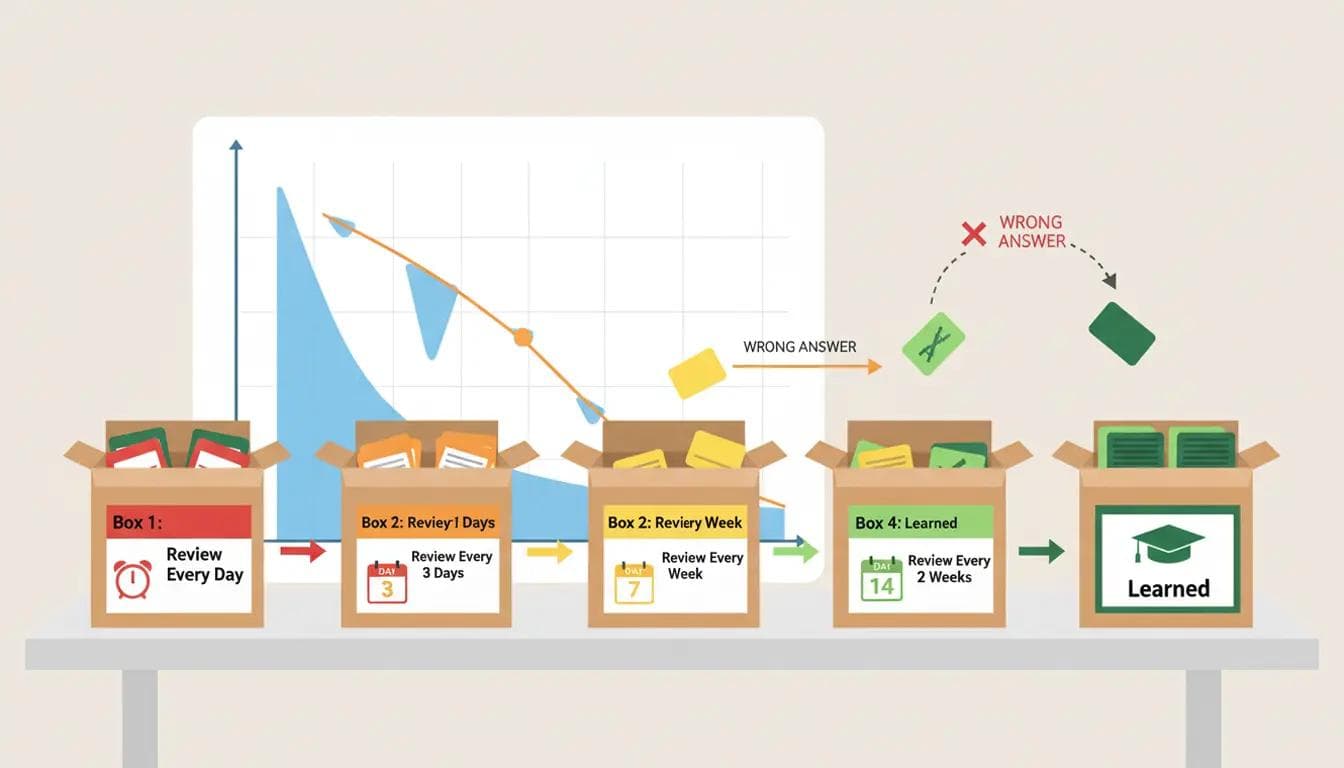
- Box 1 (Daily): New cards and cards you get wrong start here. You review this box every day.
- Box 2 (Every 3 Days): Cards you get right from Box 1 move here.
- Box 3 (Weekly): Cards you get right from Box 2 move here.
- Box 4 (Every 2 Weeks): Cards you get right from Box 3 move here.
- Box 5 (Monthly / "Learned"): Cards you get right from Box 4 move here. Once a card is here, it's likely in your long-term memory.
Step 4: The Daily Review Process
This is the simple "algorithm" that powers the entire system. Set aside 15-20 minutes each day.
- Start with Box 1: Pick up a card. Read the prompt and try to answer it aloud (this is crucial for active-recall-techniques).
- Check Your Answer: Flip the card over.
- If You Were Correct: Congratulations! Move the card to the next box (e.g., from Box 1 to Box 2).
- If You Were Incorrect: No problem! This is part of the process. The card goes all the way back to Box 1, regardless of which box it came from. This ensures you review difficult concepts more frequently.
- Repeat: Continue this process for all the cards scheduled for review that day. For example, on a Wednesday, you might review Box 1 (daily), Box 2 (if it's been 3 days), and Box 3 (if it's been a week).
That's it. The system automatically adjusts to your learning pace. Difficult concepts stay in the early boxes for frequent review, while easier concepts quickly graduate to the less frequent boxes, saving you time and effort.
A Real-World Example: Learning 50 Spanish Verbs
Let's make this concrete. Imagine you want to learn 50 Spanish verbs using this spaced repetition system.
- Day 1: You create 10 flashcards for 10 new verbs. You review them. You get them all right after a few tries. All 10 cards now live in Box 1. You will review them tomorrow.
- Day 2: You review the 10 cards in Box 1. You get 8 correct—they graduate to Box 2. You get 2 wrong—they stay in Box 1. You also create 10 new cards for new verbs, which also go into Box 1. At the end of the day, Box 1 has 12 cards and Box 2 has 8.
- Day 3: You only review Box 1 (the 12 cards). You get 10 right (they move to Box 2) and 2 wrong (they stay in Box 1). You add 10 new cards to Box 1.
- Day 4: Today is a review day for Box 2! First, you review Box 1. Then, you review the cards in Box 2. Any you get right graduate to Box 3. Any you get wrong go all the way back to Box 1.
By following this process, you are building a robust, personalized learning engine. The spaced retrieval practice ensures every minute you spend studying is as efficient as possible.
What is the Best Interval Schedule for Spaced Repetition?
While the Leitner schedule (Daily, 3 Days, 1 Week, 2 Weeks, 1 Month) is a fantastic starting point, there is no single "perfect" schedule. The optimal interval depends on the material's difficulty and your own memory.
Here are a few popular interval families:
- Aggressive (for exams): 1 day, 2 days, 4 days, 1 week, 2 weeks.
- Leitner-Style (balanced): 1 day, 3 days, 7 days, 14 days, 30 days.
- SuperMemo SM-2 (algorithmic base): The intervals are calculated based on performance, but a simplified version is roughly: 1 day, 6 days, then each subsequent interval is ~1.7x the previous one.
The key takeaway: Don't obsess over the exact numbers. The most important thing is that the intervals are increasing and that you are consistent with your reviews.
Common Mistakes to Avoid With Your Spaced Repetition System
- Overly Complex Cards: Putting an entire paragraph on a card encourages passive reading, not active recall. Keep it atomic: one question, one answer.
- Skipping Review Days: Consistency is everything. A spaced repetition system relies on timeliness. Missing a day disrupts the algorithm. If you miss a day, just pick up where you left off; don't quit.
- The Illusion of Recognition: Don't just look at the answer and think, "Oh yeah, I knew that." Force yourself to produce the answer from memory before you check. If you can't, you got it wrong. Be honest with yourself.
- Giving Up Too Soon: The first week can feel slow as cards pile up in Box 1. Trust the process. After 7-10 days, you'll see cards start moving through the system, and your daily review load will become much more manageable.
Beyond Flashcards: Other Ways to Use Spaced Retrieval
While the Leitner system is built on flashcards, the principle of spaced learning can be applied to almost anything:
- Cornell Notes: Re-read your summary questions on a spaced schedule.
- Problem Solving: Re-do a challenging math or physics problem every few days, then weeks.
- Explaining Concepts: Try to explain a concept to a friend (or a rubber duck) on Day 1, Day 3, and Day 7. If you can teach it, you know it.
Your Path to Mastery
You now have a complete blueprint for building one of the most powerful learning tools ever devised. A spaced repetition system isn't about studying harder; it's about studying smarter. It respects the architecture of your brain and works with it, not against it.
Pick one subject you want to master. Create just five flashcards today. Put them in Box 1. You've already started your journey to remembering what matters.
Frequently Asked Questions
Yes, absolutely. Decades of cognitive science research have proven that spaced repetition (or distributed practice) is one of the most effective techniques for long-term memory retention. It works by interrupting the brain's natural 'forgetting curve' at optimal intervals, strengthening neural pathways each time.
There is no single 'perfect' interval, as it depends on the material and the learner. However, a great starting point for a manual system like the Leitner method is: review daily, then every 3 days, then weekly, then every 2 weeks, and finally monthly. The key is that the intervals consistently increase.
They are two different concepts that work together perfectly. Active recall is the *action* of retrieving information from your memory (e.g., answering a flashcard). A spaced repetition system is the *schedule* that tells you the most efficient time to perform that action.
Yes. The Leitner Box Method, which uses physical index cards and a series of boxes, is a powerful and popular analog spaced repetition system. It achieves the same goal as software but without the screen time or complex setup, making it ideal for many learners.
Written by Daily Motivation Team
Sharing motivational content to inspire your journey to success.
Related Articles
 Creativity
Artistic Inspiration: A Complete Guide
Artistic inspiration isn't luck — it's a trainable skill. Learn 7 daily practices that keep ideas flowing.
 stoic
stoicStoic Quotes on Discipline: Where Stoicism Meets Self-Mastery
Discover powerful stoic quotes on discipline from Marcus Aurelius, Seneca, and Epictetus — plus how to apply them today.
 stoic
stoicBest Stoic Quotes for Hard Times: Wisdom for Modern Struggles
Powerful Stoic quotes for hard times from Marcus Aurelius, Seneca & Epictetus — wisdom that turns adversity into strength.
 stoic
stoicBest Stoic Quotes for Beginners: Where to Start Your Practice
Discover the best stoic quotes for beginners and a simple 7-day plan to turn ancient wisdom into daily practice.