
Cornell vs Mind Mapping vs Outline: Best Note Taking Method?
Three note taking methods, three different brains. Here's Cornell vs mind mapping vs outline — what each one actually does and which survives finals week.
# 7 Powerful Note Taking Strategies to Boost Your Learning (And How to Choose the Right One)
Did you know that within one hour, you'll forget an average of 50 percent of the information presented in a lecture? After 24 hours, that number jumps to 70 percent. This isn't a personal failing; it's a well-documented phenomenon called the Ebbinghaus Forgetting Curve. The problem isn't your memory—it's that you're likely using passive, ineffective note taking strategies that don't force your brain to engage with the material.
If you've ever stared at a page of your own frantic scribbles and felt completely lost, you're in the right place. This guide will transform your approach. We'll move beyond simple transcription and into the realm of active learning, breaking down seven powerful note taking strategies designed for deep comprehension and long-term retention. You'll learn not just what they are, but exactly how and when to use them.
Why Most Note Taking Fails (And How to Fix It)
Many people treat note taking like they're a court reporter, trying to capture every single word. This is a critical mistake. Effective note taking is not transcription; it's synthesis. Your goal isn't to create a perfect record of what was said, but to create a useful tool for future study and understanding.
A good system forces you to actively process information in real-time. You have to listen, filter for importance, and organize concepts on the page. This active engagement is what moves information from your short-term to your long-term memory. The key is to stop looking for a single "best" method and start building a toolkit of note taking strategies you can adapt to any situation.
How Do I Choose a Note Taking Strategy? The 3-Factor Framework
Before we dive into the specific methods, you need a framework for choosing the right one. The best note taking system is the one that aligns with your brain, the subject, and your goal. Consider these three factors:
- Factor 1: Your Learning Style: Are you a visual learner who thrives on diagrams and colors? A linear thinker who loves structure and hierarchy? Your personal preference is the most important starting point.
- Factor 2: The Subject Matter: The way you take notes for a dense history lecture should be different from how you approach a complex physics problem or a creative marketing brainstorm. Is the content fact-heavy and linear, or conceptual and interconnected?
- Factor 3: Your End Goal: What is the ultimate purpose of these notes? Are you cramming for a multiple-choice exam, writing a research paper, or building a long-term personal knowledge base? The goal dictates the required structure and detail.
Keep these three factors in mind as we explore the following methods. You'll likely find that you use a combination of these note taking strategies for different classes and projects.
The 7 Best Note Taking Strategies for Students and Professionals
Here are seven proven methods, ranging from classic university systems to modern digital frameworks. For each one, we'll cover how it works, its pros and cons, and who it's best for.
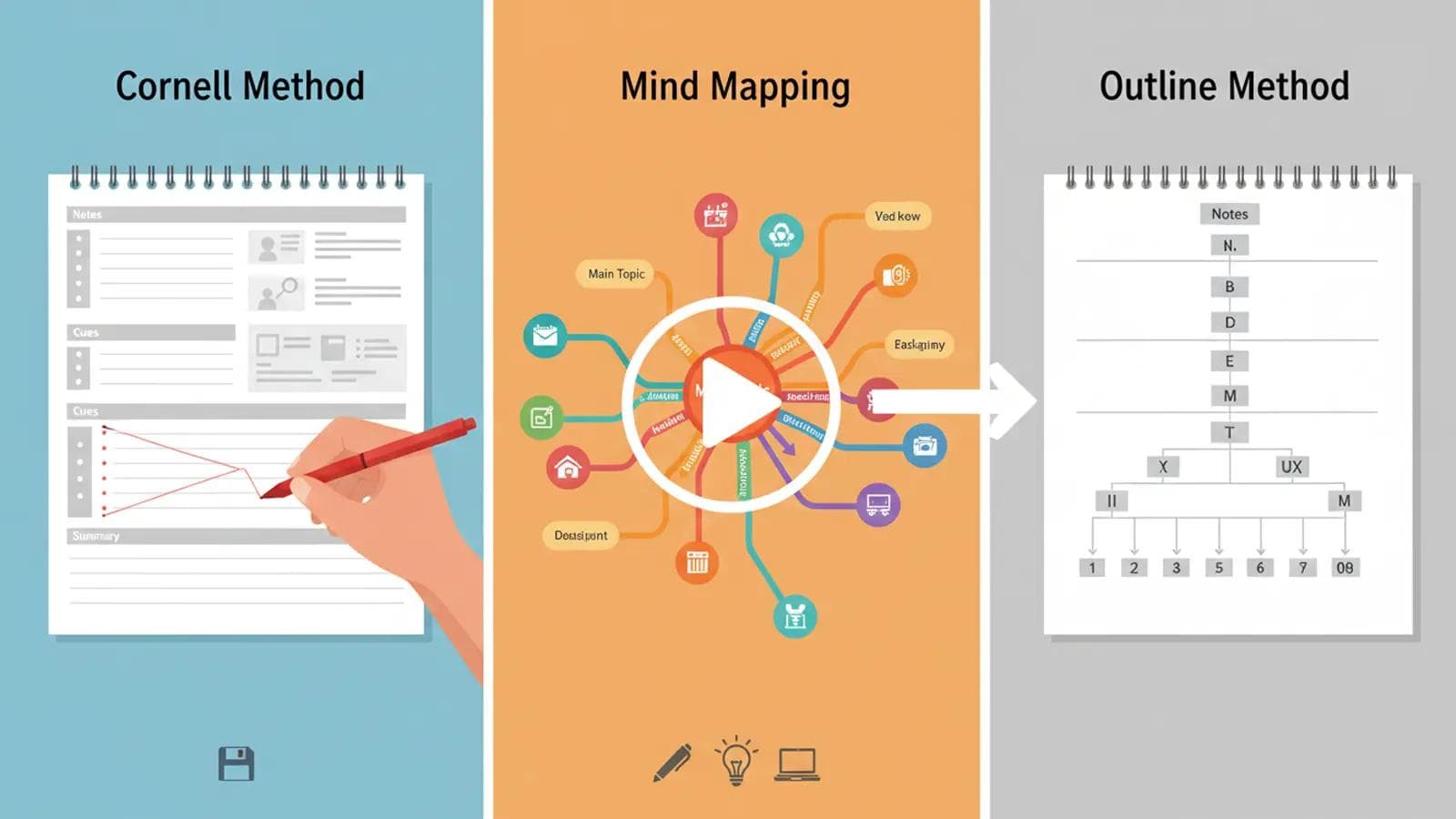
1. The Cornell Method: Best for Structured Learning and Review
The Cornell Method is a powerhouse of a system developed at Cornell University. It's designed not just for capturing information, but for actively reviewing and quizzing yourself on it later.
How It Works: A Step-by-Step Guide
- Prepare Your Page: Before class, divide your page into three distinct sections. Draw a horizontal line about two inches from the bottom. Then, draw a vertical line about 2.5 inches from the left edge, running from the top of the page down to the horizontal line you just drew.
- The Main Notes Column (Right): This is the largest section. During the lecture, take notes here. Don't write full sentences. Focus on shorthand, abbreviations, bullet points, and key ideas. Leave space between points to add more later.
- The Cue Column (Left): Within 24 hours of the lecture, review your main notes. In the narrow left-hand column, pull out main ideas, key terms, or potential test questions. These cues should correspond to the detailed notes on the right.
- The Summary Section (Bottom): At the end of your note-taking session (or as part of your review), write a one or two-sentence summary of the entire page in this bottom section. This forces you to synthesize the material at a high level.
Pros:
- Active Recall is Built-In: The cue column is a self-testing tool. Cover the right side and try to answer the questions or define the terms on the left.
- Forces Synthesis: The summary section ensures you understand the main point of the lecture.
- Organized and Systematic: The structure makes your notes easy to navigate and review.
Cons:
- Requires Setup and Discipline: You have to prepare your pages and commit to the review process for it to work.
- Can Be Rigid: Less suitable for brainstorming or highly conceptual, non-linear topics.
Best For: Students in lecture-heavy courses like history, psychology, or biology; anyone preparing for exams that require memorization of key facts and concepts.
2. The Outline Method: Best for Simplicity and Speed
This is one of the most common and intuitive note taking strategies. The Outline Method uses hierarchy to organize information, with main topics, sub-topics, and supporting details indented accordingly.
How It Works: A Step-by-Step Guide
- Start with a Main Topic: At the top left of your page, write the first major topic (e.g., "Causes of World War I").
- Indent for Sub-Topics: Underneath the main topic, indent slightly and list a key sub-topic. Use a different bullet style (e.g., letters or numbers). For example, "A. Alliances."
- Indent Further for Details: Indent again to add specific details, examples, or evidence related to the sub-topic. For example, "1. Triple Entente (France, Britain, Russia)."
- Repeat: Continue this structure throughout the lecture, moving back to the left margin whenever a new main topic is introduced.
Pros:
- Highlights Logical Relationships: The structure clearly shows the relationship between main ideas and supporting details.
- Easy to Skim: The organized format makes it simple to find information during review.
- Fast and Intuitive: Requires minimal setup and is easy to do on the fly, both on paper and digitally.
Cons:
- Less Effective for Disorganized Lectures: If a speaker jumps between topics, your outline can become messy and confusing.
- Can Encourage Passive Note Taking: It's easy to fall into the trap of just transcribing without deeply processing the information.
Best For: Organized lectures that follow a clear structure; creating study guides from textbooks; planning essays or reports.
3. Mind Mapping: Best for Visual Learners and Brainstorming
Mind Mapping is a highly visual note taking strategy that breaks away from the linear, top-to-bottom format. It's perfect for connecting ideas and seeing the big picture.
How It Works: A Step-by-Step Guide
- Central Idea: Start with the main concept or topic in the center of a blank page (preferably held horizontally) and circle it.
- Branch Out with Main Themes: Draw thick branches radiating out from the central idea. Each branch represents a major sub-topic. Label each branch with a single keyword or short phrase.
- Add Smaller Branches for Details: From your main branches, draw smaller, thinner branches (twigs) for supporting details, examples, or related concepts.
- Use Color and Images: Assign different colors to different main branches to visually separate themes. Use simple drawings or symbols to make concepts more memorable. This is a key part of the process.
Pros:
- Engages Creativity: The visual, non-linear format can spark new connections and ideas.
- Excellent for Big-Picture Thinking: Helps you see how different concepts relate to each other.
- Highly Memorable: The combination of keywords, colors, and images aids in recall.
Cons:
- Can Get Messy: Without careful planning, a mind map can become a chaotic sprawl of information.
- Takes Up a Lot of Space: Not ideal for capturing large quantities of dense, factual information.
Best For: Brainstorming sessions; exploring complex, interconnected topics like marketing strategy or literary themes; visual learners who find linear notes restrictive. For digital tools, check out our guide to the best-mind-mapping-software.
4. The Charting Method: Best for Comparing Facts and Data
When you need to organize information into distinct categories, the Charting Method is an incredibly efficient note taking system. It uses columns to break down facts, making it easy to compare and contrast information.
How It Works: A Step-by-Step Guide
- Identify Categories: Before the lecture begins, anticipate the main categories of information that will be covered. For example, in a history class comparing revolutions, your categories might be "Revolution," "Key Figures," "Causes," and "Outcomes."
- Create Columns: Draw a grid on your page, creating a column for each category you identified.
- Fill in the Chart: As the information is presented, fill in the relevant cells with concise notes. This forces you to categorize information as you hear it.
Pros:
- Excellent for Review: The structured format makes it incredibly easy to review and memorize large amounts of factual data.
- Forces Active Categorization: You have to decide where each piece of information belongs, which is a powerful learning activity.
- Reduces Note-Taking Time: You only write down the essential facts, cutting out filler words.
Cons:
- Requires Pre-Planning: You need to know the categories ahead of time, making it difficult for unpredictable lectures.
- Not Suitable for All Subjects: Works poorly for subjects that are less structured or highly narrative.
Best For: Subjects that involve a lot of factual information that can be easily categorized, such as history, economics, or comparative literature.
5. The Sentence Method: Best for Fast-Paced Lectures
This is perhaps the most straightforward of all note taking strategies. The Sentence Method involves simply writing down each new thought, fact, or topic as a separate sentence. It's a brute-force method for when speed is the top priority.
How It Works: A Step-by-Step Guide
- Number Each Point: Start with the number 1 and write down the first piece of information you hear as a complete sentence or a concise phrase.
- New Point, New Line: When the speaker moves to a new point, move to a new line and write the next number.
- Keep Going: Continue this process for the entire lecture. Don't worry about organizing by topic initially; just focus on capturing the information.
Pros:
- Extremely Fast: You can capture a large volume of information without worrying about formatting.
- Ensures You Don't Miss Details: Because you're not busy organizing, you can focus more on listening and transcribing key points.
Cons:
- Poor for Review: The notes are a wall of text with no clear hierarchy, making it difficult to identify major themes when studying.
- Requires Significant Reworking: To make these notes useful, you'll need to go back and reorganize them later using another method like the Outline or Cornell method.
Best For: Fast-paced, content-heavy lectures where it's impossible to organize on the fly. Use it as a capture method, with the intention of rewriting your notes later.
6. The Zettelkasten Method: Best for Building a "Second Brain"
Zettelkasten is less of a single-session note taking method and more of a long-term knowledge management system. It's an advanced note taking strategy for thinkers, writers, and researchers who want to connect ideas across different domains.
How It Works: A Step-by-Step Guide
- Create Atomic Notes: Each note should contain only one single idea, written in your own words. This is the core principle. Give it a unique ID.
- Link Your Notes: When you create a new note, think about how it connects to notes you've already created. Add links (or references, if using physical cards) to those related ideas.
- Add Metadata/Tags: Tag your notes with keywords to make them discoverable later.
- Create Index/Hub Notes: Periodically, create higher-level notes that link to and summarize a cluster of related atomic notes, forming a map of a topic.
Pros:
- Fosters Deep Connections: The system forces you to think about how ideas relate, leading to novel insights.
- Creates a Searchable Knowledge Base: Over time, you build a personal wiki that becomes more valuable the more you add to it.
- Combats Plagiarism: By forcing you to write everything in your own words, it ensures true understanding.
Cons:
- High Learning Curve: This is a complex system that requires significant commitment and discipline.
- Not for In-Class Note Taking: It's a system for processing and connecting ideas after they've been captured.
Best For: Researchers, writers, lifelong learners, and anyone looking to build a long-term, interconnected knowledge system. It's particularly powerful when used with digital tools like Obsidian or Roam Research. Learn more about how to build-a-personal-knowledge-management-system.
7. The Split-Page Method: A Simpler Cornell Alternative
If the Cornell Method feels too rigid, the Split-Page method offers a more flexible two-column approach. It's a great middle-ground between unstructured notes and a highly systematic format.
How It Works: A Step-by-Step Guide
- Draw a Line: Simply draw a vertical line down your page, creating two columns. A common split is 2/3 for the right column and 1/3 for the left.
- Main Ideas vs. Supporting Details: Use one column for main ideas and the other for supporting details, examples, or questions. There are two popular ways to do this:
- Method A: Main ideas on the left, details on the right.
- Method B: Take notes as you normally would on the right, and use the left column for questions, keywords, and comments (similar to Cornell's cue column).
Pros:
- Flexible and Simple: Easy to set up and adapt on the fly.
- Encourages Organization: The columns naturally encourage you to separate main concepts from secondary information.
Cons:
- Lacks a Built-in Summary: Unlike Cornell, it doesn't prompt you to synthesize the information at the end.
Best For: Anyone who finds the Outline Method too restrictive but wants more structure than a simple list of sentences.
Which Note Taking Strategy is Best? A Side-by-Side Comparison
Still not sure which method to choose? Here's a quick comparison based on common needs. Remember, the most effective students use a mix of these note taking methods.
- If you need SPEED in a fast lecture:
- Winner: The Sentence Method
- Runner-up: The Outline Method (if the lecture is well-structured)
- If your goal is REVIEW and EXAM PREP:
- Winner: The Cornell Method (its built-in self-quizzing is unmatched)
- Runner-up: The Charting Method (for fact-heavy subjects)
- If you are a VISUAL THINKER:
- Winner: Mind Mapping
- Runner-up: Using doodles and diagrams within any other method
- If you need to ORGANIZE COMPLEX, FACTUAL information:
- Winner: The Charting Method
- Runner-up: The Cornell Method
- If you want to BUILD LONG-TERM KNOWLEDGE:
- Winner: The Zettelkasten Method
- Runner-up: A well-organized digital system using the Outline Method
Digital vs. Analog: Which Tools Supercharge Your Note Taking System?
Choosing between a notebook and a laptop is a personal decision, but it can impact the effectiveness of your chosen note taking strategy.
Pen and Paper:
- Pros: Fewer distractions, better for memory (the physical act of writing aids retention), great for visual methods like Mind Mapping.
- Cons: Harder to edit and reorganize, not searchable, can be lost or damaged.
Digital Apps (e.g., Notion, Obsidian, Evernote):
- Pros: Infinitely editable, searchable, can include multimedia, easily synced across devices.
- Cons: High potential for distraction (social media is one click away), can lead to mindless typing.
Pro-Tip: Match your tool to your method. The Zettelkasten method thrives in apps like Obsidian. The Cornell Method works beautifully in a physical notebook or on a tablet with a stylus. The Outline Method is often fastest on a laptop.
Putting It All Together: Your Action Plan for Better Notes
Information is useless without action. Don't just read this article—implement it. Here’s a simple plan to find the note taking strategies that work for you.
- Assess Your Next Task: Before your next class or meeting, use the 3-Factor Framework. What's the subject? What's your goal? What's your learning style?
- Pick One Method and Commit: Choose the strategy that seems like the best fit and use it exclusively for one week. Don't switch mid-lecture. Give it a fair shot.
- Review and Adapt: At the end of the week, ask yourself: Did my notes help me understand the material better? Was I able to study from them effectively? If not, try another method from the list. The goal is to build a flexible toolkit, not find one magic bullet.
Mastering these note taking methods is a skill that pays dividends for a lifetime. It transforms you from a passive recipient of information into an active, engaged learner. Start today, and turn your messy notes into your most powerful study tool.
Frequently Asked Questions
There is no single 'most effective' strategy; the best one depends on the subject, your learning style, and your goal. The Cornell Method is highly effective for structured review and exam prep, while Mind Mapping is excellent for brainstorming and visual learners. The key is to choose a method that fits the context.
The 5 R's are a part of the Cornell Note-Taking System: 1. Record (take notes during the lecture), 2. Reduce/Question (summarize notes into cues or questions), 3. Recite (try to answer the questions from your cues), 4. Reflect (think about how the material fits into what you already know), and 5. Review (spend 10 minutes each week reviewing your notes).
To improve quickly, stop trying to write down everything. Focus on active listening to identify key concepts. Use abbreviations and symbols to increase your speed. Most importantly, review and rewrite your notes within 24 hours to solidify your understanding and organize the information.
Studies suggest that taking notes by hand can lead to better retention and comprehension because it forces you to process and summarize information rather than just transcribing it. However, digital notes offer better organization, searchability, and editing capabilities. The best method is often a hybrid approach, like using a tablet and stylus.
Written by Daily Motivation Team
Sharing motivational content to inspire your journey to success.
Related Articles
 Creativity
Artistic Inspiration: A Complete Guide
Artistic inspiration isn't luck — it's a trainable skill. Learn 7 daily practices that keep ideas flowing.
 stoic
stoicStoic Quotes on Discipline: Where Stoicism Meets Self-Mastery
Discover powerful stoic quotes on discipline from Marcus Aurelius, Seneca, and Epictetus — plus how to apply them today.
 stoic
stoicBest Stoic Quotes for Hard Times: Wisdom for Modern Struggles
Powerful Stoic quotes for hard times from Marcus Aurelius, Seneca & Epictetus — wisdom that turns adversity into strength.
 stoic
stoicBest Stoic Quotes for Beginners: Where to Start Your Practice
Discover the best stoic quotes for beginners and a simple 7-day plan to turn ancient wisdom into daily practice.