
Startup Funding Options: Bootstrapping vs Venture Capital Explained
Choosing between Bootstrapping vs Venture Capital? We explore these startup funding options to help you decide how to raise capital for your startup.
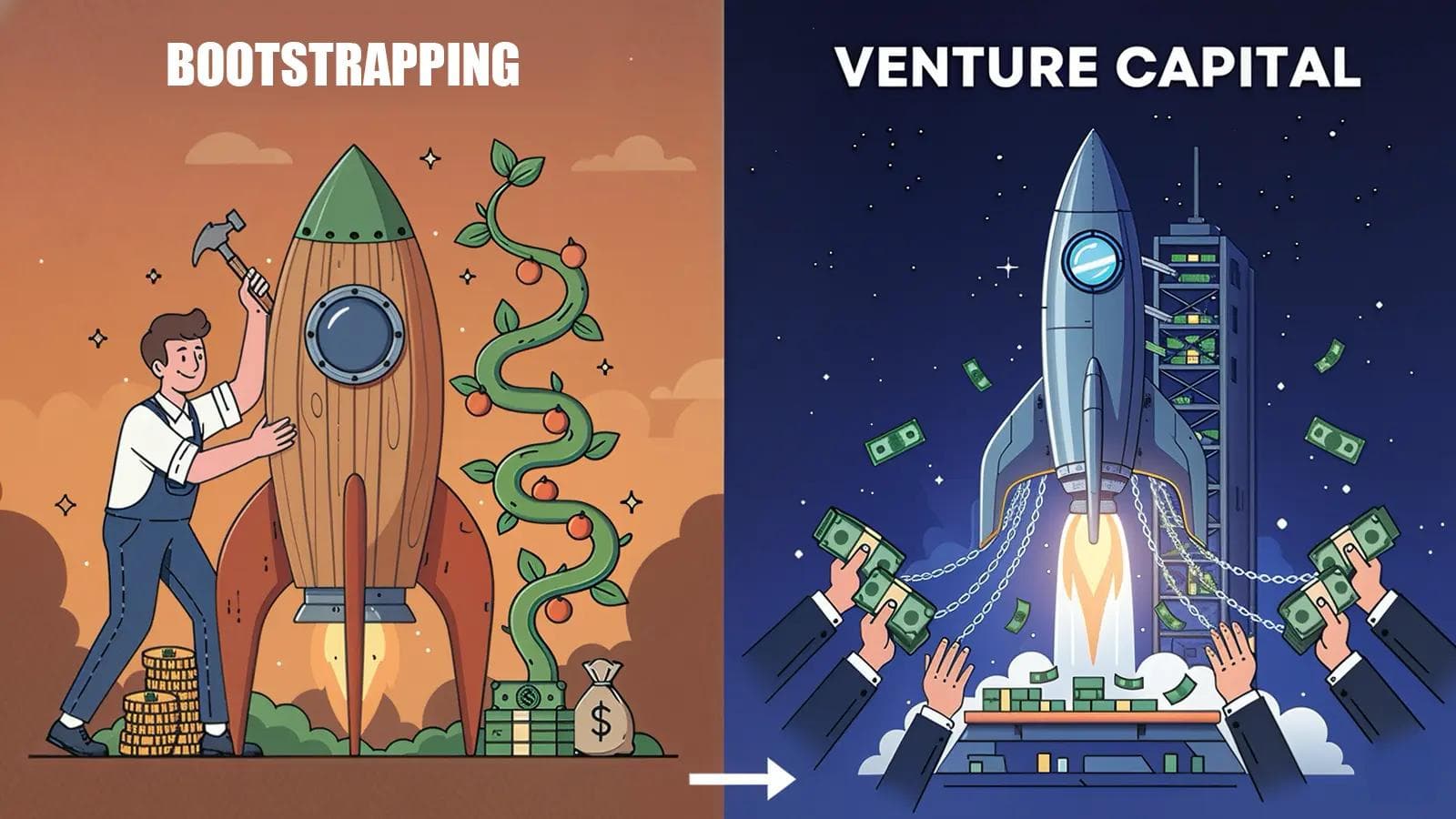
Introduction: You have a brilliant idea for a startup. But to make it real, you need one thing: capital. The path you choose to fund your business will define its entire future, your level of control, and your ultimate outcome.
The two main paths are polar opposites: Bootstrapping (using your own money) and Venture Capital (using other people's money). This is not just a financial decision; it's a philosophical one.
The 'Bootstrapping' Path (The 'Owner' Mindset)
Bootstrapping means building your company from the ground up with nothing but your own savings and the revenue from your first customers.
Pros:
- You Keep 100% Control: This is the #1 reason. You are your own boss. You have no investors to report to, no board of directors to please. You can build the company you want to build, not the one an investor thinks you should build.
- Forced 'Discipline': When every dollar is your own, you don't waste it. You're forced to build a real business model and get to profitability from Day 1. You can't burn cash on fancy offices or speculative marketing.
- You Can Build *Any* Good Business: You can build a "lifestyle" business that makes you $500,000 a year, and that's a massive success.
- No "Exit" Pressure: You can own your profitable company for 30 years and pass it on to your kids.
Cons:
- Growth is *Slow*: You can only grow as fast as your profits allow. You might miss a market opportunity because a VC-funded competitor can spend $10 million on marketing while you're saving up $1,000.
- High Personal Risk: It's your money. You might max out your credit cards or re-mortgage your house. The personal financial stress is immense.
- Lack of Network: VC money comes with a powerful network of experts, partners, and potential hires. Bootstrappers are on their own.
Who is this for? Founders who value control, want to build a long-term, profitable business, and are not trying to "blitzscale" and take over the world in 2 years. (Examples: Mailchimp, Basecamp).
The 'Venture Capital' Path (The 'All-or-Nothing' Mindset)
Venture Capital (VC) is when you take money from professional investors (Venture Capital firms) in exchange for equity (a percentage of your company).
Pros:
- Speed and Scale (Rocket Fuel): You can raise $5 Million and immediately hire the 10 best engineers, spend $1 Million on marketing, and capture the entire market before anyone else.
- The Network and 'Validation': Getting money from a top-tier VC firm (like Sequoia or Andreessen Horowitz) is a huge stamp of approval. It opens doors to partnerships, press, and top talent.
- Expert Advice: You are literally paying for (with equity) a "board" of smart, experienced people whose only job is to help you grow.
Cons:
- You *Lose* Control: You are no longer your own boss. You now have a board of directors you are accountable to. You've given up a piece of your company, and with it, a piece of your decision-making power.
- The 'Growth-at-all-Costs' Mandate: VCs don't want a "good" $500k/year business. Their business model requires you to become a $1 Billion company. They will push you to grow as fast as possible, even if it means burning millions of dollars and never being profitable.
- Extreme 'Exit' Pressure: The VC must get their money back (usually 10x). This means you must sell the company or "go public" (IPO) in 5-10 years. Your 30-year family business plan is not an option.
Who is this for? Founders who are in a huge, "winner-take-all" market, need massive capital to build their product (e.g., a new microchip), and are willing to trade control for the chance to build a billion-dollar company. (Examples: Uber, Airbnb, Google).
Conclusion: Are You Building a 'Business' or a 'Startup'?
This is the real question.
- If you want to build a profitable business that gives you freedom and wealth over the long term, Bootstrap.
- If you want to build a fast-growing startup that has a small chance of changing the world (and a large chance of failing), and you're willing to give up control for that chance, take VC money.
Neither path is "better." They are just different games with different rules. Choose your game wisely.
Frequently Asked Questions
Yes! This is often the best possible scenario. By bootstrapping to your "First 100 Customers" or to "Profitability," you prove your model works. When you go to VCs, you are no longer selling a "dream"; you're selling "traction." This gives you all the leverage to get a much better valuation (i.e., you give away less of your company).
Angel Investors are wealthy individuals (not firms) who invest their own money. They are often a good "middle ground" between bootstrapping and VCs. They write smaller checks ($25k - $100k) and are often more patient and 'founder-friendly' than VCs.
Written by Daily Motivation Team
Sharing motivational content to inspire your journey to success.
Related Articles
 stoic
stoicStoic Wallpaper Collection: Marcus Aurelius Themed Phone Backgrounds
Turn your phone into a daily Stoic practice with Marcus Aurelius wallpapers designed to remind you of what actually matters.
 manifestation
O Method Manifestation: A Complete Guide
Learn how the O Method manifestation works, why it's so effective, and exactly how to practice it for real results.
 stoic
stoicEpictetus Top 30 Quotes: The Discourses Made Accessible
Discover the top 30 Epictetus quotes from the Discourses and Enchiridion — timeless Stoic wisdom made simple and actionable.
 stoic
stoicModern Stoicism: How to Apply Ancient Wisdom in 2026
Discover how modern stoicism turns 2,000-year-old wisdom into a practical toolkit for calm, focus, and resilience in 2026.