
Cornell Note Taking Method: The Ultimate Guide (2026)
Stop passively transcribing. Learn the Cornell note-taking method to organize thoughts, engage active listening, and create effective study notes that stick.
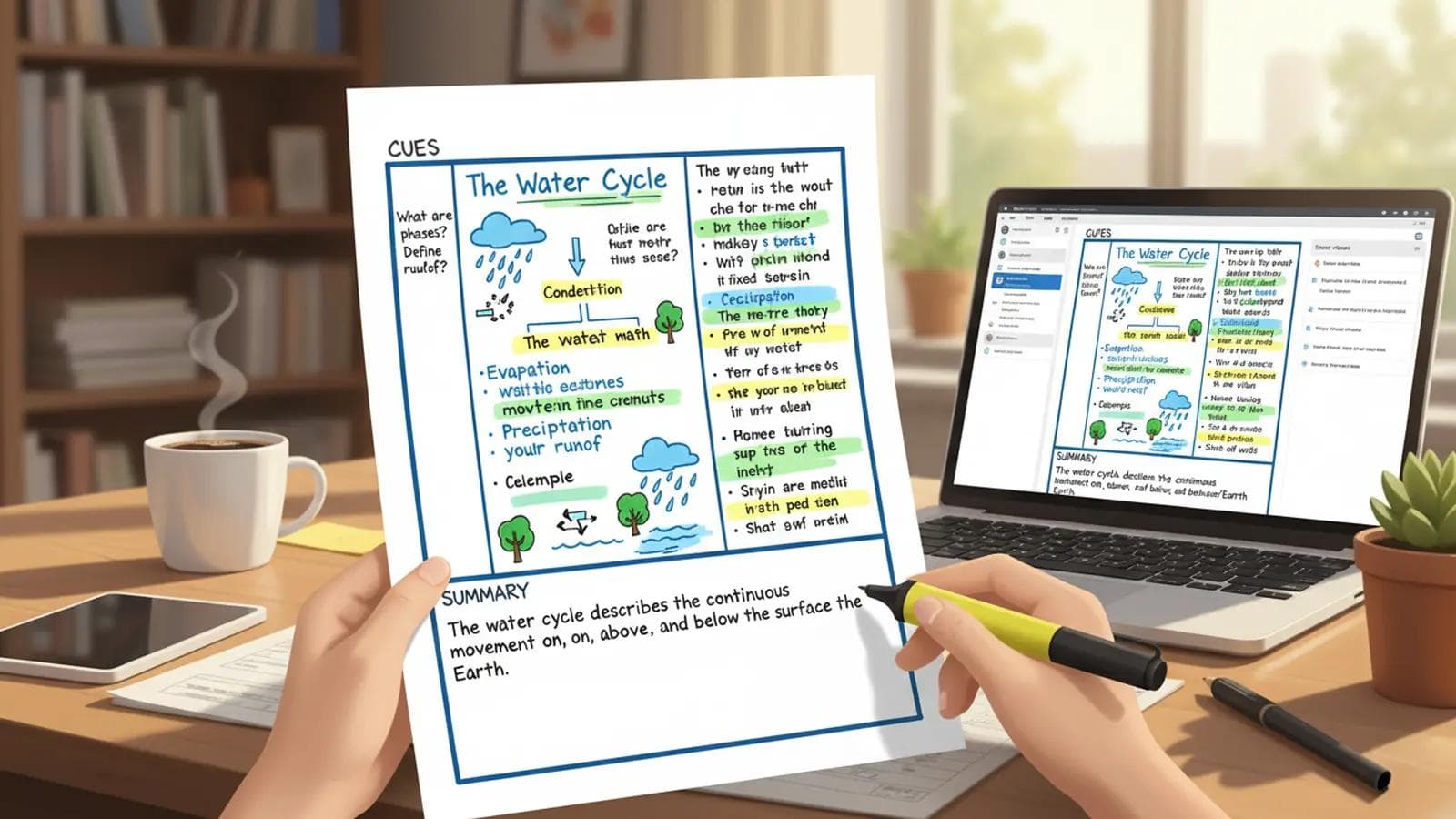
Introduction: We've all been there. You're in a lecture, typing furiously, trying to capture every single word the professor says. Your hand is cramping, your laptop is hot, and you're so focused on transcribing that you're not actually listening or understanding the material.
Then, weeks later, you open your notes to study. What you find is a 10-page wall of text that is dense, disorganized, and completely overwhelming. This is "passive note-taking," and it's one of the least effective ways to learn.
Your notes shouldn't be a court transcript; they should be a tool for thinking. The Cornell Note-Taking System is a simple, powerful method developed at Cornell University that transforms your note-taking from a passive "stenography" task into an active learning process.
What is the Cornell Note-Taking System?
The system is brilliant in its simplicity. It forces you to organize and process your notes in real-time. All you need is a single piece of paper, divided into three distinct sections.
- Divide Your Page:
- Draw a thick horizontal line about 2 inches (5 cm) from the bottom of the page. This is your 'Summary' section.
- Draw a thick vertical line about 2.5 inches (6 cm) from the left edge, starting from the top and ending at the 'Summary' line.
- You now have 3 sections:
- The 'Notes' Column (Right): This is your main, large column. This is where you'll take notes during the lecture.
- The 'Cue' Column (Left): This is the narrow column. It stays blank during the lecture.
- The 'Summary' Section (Bottom): This also stays blank during the lecture.
How to Use the Cornell Method: A 3-Phase Process
This system is about more than just how you format the page. It's a three-phase process for engaging with the material.
Phase 1: 'Record' (During the Lecture)
You'll work only in the large, right-hand 'Notes' Column.
- Don't Transcribe: Listen for main ideas, not every single word.
- Be Efficient: Use short sentences, abbreviations, and bullet points.
- Paraphrase: Try to write the concept in your own words as much as possible. This is the first step of active processing.
- Leave Space: When the professor moves to a new topic, skip a few lines. This 'chunking' helps you visually organize the ideas.
- The 'Cue' and 'Summary' sections remain EMPTY. Your only job is to capture the core ideas of the lecture.
Phase 2: 'Reduce' (Immediately After the Lecture)
This is the most critical phase, and it should be done within 24 hours (while the lecture is still fresh).
- Work in the 'Cue' Column (Left): Look at the notes you took in the right column. For each main idea or "chunk," write a 'cue' in the left column.
- 'Cues' are like study prompts. They can be:
- Key Questions: "What are the 3 causes of X?"
- Keywords: "Photosynthesis."
- Main Ideas: "Difference between Active/Passive."
- This act forces you to review your notes, identify the main points, and think about what questions those notes answer. You are creating a "self-quiz" for later.
Phase 3: 'Recite' & 'Summarize' (When You Study)
Now your notes are a powerful study tool.
- Recite (The 'Cover-Up' Method):
- Cover the right-hand 'Notes' column with a book or another sheet of paper.
- Look only at your 'Cue' column.
- Try to answer the questions or define the keywords out loud or in your head.
- Uncover the notes to check your answer.
- This is Active Recall in its purest form. You're not just re-reading; you're forcing your brain to retrieve the information.
- Summarize (At the Bottom):
- After you've reviewed the entire page, use the 'Summary' Section at the bottom.
- In 1-2 sentences, write a high-level summary of the entire page.
- This forces you to synthesize all the concepts and see the "big picture."
- This section is incredibly valuable for quick reviews before an exam.
Why This Method is So Effective
- It's an 'Active' Process: From paraphrasing during the lecture to writing 'cues' after, it forces you to engage with the material at every step.
- It Fights the 'Illusion of Fluency': Re-reading your notes feels productive, but it's not. The 'Recite' phase proves what you actually know versus what you just recognize.
- It's Organized: It automatically organizes your notes into main ideas (Cues), details (Notes), and high-level concepts (Summary).
- It's a Built-In Study Guide: You don't have to create a study guide before the exam, because you've already created one with every page of notes you've taken.
Conclusion: Stop 'Taking' Notes, Start 'Making' Notes
The Cornell System is a small shift in habit that pays massive dividends. It may feel slower or more effortful at first, but that's the point. That "desirable difficulty" is the feeling of real learning happening.
Stop being a passive transcriber and start being an active, engaged learner. Your notes are the single most powerful study tool you have—if you create them with purpose.
Frequently Asked Questions
Yes, absolutely. On a laptop, you can use a simple table in Microsoft Word or Google Docs (2 columns, with a merged 'footer' row for the summary). On a tablet, apps like GoodNotes, Notability, or OneNote are perfect for this - you can use a stylus to write and easily create the template.
This is a common problem. Prioritize capturing the 'cues' or main ideas - you can leave a space and fill in the details later from the textbook or a friend's notes. If you're comfortable, ask the professor to slow down or repeat a key point (other students will thank you). Also, develop your own shorthand using abbreviations (e.g., 'w/' for 'with', 'b/c' for 'because').
The best time is right after you've done the 'Reduce' (Cue) phase, so, within 24 hours of the lecture. This solidifies the "big picture" of that day's lesson. You can also use it as a 'warm-up' at the start of your next study session, to review what you did last time.
Written by Daily Motivation Team
Sharing motivational content to inspire your journey to success.
Related Articles
 Creativity
Artistic Inspiration: A Complete Guide
Artistic inspiration isn't luck — it's a trainable skill. Learn 7 daily practices that keep ideas flowing.
 stoic
stoicStoic Quotes on Discipline: Where Stoicism Meets Self-Mastery
Discover powerful stoic quotes on discipline from Marcus Aurelius, Seneca, and Epictetus — plus how to apply them today.
 stoic
stoicBest Stoic Quotes for Hard Times: Wisdom for Modern Struggles
Powerful Stoic quotes for hard times from Marcus Aurelius, Seneca & Epictetus — wisdom that turns adversity into strength.
 stoic
stoicBest Stoic Quotes for Beginners: Where to Start Your Practice
Discover the best stoic quotes for beginners and a simple 7-day plan to turn ancient wisdom into daily practice.