
The Eisenhower Matrix Method: How a President Prioritized His Time
The full Eisenhower Matrix method — the history behind the urgent vs important framework, the four quadrants explained with examples, when it works, when it doesn't, and how it compares to other time-management systems.
Introduction: We live in a culture of "busyness." Our to-do lists are endless, our inboxes overflow, and we rush from one fire to the next. At the end of the day we feel *exhausted*, but we also feel a nagging sense of dissatisfaction. We were *busy*. Were we *productive*?
Probably not. We're "urgency-addicted" — trapped in a cycle of reacting to whatever is loudest. The man who solved this problem first, decades before Slack and email and infinite scroll, was the same man who planned the largest amphibious invasion in history and then served two terms as President of the United States.
This is the full guide to the Eisenhower Matrix — the urgent vs important framework that earned that name. We cover Eisenhower's actual story, the four quadrants in detail with real examples, how Stephen Covey turned it into a global productivity standard, when the matrix doesn't work, and how it compares to other time-management frameworks. By the end you'll know not just *what* the matrix is, but exactly when to use it — and when to reach for something else.
If you'd rather sort tasks interactively, the [free Eisenhower Matrix tool](/tools/eisenhower-matrix) does the four-quadrant grid for you with drag-and-drop and PDF export.
Who Was Eisenhower? (And Why His Productivity System Survived)
Dwight D. Eisenhower's job stack is hard to overstate. He was a 5-star general. He was Supreme Commander of Allied Forces in Europe during World War II, the man who planned D-Day. After the war he became Supreme Commander of NATO. Then he was President of Columbia University. Then, in 1953, he was elected the 34th President of the United States and re-elected in 1956. He died in 1969 having held more demanding leadership roles than almost anyone in modern American history.
What's strange is that contemporaries rarely described him as rushed, stressed, or burned out. People who worked closely with Eisenhower noted his unusual calm under pressure — a near-total absence of reactive panic. He delegated relentlessly. He protected his time aggressively. He read for an hour every morning. He played golf almost every week, even during global crises.
In 1954, during a speech at Northwestern University, Eisenhower quoted an unnamed former college president:
> "I have two kinds of problems: the urgent and the important. The urgent are not important, and the important are never urgent."
Eisenhower didn't invent the *matrix* — that came later — but he gave the principle its name, and his life was its strongest argument. The man who could have justified spending every minute on "urgent" things instead spent enormous time on things that were "merely" important. That's the productivity philosophy buried inside the four quadrants you're about to learn.
The 4 Quadrants of the Eisenhower Matrix
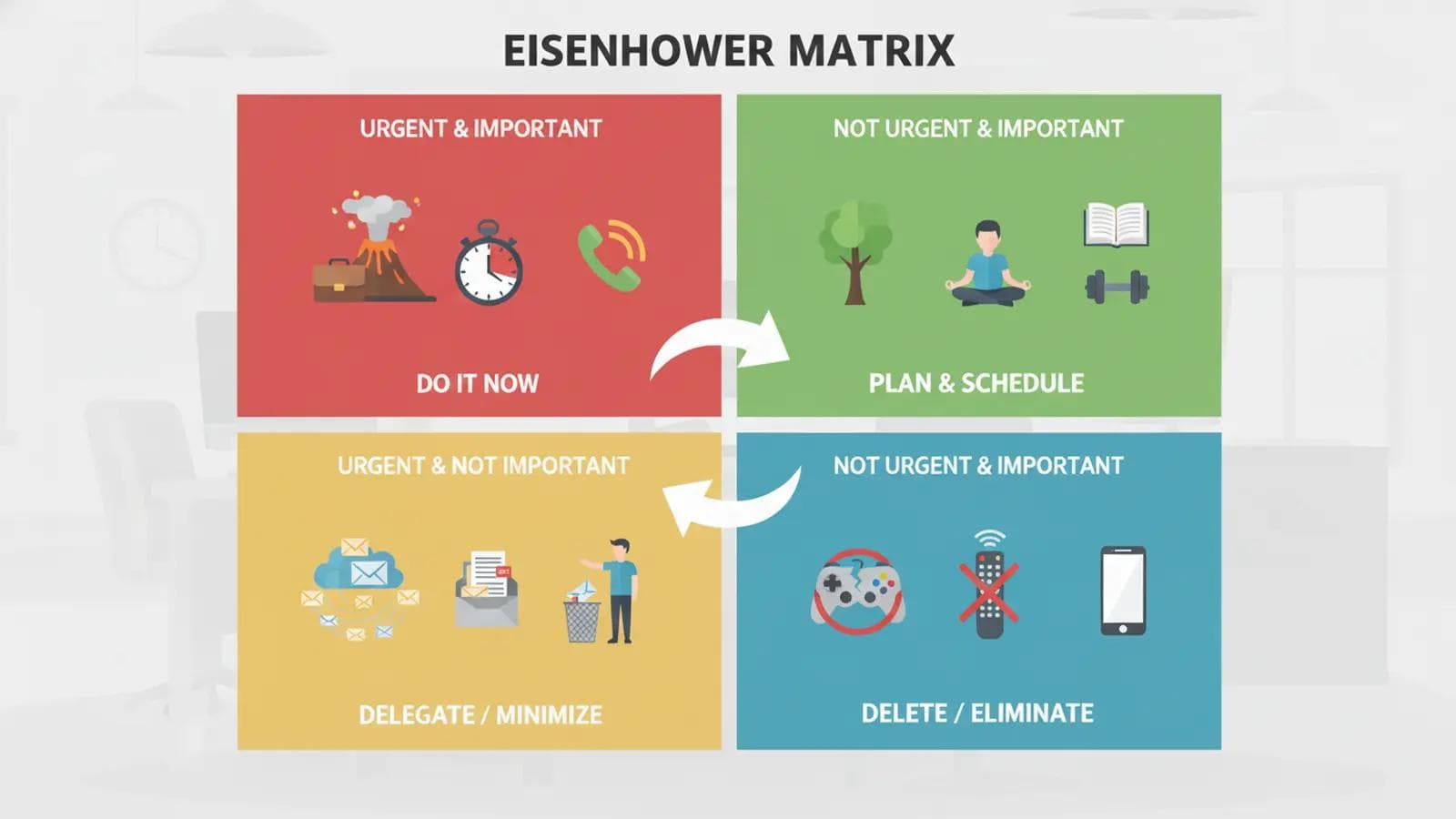
To use the matrix, take every task on your list and place it into one of these four boxes — based on two questions: *Is this urgent?* and *Is this important?*
Quadrant 1: Urgent & Important (DO)
- What it is: Fires and crises. High consequences, immediate deadlines.
- Examples: A real client emergency, a hard deadline tomorrow morning, a production bug breaking the live product, a genuine health emergency, an exam in 48 hours.
- The Action: DO IT NOW. These are non-negotiable.
- The trap: Most people overpopulate Q1. The honest test is "if I skip this, does *today* change?" If the answer is no, it isn't really Q1 — it's Q3 in disguise.
Quadrant 2: Not Urgent & Important (PLAN)
- What it is: The "magic quadrant." Your *goals*. High consequences, no immediate deadline.
- Examples: Strategic planning for the quarter, weekly workouts, sleep, deep work on your most important project, building relationships, learning a new skill, financial planning, preventive medical care.
- The Action: SCHEDULE IT. You have to put Q2 work on the calendar before anything else, or Q1 and Q3 will eat the slot. This is where compounded success comes from.
- The catch: Because Q2 has no deadline, it's the easiest quadrant to skip. Stephen Covey called Q2 "the quadrant of effective people" because almost everyone *knows* what their Q2 work is — and almost nobody does it consistently.
Quadrant 3: Urgent & Not Important (DELEGATE)
- What it is: Interruptions disguised as priorities. They *feel* urgent because they're loud (a Slack ping, a meeting request, a coworker's deadline) but they don't move *your* goals.
- Examples: Most Slack messages, FYI emails, ad-hoc "quick question" meetings, scheduling, expense reports, helping a coworker with their task instead of yours.
- The Action: DELEGATE, AUTOMATE, OR BATCH. If you can't hand it off, batch it. Don't check email 40 times a day — process it in two 30-minute blocks. That single change "delegates" 36 future interruptions to your future self.
- The trap: Q3 is where most knowledge workers live full-time. The whole job becomes responding to other people's urgency. The output is exhaustion and the illusion of being productive.
Quadrant 4: Not Urgent & Not Important (DELETE)
- What it is: Time-wasters and escapes. No consequences, no deadline.
- Examples: Doomscrolling, autoplay videos, agendaless "let's sync" meetings, reading industry news that doesn't change your behavior, tweaking your productivity stack instead of doing the work.
- The Action: DELETE. Be ruthless. This is the junk food of your time.
- The catch: Don't confuse Q4 with rest. *Intentional* rest — a planned walk, one episode of a show you love, dinner with a friend — is Q2. *Mindless* escape is Q4. The difference isn't the activity; it's the intention.
Stephen Covey: How the Matrix Became Famous
Eisenhower gave the world the urgent-vs-important *principle*, but it was Stephen Covey who turned it into the 2×2 matrix we use today. Covey's 1989 book *The 7 Habits of Highly Effective People* introduced what he called the Time Management Matrix as part of Habit 3: "Put First Things First."
Covey's contribution wasn't just the visual — it was the argument that Quadrant 2 is the *only* leverage point. His logic: you can't shrink Q1 by being smarter, because real crises happen on their own schedule. You can't ignore Q3, because other people will keep generating interruptions. And Q4 isn't where the leverage is. The only quadrant whose size *you control* is Q2. Spend more time there, and the size of Q1 shrinks automatically because you've prevented future fires.
Covey also introduced the "Big Rocks" metaphor that's now everywhere. Imagine an empty jar. If you fill it with sand first (Q3/Q4), the big rocks (Q2) don't fit. If you put the big rocks in first, the sand fills in around them. Schedule your Q2 work first, every week, before anything else gets on the calendar. The rest of life will still squeeze in around it.
Why We Fail: The Urgency Trap
Most people live in Quadrants 1 and 3. They're in a constant state of *reaction* — either fighting real Q1 fires or getting pulled into Q3 noise. They never reach Q2, and over time their Q2 work (their health, their relationships, their long-term skill development, their financial future) atrophies invisibly.
The goal is not to eliminate Q1. Crises will always happen. The goal is to *live* in Q2 — to spend so much time on planning, prevention, and deep work that fewer Q1 crises happen in the first place. Eisenhower himself didn't have *fewer* problems than other generals. He had a system that prevented many of them from ever becoming urgent.
The urgency trap has gotten worse since 1989. Modern work — Slack, async messaging, notifications, calendar inflation — is essentially a Q3 generator running 24/7. The matrix is more useful now than when Covey wrote about it, not less.
When the Eisenhower Matrix Doesn't Work
Honest disclaimer: the matrix is a great default, but it has three specific failure modes. If you've tried it and it didn't stick, one of these is probably why.
1. Creative or exploratory work. Early-stage research, writing a first draft, or exploring a new business idea is bad at fitting the matrix because *you don't yet know* what's important. Everything looks Q2 or Q4 depending on the day, and you're often wrong. For early creative work, time-boxing (just protect the time) tends to beat prioritization (deciding what's important).
2. Crisis-driven jobs. ER doctors, on-call engineers, fund managers in a downturn — for some roles, everything genuinely is Q1 for stretches of weeks or months. Trying to apply the matrix during a crisis season usually adds anxiety. Better to use it to plan the *recovery* week afterward, when you can actually invest in Q2 again.
3. ADHD and executive-function load. For some people with ADHD, all tasks feel equally urgent — the matrix becomes another task to do, which adds to the cognitive load instead of reducing it. If this is you, simpler systems work better: a single "top 1 thing" for today, body-doubling, or external structure (a coach, accountability partner, calendar app that just schedules things for you). The matrix can still help, but only when externalized — written down on a wall, or used inside an [interactive tool](/tools/eisenhower-matrix) where the structure does the work.
Eisenhower Matrix vs Other Frameworks
The matrix is one tool; it's not the only one. A short comparison:
Eisenhower Matrix vs Pareto Principle (80/20). The 80/20 rule says 20% of your tasks produce 80% of the results. It's a *strategic* filter — useful for picking *which* tasks deserve focus over a quarter or year. The Eisenhower Matrix is a *tactical* filter — it sorts that already-filtered list by urgency so you know what to do *today*. Use Pareto to pick the right tasks; use Eisenhower to schedule them.
Eisenhower Matrix vs Ivy Lee Method. The Ivy Lee Method (1918) is simpler: each evening, write down the 6 most important things to do tomorrow, in priority order. Do them in order. Don't move on until each is done. It's brutally minimal and great for people who get paralyzed by the matrix's four quadrants. The Eisenhower Matrix gives you better long-range visibility; the Ivy Lee Method gives you better daily execution.
Eisenhower Matrix vs ABC Prioritization. ABC ranks every task A (must do), B (should do), C (nice to do). It's a one-dimensional sort. The Eisenhower Matrix is two-dimensional (urgency + importance), which is more accurate but more work. ABC is faster for small daily lists; Eisenhower is better for weeks where you have to make hard tradeoffs.
The honest answer is most experienced operators use all of these at different times. The matrix's main advantage is the visual: seeing tasks in four boxes makes Q3 noise instantly obvious in a way a list doesn't.
How to Use the Matrix (A 5-Minute Daily Plan)
1. At the end of your day, take 5 minutes.
2. Write down everything on your plate for tomorrow — work, personal, errands. Brain-dump first, sort second.
3. Draw the 4-quadrant grid (or open the [interactive matrix tool](/tools/eisenhower-matrix)).
4. Drop every task into one of the 4 boxes using the "does today change?" and "does this year change?" tests.
5. Critically: schedule a specific time for your 1-2 most important Q2 tasks. Put them on your calendar *first*, before Q1 and Q3 grab the slots.
6. Tomorrow, work the map. At week's end, do a 10-minute review — what shifted, what got misclassified, what to refile.
Try the Interactive Matrix
If you want to skip the paper version, our [free Eisenhower Matrix tool](/tools/eisenhower-matrix) does the four-quadrant grid for you. Add tasks, drag them between quadrants, download the result as a PDF. No signup, no data leaving your browser. The fastest way to test whether the matrix works for *your* week is to actually run it on this week's task list.
Conclusion: Stop Being "Busy," Start Being "Intentional"
Busyness is a form of laziness — it's *passive* reaction to whatever is loudest. Productivity is a form of discipline — it's *active* planning of what deserves your attention. The Eisenhower Matrix is, in the end, just a tool to keep that distinction sharp.
You don't need to be a five-star general to use it. You just need to be honest about which of your "urgent" tasks are actually important — and brave enough to spend more time on the things that aren't loud yet.
Frequently Asked Questions
Dwight D. Eisenhower gave the underlying principle its name when he quoted an unnamed college president in a 1954 speech at Northwestern University. The 2×2 matrix as a visual tool came from Stephen Covey's 1989 book The 7 Habits of Highly Effective People. So it's accurate to say Eisenhower inspired the principle and Covey created the matrix.
Yes — they're two names for the same tool. "Urgent-Important Matrix" describes what it does; "Eisenhower Matrix" describes who inspired it. You'll also see it called the Time Management Matrix (Covey's term), the Priority Matrix, or the Eisenhower Box. All identical.
The Pareto Principle is a strategic filter — it identifies the 20% of tasks that drive 80% of results, over a long time horizon. The Eisenhower Matrix is a tactical filter — it sorts your tasks by urgency so you know what to do today. Pareto picks the right tasks; Eisenhower picks the right time for them. Most people benefit from running both: Pareto monthly, Eisenhower daily.
It can, but only when externalized. For ADHD brains, all tasks often feel equally urgent — a 2×2 matrix done in your head adds load rather than reducing it. Written down on paper, or used inside an [interactive tool](/tools/eisenhower-matrix), the visual structure does the executive-function work for you. Pair the matrix with a calendar-blocking system for best results.
Quadrant 2 (Important, Not Urgent) is where prevention, planning, learning, exercise, deep work, and long-term relationships live. Because it isn't urgent, it's the easiest to skip. But because it's important, skipping it always compounds. Spending more time in Q2 is what shrinks tomorrow's Q1 — Stephen Covey called Q2 the quadrant of effective people for exactly this reason.
Delegation isn't only handing tasks to another person. It can mean: automate (let software do it), say "no" politely ("I can't help with that right now, but I can next week"), or batch (don't process email 40 times a day — handle it in two 30-minute blocks). Batching one task into a block effectively delegates 39 future interruptions to your future self.
Rest is important — but planned rest is Q2, not Q4. The difference isn't the activity; it's the intention. "I'm going to watch one episode of my favorite show to unwind" is Q2. "I'm just going to scroll TikTok for a minute" and then losing two hours is Q4. Plan your rest the same way you plan your work.
Written by Daily Motivation Team
Sharing motivational content to inspire your journey to success.
Related Articles
 stoic
stoicBest Stoic Quotes for Hard Times: Wisdom for Modern Struggles
Powerful Stoic quotes for hard times from Marcus Aurelius, Seneca & Epictetus — wisdom that turns adversity into strength.
 stoic
stoicBest Stoic Quotes for Beginners: Where to Start Your Practice
Discover the best stoic quotes for beginners and a simple 7-day plan to turn ancient wisdom into daily practice.
 manifestation
3 6 9 Method: A Complete Guide
Learn how the 3 6 9 method rewires your focus and turns daily journaling into a powerful manifestation ritual.
 stoic
stoicMarcus Aurelius Meditations: Top 30 Quotes Decoded
Decode the top 30 Marcus Aurelius Meditations quotes with modern translations and practical ways to apply Stoic wisdom today.