
Lock In Quotes: 50 Focus & Discipline Mantras That Actually Work
50 lock-in quotes on focus and discipline, what "lock in" means in Gen-Z slang, why it went viral, and how to use it to study, train, and ship work better.
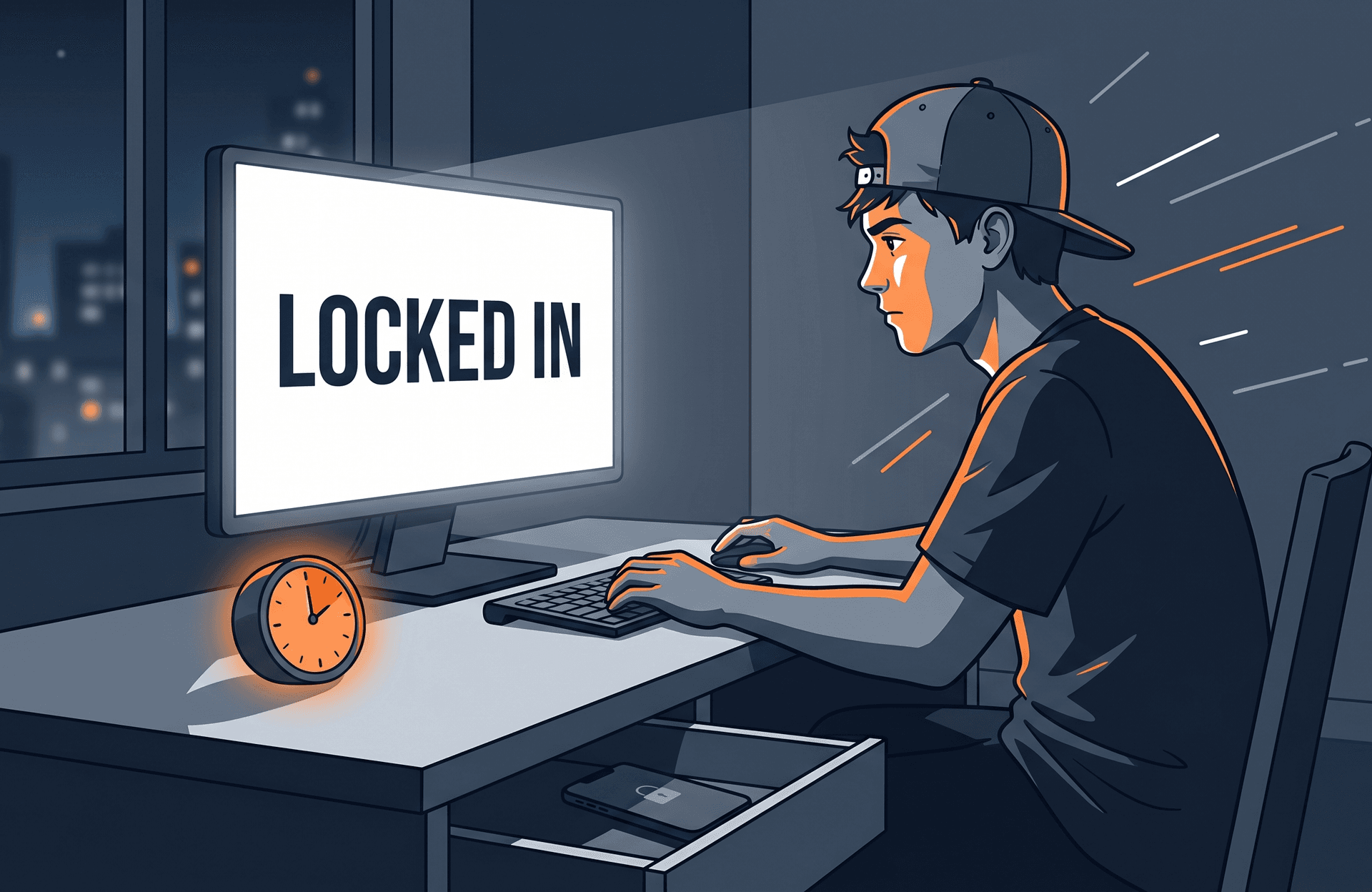
Introduction: "Lock in" went from gym-rat slang to a full-blown internet philosophy in about 18 months. Open TikTok and you'll see students at 2 a.m. with three monitors and a Pomodoro timer captioned "locked in." Open YouTube and there are 4-hour "lock in with me" study streams pulling 100,000 viewers. Open Twitter (or X, if you must) and "I'm locking in this semester" is a daily ritual.
What does it actually mean to lock in? And — much harder question — how do you actually do it, rather than just post about it?
This guide answers both. First: a clean explanation of what "lock in" means and why it went viral. Then: a 7-step framework for actually locking in (instead of performing it for the algorithm). Finally: 50 short lock-in quotes — grouped by focus, discipline, consistency, athlete mentality, and student grind — that you can screenshot, post, or put on your lock screen.
What "Lock In" Actually Means
"Lock in" is Gen-Z slang for the state of intense, single-task focus on something that matters — usually a goal that requires sustained effort: an exam, a deadline, a fitness transformation, a startup, a championship. It's a verb phrase, not a noun. You don't have lock in. You lock in.
In its strongest form, "locking in" means:
- Eliminating distractions — phone in another room, browser tabs closed, notifications off.
- Single-tasking — one thing at a time, fully, until it's done.
- Time-boxing — a defined block (90 minutes, 4 hours, a whole semester) where the only acceptable activity is the goal.
- Identity narrowing — temporarily collapsing all the things you could be into the one thing you've decided to be right now.
The phrase has roots in athletics ("lock in on the game"), gaming ("locked in for the tournament"), and academic culture ("locked in for finals"). It became viral around 2022–2023 when study-with-me and study-influencer content exploded on TikTok, and "I'm locking in" became the canonical caption for those clips.
Why "Lock In" Became a Viral Productivity Concept
Three reasons "lock in" stuck culturally where older productivity language (focus, flow, deep work) didn't quite land for Gen-Z.
It's short and identity-forward. "I'm doing deep work" sounds clinical. "I'm locking in" sounds like a decision about who you are. It frames focus as a stance, not a method.
It admits the default is broken. "Lock in" implicitly acknowledges that the normal state — phone in hand, 12 tabs open, half-listening to a podcast while half-watching Netflix — is the problem. Older productivity language assumed you were already focused and just needed to be slightly more organized. Lock-in assumes you start scattered and have to do something to get unscattered.
It's communal. Lock-in is performed publicly — study-with-me streams, "lock in with me" group chats, posting your lock screen at midnight. Old-school productivity advice was solitary and aspirational. Lock-in is a social ritual.
That last part is also what makes it dangerous. A lot of the "lock-in" content online is performance — posting about locking in is a form of procrastination if you never actually do the work. The next section is the antidote.
How to Actually Lock In (Not Just Tweet About It)
If you want to lock in for real, this is the 7-step routine that survives contact with reality. None of it is novel — it's the same advice productivity research has given for 20 years, repackaged in lock-in vocabulary.
1. Pick one thing. Not three. One. The single task whose completion would make today actually count. Lock-in is binary — you're either fully in on the one thing, or you're scattered across many. There is no third option.
2. Put the phone somewhere you have to physically walk to. Not face-down on the desk. Not in your pocket. In another room, in a drawer with a kitchen timer on it, in a bag in the hall. The friction is the point. If unlocking it takes 8 seconds, you'll do it 40 times today; if it takes 3 minutes, you'll do it twice.
3. Define the block. Lock-in needs a fence. Not "I'm going to study tonight." Instead: "I'm going to lock in from 7:00 to 9:30, then take a 30-minute break, then go again until 11:00." The brain can do almost anything for a defined window. It cannot do unbounded effort.
4. Set a single success condition. "I will finish problem set 4." "I will write 800 words of the draft." "I will read chapter 6 and make active-recall flashcards from it." Vague intentions are the death of lock-in. The success condition is the only thing that determines whether you actually locked in tonight, or just looked busy.
5. Use music with no lyrics, or none at all. Lyrics share neural real estate with verbal work. If you're reading, writing, or coding, vocal music actively competes with the task. Instrumental, lofi, classical, or silence outperforms vocal tracks in nearly every study of focus performance.
6. Build the recovery into the plan. Lock-in isn't sustainable for 8 hours straight; it's sustainable in cycles. 90 minutes of locked-in work, 15-30 minutes of full disengagement (walk, food, conversation — not phone). Repeat. The break is not weakness. It's the reason the next block is still high-quality.
7. End the day with a 5-minute review. Did you hit the success condition? If yes, write down what made it work. If no, write down what got in the way. Both go into next week's plan. Lock-in compounds when you treat it as a skill to refine, not a feeling to chase.
If you do this for 30 days, you'll know more about your own focus than 95% of the people posting "locked in" captions. The skill is rare because the routine is boring.
50 Lock In Quotes — For Focus, Discipline, and Showing Up
Use these on your lock screen, in your group chat, on a sticky note above the desk, or in the caption when you actually do the work (not when you're posting about doing the work).
Lock In Quotes About Focus & Cutting Distractions
- Lock in or lose to people who did.
- The phone is the enemy of the dream.
- Your future is built in the hours nobody sees you working.
- Distractions are decisions. Decide better.
- Lock in for 90 minutes. Repeat 3 times. That's a day.
- The world is full of people who almost did it.
- Focus is the new flex.
- You don't need more time. You need fewer tabs.
- Cap on the head. Headphones in. World out.
- One thing at a time. Done well. Done fully.
Lock In Quotes About Discipline
- Discipline beats motivation, every single time.
- Lock in when you don't feel like it. That's the whole game.
- You're either disciplined or you're entertained.
- Discipline is doing what your future self will thank you for.
- The win is built in the boring middle.
- Mood is not strategy. Discipline is.
- Lock in on the days nobody is watching.
- Consistency beats intensity. Always.
- Don't break the chain. Don't.
- Discipline is just remembering what you actually want.
Lock In Quotes About Consistency & Showing Up
- Show up. Even when you're tired. Especially then.
- Lock in for 30 days. Watch your life change.
- Same time. Same place. Every day. That's how it's done.
- Streaks don't lie.
- Be the person who's still doing it in week 6.
- Quitting feels good for 24 hours. Then it costs you years.
- You don't need to be motivated. You need to be unmissable.
- The grind doesn't quit. So you can't either.
- Boring is the secret ingredient.
- Lock in even when nobody's clapping.
Lock In Quotes for Athletes & Hustlers
- Lock in or get locked out.
- The pain is the price. Pay it.
- Champions are built in the dark.
- Average is the enemy.
- Lock in. Outwork. Outlast.
- Effort is the only thing nobody can take from you.
- The reps you skip today, you'll regret on game day.
- They sleep. You work. That's the difference.
- Be obsessed or be average.
- Lock in until the discipline becomes identity.
Lock In Quotes for Students
- Two hours of locked-in study beats five hours of distracted study.
- Your future GPA is being built right now.
- Lock in for the exam. Reward yourself after.
- Phones in the drawer. Notes on the desk.
- The library at 8 p.m. is full of your competition.
- Every closed tab is a step toward graduation.
- Lock in this semester. Coast the next one.
- You won't remember the show you binged. You'll remember the grade.
- The discipline you build at 19 pays you for life.
- Lock in now. Brag later.
Lock-In vs Flow State (What the Science Actually Says)
"Lock in" is the social-media version of what psychologists call flow state — a term coined by Mihaly Csikszentmihalyi in the 1970s. Flow describes a state of complete absorption in a task: time distorts, self-consciousness disappears, and performance peaks. The conditions for flow, according to four decades of research, are stable:
- A clear, immediate goal.
- A skill level matched to the difficulty (too easy = bored, too hard = anxious).
- Direct feedback on whether you're succeeding.
- Few or no distractions.
Look at those four conditions and the 7-step lock-in routine above. They're describing the same thing. "Lock in" is flow state with a TikTok caption. The reason the routine works isn't because it's new — it's because every step engineers the conditions flow requires.
Where lock-in vocabulary actually beats older productivity language: it's more honest about effort. Flow gets romanticized as "effortless absorption," which makes people think they're failing when sustained focus feels hard. Lock-in is upfront that you're forcing yourself into the state, at least at first. The effort is part of the deal.
Put a Lock-In Quote on Your Lock Screen
The fastest way to put a lock-in mindset where you'll actually see it: put a short lock-in quote on your phone's lock screen. You unlock your phone roughly 96 times a day. That's 96 reminders that you decided to lock in — every one of them right before you would otherwise have started scrolling.
We've curated 36 short, high-contrast quote wallpapers built specifically for lock screens. They're free, no signup, sized for iPhone and Android: [Lock Screen Quote Wallpapers →](/wallpapers/lock-screen)
Make Your Own Lock-In Wallpaper
The most powerful lock-in quote is probably one only you would write — something from your coach, a journal entry, a line your father said, or a sentence from the version of you who already locked in once. The [free quote wallpaper maker](/tools/wallpaper-generator) lets you turn any text into a wallpaper in about 30 seconds. Pick phone size, type your line, pick a high-contrast font, download. No watermark, no signup, no payment.
If you can only do one thing from this guide today, make a lock-screen wallpaper with the quote that hits you hardest from the list above. Then put your phone in the drawer and actually lock in for 90 minutes.
Conclusion: Lock In, Then Stop Talking About It
The funny thing about "lock in" as a phrase is that it became viral because it sounded productive — and posting about it instead of doing it became the most common form of procrastination on the internet.
If you take one thing from this guide, take this: the people who lock in for real almost never talk about it while they're doing it. They post afterward, if at all. Lock-in is a private act with public results. Make the wallpaper. Put the phone in the drawer. Set the success condition. Then disappear into the work.
The world will know you locked in when you walk out of finals with the grade, finish the draft, hit the lift, ship the product. Don't perform the lock-in. Just do it.
Frequently Asked Questions
"Lock in" is Gen-Z slang for entering a state of intense, single-task focus — usually on a goal that requires sustained effort like exams, training, or shipping work. It implies eliminating distractions (phone away, tabs closed), single-tasking, and committing to a defined time block. The phrase originated in athletics and gaming and went viral on TikTok study-influencer content around 2022–2023.
They describe the same psychological state, but the vocabulary is different. Flow state (coined by Mihaly Csikszentmihalyi in the 1970s) is the academic term for complete task absorption. "Lock in" is the social-media version, with the same conditions: clear goal, matched skill level, direct feedback, no distractions. Lock-in is more honest about the effort required to get there.
90-minute blocks are the upper limit for most people before focus degrades. The standard routine is 90 minutes locked in, 15-30 minutes of full disengagement (walk, food, conversation — not phone), then repeat. Most "I locked in for 8 hours straight" claims are either exaggerated or describe low-quality work. Cycles beat marathons.
Externalize everything. A vague mental intention won't survive. Write the one task on paper. Set a 30-90 minute timer. Put the phone in a different room with the door closed. Use body-doubling (someone working alongside you, in person or via a focus stream). Reward yourself for completing the block, not the task — finishing the time you committed to is the actual win for ADHD focus.
The best lock-screen quote is short (under 10 words), behavioral (describes an action, not a feeling), and personally meaningful. "Lock in or lose to people who did" works because it's confrontational. "Focus is the new flex" works because it's identity-level. The strongest version is usually one you wrote yourself — make it in our [free wallpaper maker](/tools/wallpaper-generator).
Written by Daily Motivation Team
Sharing motivational content to inspire your journey to success.
Related Articles
 manifestation
O Method Manifestation: A Complete Guide
Learn how the O Method manifestation works, why it's so effective, and exactly how to practice it for real results.
 stoic
stoicEpictetus Top 30 Quotes: The Discourses Made Accessible
Discover the top 30 Epictetus quotes from the Discourses and Enchiridion — timeless Stoic wisdom made simple and actionable.
 stoic
stoicModern Stoicism: How to Apply Ancient Wisdom in 2026
Discover how modern stoicism turns 2,000-year-old wisdom into a practical toolkit for calm, focus, and resilience in 2026.
 stoic
stoicDaily Stoic Meditation Guide: 10 Minutes Each Morning
Build a daily stoic meditation practice in just 10 minutes each morning — the exact ritual, sources, and mistakes to avoid.