
5 Essential Decision Making Frameworks for Leaders
Paralyzed by choices? Use these decision making frameworks to master risk management for entrepreneurs and make high-stakes decisions confidently.
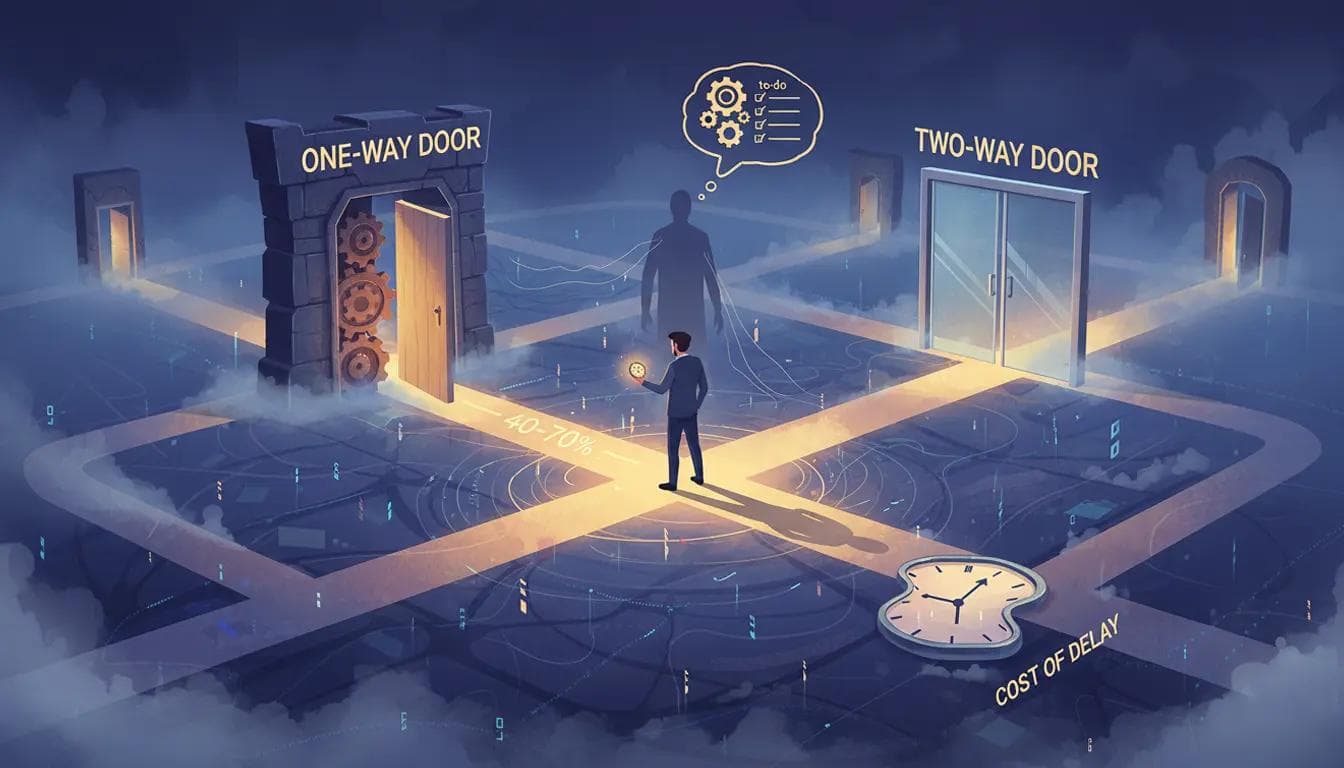
Introduction: As an entrepreneur, you are a professional decision-maker. But unlike a corporate manager, you don't have perfect data. You don't have 6 months for a committee to analyze a problem. You are operating in a fog of uncertainty, and every decision feels "high-stakes."
This uncertainty breeds "Analysis Paralysis." This is the state of being so stuck in "research" and "what-if" scenarios that you never actually make the decision.
Analysis Paralysis is just the fear of failure in a business suit. You're so afraid of making the wrong choice that you make no choice—which is, in itself, a choice. And it's almost always the wrong one.
Successful entrepreneurs aren't better at predicting the future. They are simply faster at making "good enough" decisions and better at "course-correcting." They do this by using mental models. This is your 4-step framework.
Step 1: Is This a 'One-Way' or 'Two-Way' Door?
This mental model, famously used by Jeff Bezos at Amazon, is the most powerful tool for ending paralysis.
- One-Way Door (Irreversible): These are "bet the company" decisions. They are difficult (or impossible) to reverse.
- Examples: Selling your company, taking on a huge VC round, firing a co-founder.
- Action: Analyze these decisions slowly and carefully.
- Two-Way Door (Reversible): These are decisions that you can "walk back" if you're wrong.
- Examples: Trying a new pricing plan, launching a new marketing campaign, testing a new feature.
- Action: Make these decisions quickly.
The Trap: Most entrepreneurs treat every decision like a "One-Way Door." They'll spend a month debating a new pricing plan. This is a "Two-Way Door"! Launch it. If it doesn't work, you can change it back in a week.
Action: The next time you are stuck, ask: "Is this a One-Way or Two-Way door?" 99% of your decisions are Two-Way Doors. Make them fast.
Step 2: What is the 'Cost of Delay'?
We are very good at analyzing the "risk of action" (What if I launch this and it fails?). We are terrible at analyzing the "risk of in-action" (What if I don't launch this?).
This is the "Cost of Delay."
- While you spend 3 months "perfecting" your MVP, your competitor launches and gets the first 1,000 customers.
- While you "analyze" a new marketing channel, the ad costs on that channel double.
- While you are paralyzed, your team is "blocked" and "frustrated," and your A-players start looking for a new job.
Action: Reframe the decision. It's not "Choice A" vs. "Choice B." It's "Choice A" vs. "The High Cost of Waiting." This creates the urgency you need to act.
Step 3: Run a 'Pre-Mortem' (Using Fear as a Compass)
Your fear of failure is not a stop sign; it's a compass. It's your brain pointing out exactly what the risks are. Use this.
A "Pre-Mortem" is a strategic exercise in pessimism.
- The Process: Get your team (or just yourself) in a room.
- The Prompt: "Imagine it is 6 months from now. We have made this decision, and it has failed catastrophically. It was a complete disaster. Why did it fail?"
- Brainstorm:
- "It failed because our competitor lowered their price."
- "It failed because the new feature was too complicated for users."
- "It failed because our server crashed."
- The Magic: You have just created a list of the real risks. Now, you can build a mitigation plan before you start.
- "If our competitor lowers their price, what is our response?"
- "How can we simplify the feature before launch?"
- "Let's stress-test the server this week."
This process turns your vague "fear" into an actionable to-do list.
Step 4: The '70% Rule' (Data vs. Gut)
You will never have 100% of the data. Waiting for it is a form of procrastination. Former Secretary of State Colin Powell had a 40/70 rule.
- You should not make a decision with less than 40% of the information (that's reckless).
- If you have more than 70% of the information, you are too slow.
The Sweet Spot: Make the call when you have 40-70% of the data. What closes the gap? Your "gut." Your "gut" is not magic; it is the sum of all your past experiences and "data" that your subconscious has processed.
- Action: Stop researching. You have 70% of the data. Trust your gut. Make the call.
Conclusion: 'Decide and Iterate' Beats 'Ponder and Perish'
There is no "perfect" path. There is only "Path A" and "Path B." An entrepreneur's job is to pick a path today and walk down it.
If it's a Two-Way Door, you can always walk back. If it's the wrong path, you've gathered "data" that will help you pick the next path more intelligently. The only true failure is standing at the crossroads, paralyzed by fear, while your competitors run past you.
Frequently Asked Questions
This is why you analyze them slowly. You run multiple "Pre-Mortems." You get outside advice from mentors. You "de-risk" the decision as much as possible. But at the end of the day, true "One-Way Doors" are rare. Even a "failed" company is a "Two-Way Door"—you can always start a new one, armed with your new "Real-World MBA."
Use the "Disagree and Commit" principle: (1) Disagree: Both sides present their case, backed by data (not just feelings). (2) Debate: Argue passionately. (3) Decide: One person (usually the CEO or the person owning that domain) must make the call. (4) Commit: Everyone on the team, even those who disagreed, must "commit" 100% to making the chosen path succeed. No "I told you so."
Written by Daily Motivation Team
Sharing motivational content to inspire your journey to success.
Related Articles
 Creativity
Artistic Inspiration: A Complete Guide
Artistic inspiration isn't luck — it's a trainable skill. Learn 7 daily practices that keep ideas flowing.
 stoic
stoicStoic Quotes on Discipline: Where Stoicism Meets Self-Mastery
Discover powerful stoic quotes on discipline from Marcus Aurelius, Seneca, and Epictetus — plus how to apply them today.
 stoic
stoicBest Stoic Quotes for Hard Times: Wisdom for Modern Struggles
Powerful Stoic quotes for hard times from Marcus Aurelius, Seneca & Epictetus — wisdom that turns adversity into strength.
 stoic
stoicBest Stoic Quotes for Beginners: Where to Start Your Practice
Discover the best stoic quotes for beginners and a simple 7-day plan to turn ancient wisdom into daily practice.