
Feynman Technique: The Ultimate Guide to Learning Anything Faster
Stop memorizing, start understanding. This guide reveals Richard Feynman's 4-step method for mastering any topic by explaining it in simple terms.
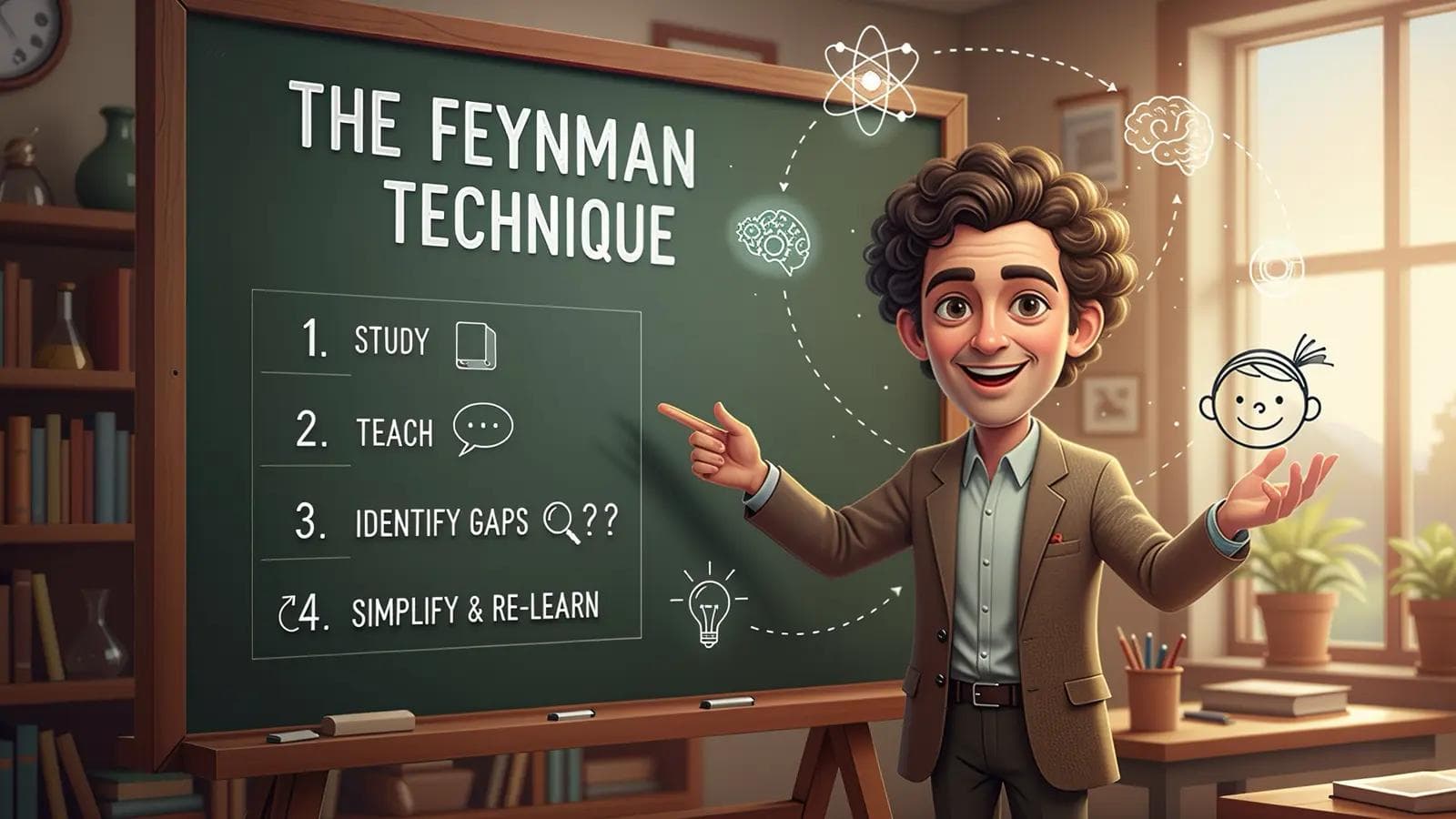
# Feynman Technique: The Ultimate Guide to Learning Anything Faster
Ever spent hours reading a textbook chapter, nodding along, only to realize 24 hours later you can't explain the core concept to save your life? You're not alone. This frustrating cycle is called the "Illusion of Competence," where your brain mistakes familiarity for true understanding.
There is a powerful antidote. It comes from Nobel Prize-winning physicist Richard Feynman, a man renowned not just for his genius in quantum electrodynamics, but for his uncanny ability to make the complex simple. He famously believed, "If you cannot create, you do not understand." From this philosophy, the Feynman Technique was born—a deceptively simple, four-step framework for learning anything faster, deeper, and for good.
This guide isn't just a summary. We'll provide a detailed, step-by-step walkthrough, complete with real-world examples, common mistakes to avoid, and how this method compares to other popular learning strategies. Prepare to replace passive highlighting with active, durable knowledge.
What is the Feynman Technique? (And Why It Works)
The Feynman Technique is a mental model and learning strategy that deconstructs a topic into its fundamental principles by attempting to explain it in plain, simple language. The process systematically exposes your knowledge gaps—the fuzzy areas where you've relied on jargon or memorization—and forces you to fill them.
It's effective because it shifts your brain from a passive state (reading, watching) to an active one (retrieving, articulating, structuring). This process of active recall is scientifically proven to build stronger neural pathways, making knowledge stick. The technique essentially forces you to build a concept from the ground up in your own words, which is the ultimate test of understanding.
The 4 Steps of the Feynman Technique: A Detailed Walkthrough
Many guides list the four steps, but true mastery lies in the execution. Let's break down each step with actionable advice and a running example. For this guide, our goal will be to learn a common technical concept: "What is an API?"
Step 1: Choose Your Concept and Immerse Yourself
This first step is about more than just picking a topic; it's about defining its scope and gathering your materials. Generic advice like "study the topic" is not enough.
Be Specific. Don't choose "Marketing." Instead, choose "What is SEO on-page optimization?" Don't pick "History." Pick "What were the primary causes of the Peloponnesian War?" A narrowly defined scope prevents you from getting overwhelmed.
Gather Diverse Resources. Don't rely on a single textbook. For our API example, you might:
- Read a chapter in a computer science textbook.
- Watch a YouTube explainer video (or two).
- Read a blog post titled "APIs for Dummies."
- Look at the documentation for a simple, public API (like a weather API).
During this phase, take notes as you normally would. Don't worry about understanding everything perfectly yet. The goal is to get a foundational layer of information. For now, you're just loading the raw materials into your brain.
Step 2: Teach It to a Layperson (The Simplification Engine)
This is the heart of the Feynman learning method. It's where the magic happens. The goal is to explain the concept you just studied as if you were teaching it to someone with no prior knowledge, like a curious 12-year-old or your grandmother.
Get a blank piece of paper (or open a new document) and write the name of the concept at the top.
Write out your explanation. Don't just think it—the physical act of writing or speaking forces clarity. Use your own words. Crucially, you must adhere to two rules:
- No Jargon: If you write a technical term (like "endpoint" or "JSON payload" in our API example), you must be able to break that term down into simple words. If you can't, you've found a knowledge gap.
- Use Analogies: Connect the new, abstract idea to a simple, concrete concept the person already understands. Analogies are bridges for the brain.
Running Example: First Attempt at Explaining "API"
"Okay, so an API, or Application Programming Interface, is an interface that lets two different software applications talk to each other. It's a set of rules and protocols. When you use an app on your phone, like a weather app, it uses an API to get data from the weather service's server. The app sends a request, and the server sends back a response with the data, maybe in a format like JSON. The API is the messenger that handles this interaction... it defines the kinds of calls or requests that can be made, how to make them, the data formats that should be used... and it has endpoints..."
Notice the problems? The explanation quickly falls back on jargon: "interface," "protocols," "server," "request/response," "JSON," "endpoints." A 12-year-old would be lost. This is not a failure; it's a success! We've just completed Step 3.
Step 3: Identify Your Knowledge Gaps (The 'Aha!' Moment)
As you try to explain the concept simply, you will inevitably get stuck. These moments of friction are the entire point of the Feynman Technique. They are a bright, flashing sign pointing directly at the holes in your understanding.
Review your explanation from Step 2. Where did you feel your explanation was weak? Where did you have to use a complex term? Where did you wave your hands and say, "...and it sort of just connects..."?
Create a "Gap List." Be brutally honest with yourself. From our API example, the list would be:
- What is an "interface" in simple terms?
- What does a "protocol" actually mean here?
- I can't explain what an "endpoint" is without using the word itself.
- I said "server" but didn't explain its role simply.
- I mentioned "JSON" but can't describe what it is or why it's used.
This list is your targeted study guide. It's gold. You now know exactly what you don't know.
Step 4: Review, Refine, and Repeat
Now, go back to your source materials from Step 1, but with a laser focus. You are no longer broadly "studying APIs." You are on a mission to answer the specific questions on your Gap List.
- Look up a simple definition of "endpoint." (e.g., "It's like a specific web address for one particular piece of information.")
- Find an analogy for JSON. (e.g., "It's like a neatly organized shopping list that both the customer and the store can easily read.")
Once you've filled these gaps, the most important part is to go back to your blank sheet of paper and try the explanation again. This iterative process is key. Don't just edit your old explanation; rewrite it from scratch. The goal is to make it simpler, clearer, and more intuitive.
Running Example: Second, Improved Explanation of "API"
"Imagine you're at a restaurant. You are the 'app,' and the kitchen is the 'system' with the food (the data) you want. You can't just walk into the kitchen and get the food yourself, right?
You need a waiter. The waiter is the API.
You look at the menu (the documentation) and give your order to the waiter. You have to use a specific format: 'I'd like the steak, medium-rare.' You can't just shout 'Food!' That's the 'protocol' or rule.
The waiter takes your order to the kitchen. The kitchen prepares your food. The waiter then brings the food back to you. The waiter acts as the messenger, preventing you from having to know how the kitchen works, and preventing the kitchen from being disrupted by every customer.
An API does the same for software. It's a messenger that takes a specific request from an app (like your weather app asking for the forecast for 'New York'), goes to the server (the kitchen), gets the data, and brings it back to your app in a clean, predictable format."
See the difference? No jargon. A clear analogy. This is true understanding, and it was forged by using the Feynman learning technique to find and fix the weak spots.
Feynman Technique in Action: Real-World Examples
This method isn't just for technical topics. Let's see how it can be applied to different domains.
Learning a Scientific Concept: Photosynthesis
- Jargon-Filled Explanation: "Photosynthesis is a process used by plants, algae, and cyanobacteria to convert light energy into chemical energy, through a process that converts carbon dioxide and water into glucose and oxygen."
- Feynman-Style Explanation: "Imagine a plant is like a tiny solar-powered chef. It takes in three ingredients: sunlight (from its solar panels, the leaves), water (sucked up through its roots), and a gas from the air called carbon dioxide. It uses the energy from the sun to cook these ingredients together inside its leaves, creating two things: a sugary food for itself to live on (glucose), and a waste product that it breathes out, which we need to live: oxygen."
Mastering a Business Framework: Compound Interest
- Jargon-Filled Explanation: "Compound interest is the interest on a loan or deposit calculated based on both the initial principal and the accumulated interest from previous periods."
- Feynman-Style Explanation: "Imagine you have a 'money snowman.' You start with a small snowball (your initial money). At the end of the year, the weather is so good that a little layer of new snow (the interest) covers your snowball, making it bigger. The next year, you get another layer of snow, but now it's covering a bigger snowball, so the new layer is even thicker. Compound interest is your money snowman getting bigger and bigger, faster and faster, because the new 'snow' is always landing on all the old snow, not just the original snowball."
How Does the Feynman Technique Compare to Other Learning Methods?
Understanding how Richard Feynman's technique fits with other strategies can help you build a powerful learning toolkit.
Feynman Technique vs. Active Recall
This is not an "either/or" comparison. The Feynman Technique is a highly structured form of active recall.
- Active Recall is the general principle of actively retrieving information from your brain rather than passively reviewing it (e.g., using flashcards).
- The Feynman Technique takes this a step further. It's not just about recalling a fact; it's about recalling interconnected concepts and structuring them into a coherent, simple narrative. It adds the critical layers of simplification and gap identification.
Feynman Technique vs. Spaced Repetition
These two techniques are perfect partners and should be used together.
- Use the Feynman Technique first to achieve deep, initial understanding of a concept. This is for encoding the information correctly the first time.
- Use Spaced Repetition systems (like Anki or SuperMemo) afterward to efficiently retain that understood information over the long term. Spaced repetition is for combating the forgetting curve. spaced-repetition-software-guide
Think of it this way: Feynman is for building the house, and Spaced Repetition is for doing the regular maintenance to keep it from falling apart.
Common Mistakes to Avoid When Using This Learning Method
While the process is simple, a few common pitfalls can reduce its effectiveness.
- Choosing a Topic That's Too Broad: Trying to explain "World War II" in one go is impossible. Start with "Why did the Battle of Stalingrad happen?" and build from there.
- Skipping the Physical Act: Don't just do it in your head. The act of writing or speaking aloud forces you to confront fuzzy thoughts and commit to a single explanation.
- Being Dishonest About Gaps: It's tempting to gloss over a term you sort of know. Don't. Your ego is the enemy of learning. If you can't explain it to a five-year-old, you don't know it. Add it to the gap list.
- Not Simplifying Enough: If your explanation still has complex words, you haven't finished. The goal isn't to sound smart; it's to be understood. Challenge every single word.
Tools and Resources to Supercharge the Feynman Technique
You don't need fancy software, but a few tools can streamline the process:
- Whiteboards (Physical or Digital): Excellent for drawing diagrams and creating visual analogies.
- Note-Taking Apps (Notion, Obsidian, Roam Research): Great for creating linked notes that allow you to quickly dive into sub-topics when you identify a knowledge gap.
- The Rubber Duck Method: Don't have a 12-year-old handy? Grab a rubber duck (or any inanimate object) and explain the concept to it out loud. This is a well-known technique in software development to debug code and clarify thoughts. how-to-be-more-productive
Final Thoughts: From Memorizing to Understanding
The true power of the Feynman Technique is that it fundamentally changes your relationship with information. It moves you from being a passive consumer to an active creator of knowledge.
It's more than a study hack; it's a mindset. It's the discipline of seeking true, simple understanding over the illusion of complex knowledge. It's the confidence that comes from knowing you can break down any topic, no matter how intimidating, into its core components and build it back up again.
So, the next time you're faced with a difficult subject, don't just read about it. Grab a blank sheet of paper and start explaining. Identify your gaps, refine your understanding, and teach it. That is how you truly learn.
Frequently Asked Questions
The time varies depending on the complexity of the topic. A simple concept might take 20-30 minutes for a single pass. A more complex subject, like a university-level topic, might require several hours spread over multiple sessions as you identify and fill numerous knowledge gaps.
Yes, its principles are universal. It is exceptionally effective for STEM subjects (math, physics, computer science) and complex frameworks (economics, philosophy), but it can also be used for skills, historical events, or even artistic concepts by forcing you to articulate the 'why' and 'how' in simple terms.
The Feynman Technique is a specific, structured method of active recall. While basic active recall might involve flashcards to remember a single fact, the Feynman Technique forces you to recall and synthesize multiple concepts into a coherent, simplified explanation, making it a more advanced form of the practice.
Step 2, 'Teach it to a layperson,' is the most critical step. This is where the learning process is truly tested. The act of simplification and articulation is what exposes the knowledge gaps (Step 3), which is the entire purpose of the technique.
Written by Daily Motivation Team
Sharing motivational content to inspire your journey to success.
Related Articles
 Creativity
Artistic Inspiration: A Complete Guide
Artistic inspiration isn't luck — it's a trainable skill. Learn 7 daily practices that keep ideas flowing.
 stoic
stoicStoic Quotes on Discipline: Where Stoicism Meets Self-Mastery
Discover powerful stoic quotes on discipline from Marcus Aurelius, Seneca, and Epictetus — plus how to apply them today.
 stoic
stoicBest Stoic Quotes for Hard Times: Wisdom for Modern Struggles
Powerful Stoic quotes for hard times from Marcus Aurelius, Seneca & Epictetus — wisdom that turns adversity into strength.
 stoic
stoicBest Stoic Quotes for Beginners: Where to Start Your Practice
Discover the best stoic quotes for beginners and a simple 7-day plan to turn ancient wisdom into daily practice.