
Deep Focus Ritual: Start Any Study Session in 15 Min
Wasting 25 min before you even open your textbook? This 15-minute focus ritual rewires your brain to study on command.
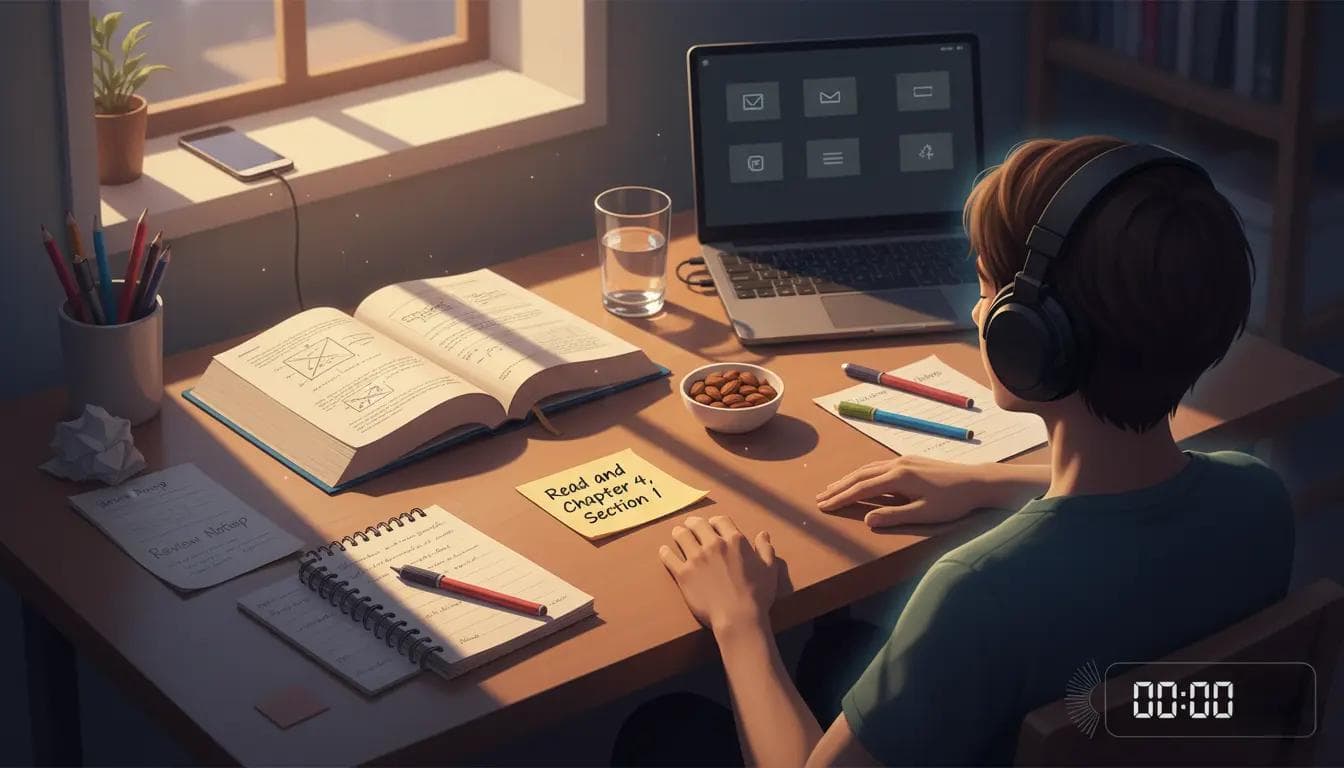
# Deep Focus Ritual: How to Focus on Studying in 15 Minutes Flat
Studies show the average student wastes 25 minutes before settling into genuine study mode — and most never reach deep focus at all. If you've ever sat down to study and ended up reorganizing your desk, scrolling your phone, or staring at a blank page, you're not lazy. Your brain is simply cold.
This guide gives you a battle-tested, 15-minute ritual that solves exactly that. It's built on behavioral science, used by high-performing students, and designed to make how to focus on studying feel less like willpower and more like flipping a switch.
---
Why Is It So Hard to Focus on Studying? (The Real Reason)
Most advice tells you to "just eliminate distractions." That's like telling someone to "just run faster." It ignores the underlying problem.
The real culprit is Task Initiation Resistance — a well-documented cognitive phenomenon where your brain actively avoids switching from a low-effort state (scrolling, chatting, snacking) to a high-effort state (reading, analyzing, problem-solving).
Your prefrontal cortex — the part responsible for focus and decision-making — needs time to "warm up." Without a deliberate transition, your brain defaults to the path of least resistance. Every. Single. Time.
The fix isn't more discipline. It's a smarter warm-up.
Athletes don't sprint cold. Musicians don't perform without scales. Students who consistently learn how to focus on studying use a pre-session ritual to prime their brain before the hard work begins.
---
What Is a 'Focus Ritual' and Why Does It Work?
A focus ritual is a fixed, repeatable sequence of actions you perform before every study session. It works because of a principle called behavioral priming — the same mechanism behind Pavlov's famous experiments.
When you repeat the same sequence of actions before studying, your brain starts to associate those actions with focused work. After 7–10 days, the ritual itself becomes the trigger. You stop fighting to focus. Your brain just... shifts.
Here's the loop:
- The Cue: Your 15-minute ritual begins
- The Routine: A deep, distraction-free study block (45–90 minutes)
- The Reward: A guilt-free break + the satisfaction of real progress
This isn't motivation hacking. It's neuroscience applied to your desk.
Pro tip: Pair your ritual with a consistent environmental cue — the same desk, the same lamp, the same playlist. Consistency accelerates the priming effect dramatically.
study-environment-setup
---
The 5-Step, 15-Minute Focus Ritual (Exact Steps)
This ritual is designed to eliminate physical, digital, and mental friction before it can derail your session. Follow it in order. The sequence matters.
---
Step 1 — Environment Shutdown (Minutes 1–5)
Your physical environment is a direct input to your mental state. Clutter competes for your attention even when you're not looking at it.
Do this, in this order:
- Clear your desk of everything unrelated to today's one task. Old notes, coffee mugs, chargers — gone.
- Place only what you need within arm's reach: textbook, notebook, one pen, calculator if needed.
- Set out one glass of water and a small snack (almonds, a banana, or dark chocolate work well). This eliminates the "I need to get up" escape hatch.
- Adjust your lighting. Bright, cool-toned light increases alertness. Dim, warm light signals rest. Choose accordingly.
- Set your room temperature between 68–72°F (20–22°C) — the range most associated with peak cognitive performance in research settings.
Why this works: Decision fatigue is real. By pre-loading your environment, you remove micro-decisions that drain mental energy before you've even started.
---
Step 2 — Digital Fortress Mode (Minutes 5–8)
This is the step most students skip — and the reason most students can't figure out how to focus on studying for more than 10 minutes.
Execute this checklist:
- Put your phone on Do Not Disturb and place it face-down outside arm's reach (ideally in another room or a drawer)
- Close every browser tab not related to your study material
- Use a site blocker: Freedom, Cold Turkey, or Forest are all excellent. Set a block for 60–90 minutes
- If you use music, queue it before you start. Mid-session playlist hunting is a focus killer
- Turn off desktop notifications — email, Slack, everything
Distraction-free vs. "I'll just ignore it" — the real difference:
- Distraction-free: Phone is in another room. Notifications are off. Sites are blocked.
- "I'll just ignore it": Phone is on your desk. You can see it light up. You're using willpower instead of systems.
Willpower is a finite resource. Systems are not. Build the fortress.
---
Step 3 — The Brain Dump (Minutes 8–11)
One of the biggest hidden enemies of focus is open loops — unfinished thoughts, tasks, and worries floating around in your working memory.
Your brain is not designed to store tasks. It's designed to process them. When you try to study while mentally holding a grocery list, a text you need to reply to, and a deadline you're anxious about, your focus is fractured before it begins.
The Brain Dump process:
- Open a blank page in your notebook or a notes app
- Set a timer for 2 minutes
- Write down everything on your mind — tasks, worries, random thoughts, things you're afraid you'll forget
- Don't organize it. Don't prioritize it. Just get it out of your head and onto paper
- At the bottom, write: "These are handled. My only job right now is [subject]."
This technique, popularized by productivity researcher David Allen, is called a capture sweep. It signals to your brain that these items are safe — they won't be forgotten — so it can stop cycling through them.
Students who add this step report a noticeably calmer, more settled feeling within minutes. Try it once and you'll never skip it.
---
Step 4 — Set a Micro-Goal (Minutes 11–13)
Vague intentions produce vague results. "Study chemistry" is not a goal. It's a wish.
Before every session, define your outcome with surgical precision.
Use this formula:
"By the end of this session, I will have [specific output] so that [specific reason]."
Weak goal: "Study for the biology exam."
Strong goal: "By the end of this session, I will have completed practice problems 1–20 in Chapter 7 and written a one-paragraph summary of cellular respiration so that I can identify my gaps before Thursday's exam."
Write this goal at the top of your notebook page. This becomes your anchor. Every time your mind drifts, you have a written target to return to.
Also decide:
- How long is this session? (45 min? 90 min?)
- What counts as "done"?
- What's the first sentence or problem you'll tackle?
That last one is critical. Starting is the hardest part. Pre-deciding your first action removes the friction entirely.
---
Step 5 — The 2-Minute Activation (Minutes 13–15)
This is the secret step that separates students who want to focus from students who actually focus.
Before you open your textbook, spend exactly 2 minutes on a low-effort, high-relevance warm-up:
- For reading/writing: Read the last paragraph you wrote in your previous session, or skim the headings of today's chapter
- For math/science: Solve one easy problem from material you already know
- For language learning: Say 10 vocabulary words you've already mastered out loud
- For memorization: Flip through flashcards you've already learned
This "activation" step works because it gets your brain processing related content at low intensity before ramping up. It's the cognitive equivalent of a light jog before a sprint.
After 2 minutes, you're warm. You're in context. You're ready.
Now open the textbook. Start the timer. Go.
---
How Long Should a Study Session Actually Be?
Once your ritual is complete, how long should you actually study?
The research points to a clear sweet spot:
- 45–50 minutes of focused work followed by a 10-minute break (the Pomodoro method, adapted)
- 90 minutes of deep work followed by a 20–30 minute break (aligned with ultradian rhythm cycles)
- Never more than 2 hours without a significant break — cognitive performance drops sharply after this point
Which should you choose?
- New to focused studying or working on difficult material → Start with 45-minute blocks
- Experienced with deep work or working on flow-friendly tasks → Try 90-minute blocks
- Exam crunch mode → Alternate: 50 min on, 10 min off, repeat 3–4 times
The ritual works for any of these formats. It's the on-ramp, not the highway.
pomodoro-technique-for-students
---
What to Do During Your Break (This Matters More Than You Think)
Most students break wrong. They swap one screen for another — phone instead of laptop — and wonder why they feel mentally exhausted after two hours.
Effective break activities:
- Walk around the room or outside for 5–10 minutes
- Do light stretching or breathing exercises
- Drink water, eat your snack
- Stare out a window (seriously — unfocused visual attention helps the brain reset)
- Do a brief review of what you just studied (this boosts retention by up to 40% according to spaced repetition research)
Ineffective break activities:
- Scrolling social media
- Watching YouTube videos
- Texting back and forth
- Checking email
The goal of a break is neural recovery, not entertainment. Give your brain actual rest, and your next session will start stronger.
---
How to Build This Into a Daily Habit (The 7-Day Kickstart)
Knowing the ritual is one thing. Making it automatic is another.
Here's a simple 7-day framework for locking in the habit:
Days 1–3: Anchor it to an existing habit Perform the ritual immediately after something you already do every day — finishing lunch, making coffee, or sitting down after school. This is called "habit stacking" and dramatically increases follow-through.
Days 4–5: Track it visibly Use a simple habit tracker — even a paper calendar with X marks. Don't break the chain. The visual record creates its own motivation.
Days 6–7: Personalize it Swap out any step that feels forced. Hate instrumental music? Try silence or white noise. Prefer standing? Use a standing desk. The ritual works because it's yours, not because it's perfect.
By day 10, you'll notice something strange: you'll start feeling the urge to study when you begin the ritual. That's the priming effect kicking in. That's your brain rewired.
---
How to Make Your Study Space Motivating (Not Just Functional)
Your environment isn't just about removing distractions. It's about adding motivation.
One surprisingly effective tactic: visual motivation anchors. These are images, quotes, or visual cues placed in your study space that remind you why you're doing the hard work.
This could be a printed goal statement, a photo of where you want to be, or a motivational quote displayed prominently at eye level.
If you want to make this personal and visually compelling, try using a motivational wallpaper generator to create a custom desktop background with your own goal or a quote that actually resonates with you — not a generic one-size-fits-all poster. A custom motivational wallpaper on your study laptop becomes a micro-cue every time you open your screen: this machine is for focused work.
Small environmental signals like this compound over time. Don't underestimate them.
---
Common Mistakes Students Make When Trying to Focus on Studying
Even with a solid ritual, these pitfalls derail progress:
Mistake 1: Multitasking during the session Switching between tasks doesn't save time — it costs it. Research from the American Psychological Association shows task-switching can reduce productivity by up to 40%. One task. One timer. Full attention.
Mistake 2: Studying in the same place you relax Your bed or couch is wired to your brain as a rest zone. Studying there creates conflicting cues. If possible, designate one physical location exclusively for study. Even a specific chair at the kitchen table works.
Mistake 3: Skipping the ritual when "in a rush" This is exactly when you need it most. A 15-minute ritual that produces 90 minutes of real focus beats 90 minutes of distracted pseudo-studying every time. Do the math.
Mistake 4: Using passive study methods Highlighting, re-reading, and watching lecture videos feel productive but produce weak retention. Active methods — practice problems, self-testing, teaching the material out loud — are what actually move the needle on how to focus on studying effectively.
Mistake 5: No defined end point Open-ended sessions breed procrastination. Always set a timer. Always know when you're done. The brain works better with defined boundaries.
---
The 'Cold Start' vs. 'Ritual Start' — What the Difference Feels Like
Here's what most students experience before adopting a ritual:
- Sit down with vague intention to "study"
- Spend 20–30 minutes "getting ready" (procrastinating)
- Finally open the book, but feel scattered
- Check phone 3–4 times in the first hour
- End the session feeling like they didn't accomplish much
- Feel guilty, which makes the next session harder to start
Here's what the same student experiences after 2 weeks of using the ritual:
- Sit down, begin the 15-minute sequence
- Brain recognizes the cues and begins shifting into focus mode
- Session starts with clarity and a defined goal
- Distractions are blocked before they appear
- 45–90 minutes of genuine deep work
- End the session with a concrete output and a sense of accomplishment
- That feeling makes the next session easier to start
The ritual creates an upward spiral. The cold start creates a downward one.
---
A Real Example: How One Student Used This to Pass Her Boards
A nursing student — let's call her Maya — was struggling to study for her NCLEX boards while working part-time. She had the material. She had the time (barely). What she didn't have was focus.
She implemented this exact ritual. Her modifications:
- Replaced music with brown noise (better for her concentration)
- Used her brain dump to offload work-related worries before each session
- Set micro-goals tied to specific NCLEX question categories
- Added a custom motivational wallpaper on her laptop with her target exam date and the phrase: "Future RN. One session at a time."
After three weeks, she was averaging 75 minutes of uninterrupted study per session — up from roughly 20. She passed her boards on the first attempt.
The ritual didn't give her more hours. It gave her better ones.
---
Quick-Reference: The 15-Minute Focus Ritual at a Glance
- Minutes 1–5: Clear your desk, gather tools, set out water and snack, optimize lighting and temperature
- Minutes 5–8: Phone away, site blocker on, notifications off, music queued
- Minutes 8–11: Brain dump — empty your mental RAM onto paper
- Minutes 11–13: Write your micro-goal using the specific output formula
- Minutes 13–15: 2-minute activation warm-up with easy, related material
- Minute 15: Start your timer. Begin.
That's it. Fifteen minutes of intentional preparation for hours of effective work.
The students who consistently learn how to focus on studying aren't more disciplined than you. They've just built better systems.
Start the ritual tonight. Even once. See what happens.
Frequently Asked Questions
Motivation usually follows action, not the other way around. Instead of waiting to feel motivated, use a short pre-study ritual — clearing your space, blocking distractions, and setting a specific micro-goal — to trigger focus mechanically. After 5–7 minutes of actual studying, motivation tends to appear on its own.
Research supports 45–50 minute study blocks followed by a 10-minute break for most students, or 90-minute blocks for those comfortable with deep work. Never study for more than 2 hours without a meaningful break, as cognitive performance drops significantly after that threshold.
Difficulty focusing is usually caused by Task Initiation Resistance — your brain resisting the switch from low-effort to high-effort activity. It's not a character flaw. The solution is a consistent pre-study ritual that primes your brain for focused work before you open your textbook.
It depends on the person and the task. Instrumental music, brown noise, or lo-fi beats tend to help with repetitive or reading-based tasks. Music with lyrics typically hurts focus on language-heavy work like writing or reading comprehension. The key is to choose and queue your audio *before* the session starts — not during.
Willpower alone rarely works. The most effective method is physical and digital separation: put your phone in another room or a drawer (not just face-down on your desk), activate Do Not Disturb, and use a site blocker like Freedom or Cold Turkey on your computer. Remove the option to be distracted rather than relying on resisting it.
Written by Daily Motivation Team
Sharing motivational content to inspire your journey to success.
Related Articles
 manifestation
O Method Manifestation: A Complete Guide
Learn how the O Method manifestation works, why it's so effective, and exactly how to practice it for real results.
 stoic
stoicEpictetus Top 30 Quotes: The Discourses Made Accessible
Discover the top 30 Epictetus quotes from the Discourses and Enchiridion — timeless Stoic wisdom made simple and actionable.
 stoic
stoicModern Stoicism: How to Apply Ancient Wisdom in 2026
Discover how modern stoicism turns 2,000-year-old wisdom into a practical toolkit for calm, focus, and resilience in 2026.
 stoic
stoicDaily Stoic Meditation Guide: 10 Minutes Each Morning
Build a daily stoic meditation practice in just 10 minutes each morning — the exact ritual, sources, and mistakes to avoid.