
Handling Sales Objections Scripts: The Entrepreneur's Guide to 'No'
'No' isn't failure, it's data. Use our handling sales objections scripts to turn rejection into opportunity and build a resilient entrepreneur mindset.
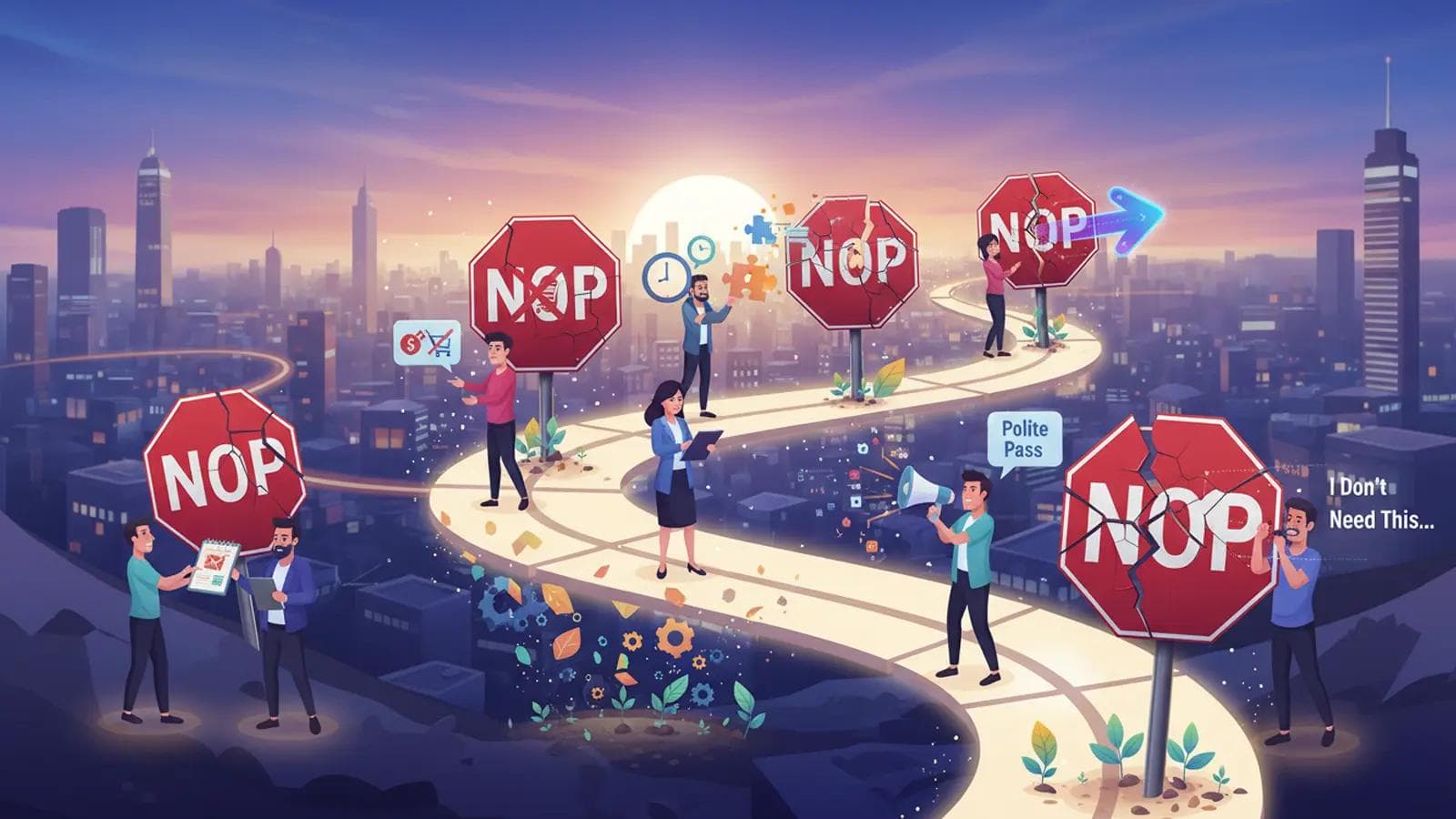
Introduction: If you're an entrepreneur, your 'real' job title is "Professional Rejection Handler." You will hear 'no' more than any other word.
- 'No,' your idea won't work.
- 'No,' we won't invest.
- 'No,' your price is too high.
- 'No,' I'm not interested.
- (Or the worst 'no' of all... silence).
Each 'no' can feel like a personal failure, a judgment on your worth and your dream. It's the #1 reason most people quit.
But successful entrepreneurs understand a powerful secret: 'No' is not a 'stop sign.' It's a 'GPS re-routing.'
'No' is never the end of the conversation; it's the beginning of a negotiation. 'No' is data. It's the 'failure' you need to learn, adapt, and eventually, win (see our 'Fear of Failure' article!).
This guide will give you the mindset and the exact scripts to turn a 'no' from a 'rejection' into a 'redirect.'
The Mindset: You Are Not Your 'Idea'
The 'no' is not about you. They are not rejecting you, your family, or your dog. They are rejecting your offer. They are saying, "Based on the 10 minutes of information I have, this 'offer' is not a 'yes' for me right now."
When you separate your 'self' from your 'offer,' the 'no' loses its emotional power. It's no longer a 'rejection'; it's 'feedback.'
Scenario 1: The 'Price Objection' (From a Customer)
This is the most common 'no.' They say, "This is too expensive," or "I don't have the budget."
- The Bad Response: "Oh, okay. I can give you a 20% discount!" (You've just devalued your product and taught them you're desperate).
- The Good Response: You need to understand the 'no.'
- The Script (Step 1 - Empathize): "I completely understand. It's a significant investment. Can I ask a clarifying question?"
- The Script (Step 2 - Isolate):
- "Is 'price' the only thing holding you back? If this were the 'perfect' price, would this be the 'perfect' solution for you?" (This isolates the problem. If they say 'yes,' you just need to fix the price. If they say 'no, your features are also bad,' you have a different problem).
- "Compared to what?" (This is a powerful question. "Too expensive" compared to what? A competitor? Doing it themselves? This tells you who your real competition is).
Scenario 2: The 'Polite Pass' (From an Investor)
This is the 'soft no.' They'll say, "This is a great idea, but it's just 'too early' for us," or "It's not a fit for our 'thesis' right now."
- The Bad Response: "Okay, thank you for your time." (You just wasted a massive opportunity to learn).
- The Good Response: You must get one piece of actionable data.
- The Script:
"Thank you so much for the feedback. I really respect your time and transparency.
>
- Option A (The 'Feedback' Ask): "So we can get better, what was the single biggest weakness you saw in our pitch today?"
- Option B (The 'Timeline' Ask): "I understand we're 'too early.' In your mind, what's the one milestone (e.g., '$10k MRR,' '10,000 users') we would need to hit for this to not be 'too early' for a firm like yours?"
Scenario 3: The 'Ghost' (From Anyone)
You had a great meeting, you sent the proposal, and... crickets. Two weeks have gone by.
- The Bad Response:
- Doing nothing (fear of being 'annoying').
- Sending an angry, passive-aggressive email ("Checking in on the proposal I sent...").
- The Good Response: The "Polite & Professional 3-Step Follow-up."
- The Scripts:
- Email 1 (Day 7): The 'Polite Bump'
"Hi [Name],
>
Just 'bumping' this to the top of your inbox. Did you have a chance to review the proposal we discussed?
>
All the best,"
- Email 2 (Day 14): The 'Value Add'
"Hi [Name],
>
I was just reading this article on [Their Industry] and it made me think of our conversation.
>
Hope all is well,"
- Email 3 (Day 21): The 'Breakup Email' (This works!)
"Hi [Name],
>
I haven't heard back from you, so I'm going to assume you're either swamped or you've gone in a different direction.
>
If that's the case, no hard feelings! I'm going to 'close the file' on this for now. If you ever want to re-open it, just let me know.
>
All the best,"
- This email gets a 70%+ response rate. It's professional, it takes back 'control,' and it respects their time.
Scenario 4: The 'I Don't Need This' (From a Customer)
This 'no' means you've failed to show 'value.'
- The Bad Response: "Okay, sorry to bother you."
- The Good Response: You've got nothing to lose. Go for the 'big swing.'
- The Script:
- "I appreciate your honesty. It sounds like I did a bad job explaining what we do.
- "Can I have 60 seconds to try one more time? If it's still a 'no,' I promise to never bother you again." (This is the 'Pattern Interrupt'—it's disarming).
- (If they say yes): "Forget our 'features.' We help [People like you] solve [This one painful problem]. Are you not experiencing that problem?"
- This cuts through the 'sales' talk and gets to the real issue.
Conclusion: 'No' is Your 'Compass'
Every 'no' is a free lesson.
- "No, it's too expensive" = You need to show more value (or find richer customers).
- "No, I don't get it" = Your marketing is confusing.
- "No, it's too early" = You need to build more traction.
Stop 'fearing' the 'no.' Start 'hunting' for it. You need 1,000 'no's to build a great business. Go get your first one today.
Frequently Asked Questions
That's not a 'no'; that's a 'gift.' They just gave you a 100% free signal that they would be a terrible partner, and you just dodged a bullet. Send a polite, one-sentence 'thank you' (e.g., "Appreciate the candor.") and be thrilled you'll never have to talk to them again.
A 'no' is final when they ask you to stop. "Please stop contacting me" is a real 'no.' Everything else is just a 'negotiation.' However, you must decide when it's not worth your time. Your time is your most valuable asset. Don't waste it on 'leads' that will never convert. Use the 'Breakup Email' and move on.
Stop 'selling.' Start 'helping.' (See our 'Copywriting' article!). You believe your product helps people, right? If so, you have a moral obligation to try to help them. 'Sales' is just 'a conversation to see if I can help you.' When you reframe it this way, the fear of 'rejection' disappears and is replaced by a 'mission.'
Written by Daily Motivation Team
Sharing motivational content to inspire your journey to success.
Related Articles
 stoic
stoicModern Stoicism: How to Apply Ancient Wisdom in 2026
Discover how modern stoicism turns 2,000-year-old wisdom into a practical toolkit for calm, focus, and resilience in 2026.
 stoic
stoicDaily Stoic Meditation Guide: 10 Minutes Each Morning
Build a daily stoic meditation practice in just 10 minutes each morning — the exact ritual, sources, and mistakes to avoid.
 Creativity
Artistic Inspiration: A Complete Guide
Artistic inspiration isn't luck — it's a trainable skill. Learn 7 daily practices that keep ideas flowing.
 stoic
stoicStoic Quotes on Discipline: Build Unshakeable Willpower
Discover powerful stoic quotes on discipline from Marcus Aurelius, Seneca, and Epictetus — plus how to apply them today.