
How to Study for Finals Week: A No-Cram Study Plan
Behind on studying? Don't panic. This 7-day emergency cram plan uses active recall and prioritization to help you learn weeks of material in just days.
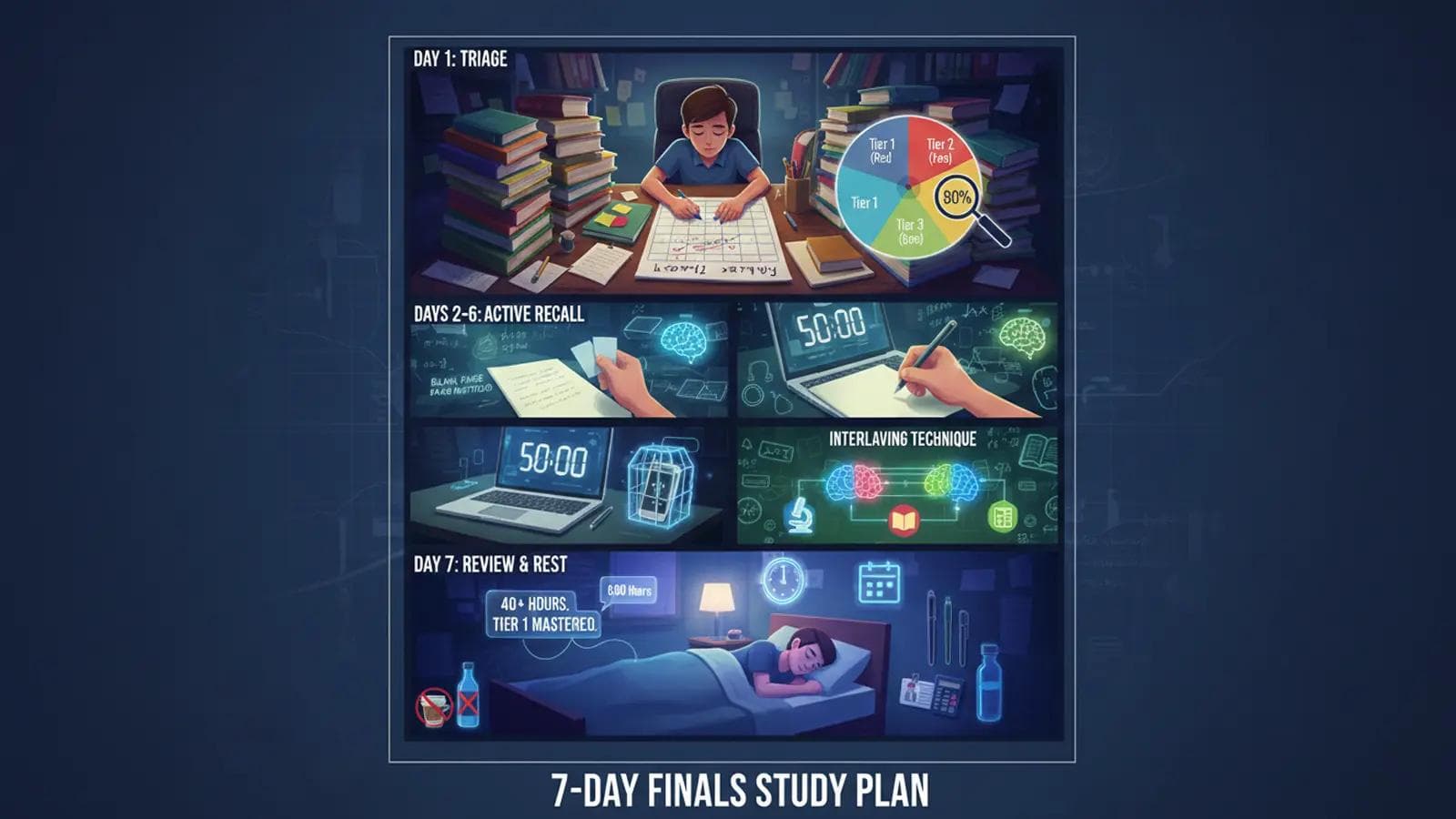
Introduction: Finals week is seven days away. You've been "planning" to study for weeks, but between assignments, social life, and sheer procrastination, you're now staring at a mountain of material with very little time. Panic is setting in. Before you resign yourself to failure or pull three all-nighters in a row, read this. This is your emergency 7-day finals study plan—a scientifically-backed system for cramming effectively when time is not on your side.
Day 1: The Triage Phase (3-4 Hours)
Today is NOT a study day. It's a planning day. Cramming without a plan is like driving without a map—you'll burn fuel and get nowhere.
Step 1: Gather Your Materials
Collect everything for every exam:
- Lecture notes
- Textbook chapters
- Study guides from your professor
- Old homework assignments
- Practice exams (if available)
Step 2: The "Triage" System
You don't have time to learn everything. You must prioritize ruthlessly using this three-tier system:
- Tier 1 (Must Know): Concepts the professor emphasized repeatedly, topics on the study guide, anything that appeared on past exams. These are high-probability test questions. This is 40% of the material.
- Tier 2 (Should Know): Important concepts but not repeatedly emphasized. This is another 40% of the material.
- Tier 3 (Nice to Know): Obscure details, footnotes, and tangents. You will NOT study these. You're sacrificing the 20% to master the 80%. This is the 80/20 rule in action.
Step 3: Create Your 7-Day Study Schedule
Break down Tier 1 and Tier 2 material across the next six days. Assign each subject a specific time block. Write this on paper. This schedule is your lifeline.
Days 2-6: The Active Recall Grind (8-10 Hours per Day)
This is where the work happens. But "work" doesn't mean passively re-reading your notes. That's the #1 mistake students make when cramming.
The Golden Rule: Active Recall Only
For every topic, you must force your brain to retrieve the information, not just recognize it.
Bad Study Methods (Passive):
- Re-reading notes
- Highlighting
- Watching lecture summaries
Good Study Methods (Active):
- The Blank Page Method: Close your notes. Write down everything you remember about Topic X on a blank page. Then, check your notes and fill in the gaps. Repeat.
- Flashcards (Digital or Paper): Use Anki or Quizlet. The act of trying to recall the answer (before flipping the card) is what creates long-term memory.
- Practice Problems (For STEM): Don't just "look at" the solution. Cover it up and try to solve it yourself. Get stuck. Look at the solution. Try again.
- Teach It Out Loud: Explain the concept to an empty room, a friend, or your pet. If you can't explain it simply, you don't understand it.
The 50/10 Study Blocks
Your brain cannot focus for 8 straight hours. Use the Pomodoro Technique on steroids:
- 50 minutes: Deep, distraction-free study (phone in another room).
- 10 minutes: Stand up, walk around, stretch, grab a snack.
Repeat this cycle 8-10 times per day. This is 400-500 minutes (6.5-8 hours) of actual study time, which is more than most students do in a week.
The Interleaving Technique
Don't study one subject for 8 hours straight. Your brain will glaze over. Instead, interleave your subjects:
- 9:00 AM - 10:00 AM: Biology (Tier 1)
- 10:10 AM - 11:10 AM: History (Tier 1)
- 11:20 AM - 12:20 PM: Math (Tier 1)
This forces your brain to "reload" different types of information, which improves retention.
Day 7: The Review & Rest Day (4-5 Hours)
The day before your first exam is NOT an all-nighter. It's a strategic review and recovery day.
Morning: The "Greatest Hits" Review (3 Hours)
Do not learn anything new. Only review your Tier 1 material. Go through your flashcards, your "blank page" summaries, and any practice exams. Focus on your weak spots—the topics where you got stuck during Days 2-6.
Afternoon: The Pre-Exam Logistics
- Check the Exam Location: Know exactly where you're going and how long it takes to get there.
- Prep Your Materials: Pencils, pens, calculator, student ID, water bottle. Lay them out the night before.
- Prep Your "Brain Dump" Sheet: Write down key formulas, dates, or concepts you're afraid of forgetting on a single sheet. You won't bring this into the exam, but reviewing it 30 minutes before the test helps lodge it in short-term memory.
Evening: Sleep is Non-Negotiable (8 Hours)
This is the most important part of the plan. Sleep is when your brain consolidates everything you crammed into long-term memory. If you pull an all-nighter, you're sabotaging 6 days of hard work.
The Sleep Protocol:
- No caffeine after 2 PM.
- No screens 1 hour before bed.
- Set your alarm for 8 hours from now.
- Lay down, and do the 4-7-8 breathing technique (inhale for 4, hold for 7, exhale for 8, repeat 4 times).
The Night-Before Panic Attack: How to Calm Down
Your brain will try to sabotage you. At 10 PM, it will whisper, "You don't know enough. You're going to fail." This is normal. Here's how to handle it:
- The "Fact vs. Feeling" Exercise: Write down your fear: "I feel like I'm going to fail." Then, write the fact: "I studied for 40+ hours this week using active recall. I know Tier 1 material well. I have done everything I can."
- The "Worst Case" Reframe: Ask yourself, "What is the actual worst thing that happens if I fail this exam?" You retake it. You get a B instead of an A. Your life continues. This removes the catastrophic thinking.
What About Energy Drinks and Study Drugs?
Caffeine: One cup of coffee in the morning is fine. More than that, and you'll crash by 2 PM and wreck your sleep.
Energy Drinks: No. The sugar crash will destroy your focus.
"Study Drugs" (Adderall, Ritalin without a prescription): Absolutely not. They're illegal, dangerous, and they don't make you "smarter." They just make you feel focused while your actual comprehension stays the same (or drops). Plus, they destroy your sleep, which ruins memory consolidation.
Conclusion: Cramming is a Band-Aid, Not a Strategy
Let's be clear: this 7-day plan is an emergency protocol. It's not optimal. The best way to study is spaced repetition over weeks, not cramming over days. But if you're here, you're already behind, and this plan gives you the best chance to survive finals week. After this, commit to better habits next semester. Use active recall, start early, and never let yourself get here again.
Frequently Asked Questions
Instrumental music (classical, lo-fi beats) is fine. Music with lyrics will compete for your brain's language-processing resources and hurt comprehension. For maximum focus, study in silence or with white noise.
Only if you're actually testing each other (e.g., quizzing with flashcards). "Group study" where you just chat about the material is passive and ineffective. 90% of your study time should be solo, active recall.
Prioritize by weight/difficulty. If one exam is worth 40% of your grade and another is worth 20%, give the 40% exam double the study time. Also, use the "interleaving" method even more aggressively—switch subjects every 50 minutes to keep your brain fresh.
Written by Daily Motivation Team
Sharing motivational content to inspire your journey to success.
Related Articles
 Creativity
Artistic Inspiration: A Complete Guide
Artistic inspiration isn't luck — it's a trainable skill. Learn 7 daily practices that keep ideas flowing.
 stoic
stoicStoic Quotes on Discipline: Where Stoicism Meets Self-Mastery
Discover powerful stoic quotes on discipline from Marcus Aurelius, Seneca, and Epictetus — plus how to apply them today.
 stoic
stoicBest Stoic Quotes for Hard Times: Wisdom for Modern Struggles
Powerful Stoic quotes for hard times from Marcus Aurelius, Seneca & Epictetus — wisdom that turns adversity into strength.
 stoic
stoicBest Stoic Quotes for Beginners: Where to Start Your Practice
Discover the best stoic quotes for beginners and a simple 7-day plan to turn ancient wisdom into daily practice.