
How to Validate Your Business Idea: The Ultimate Guide
Stop guessing. Learn the 5-step framework to validate your business idea with real data and paying customers before you invest months building it.
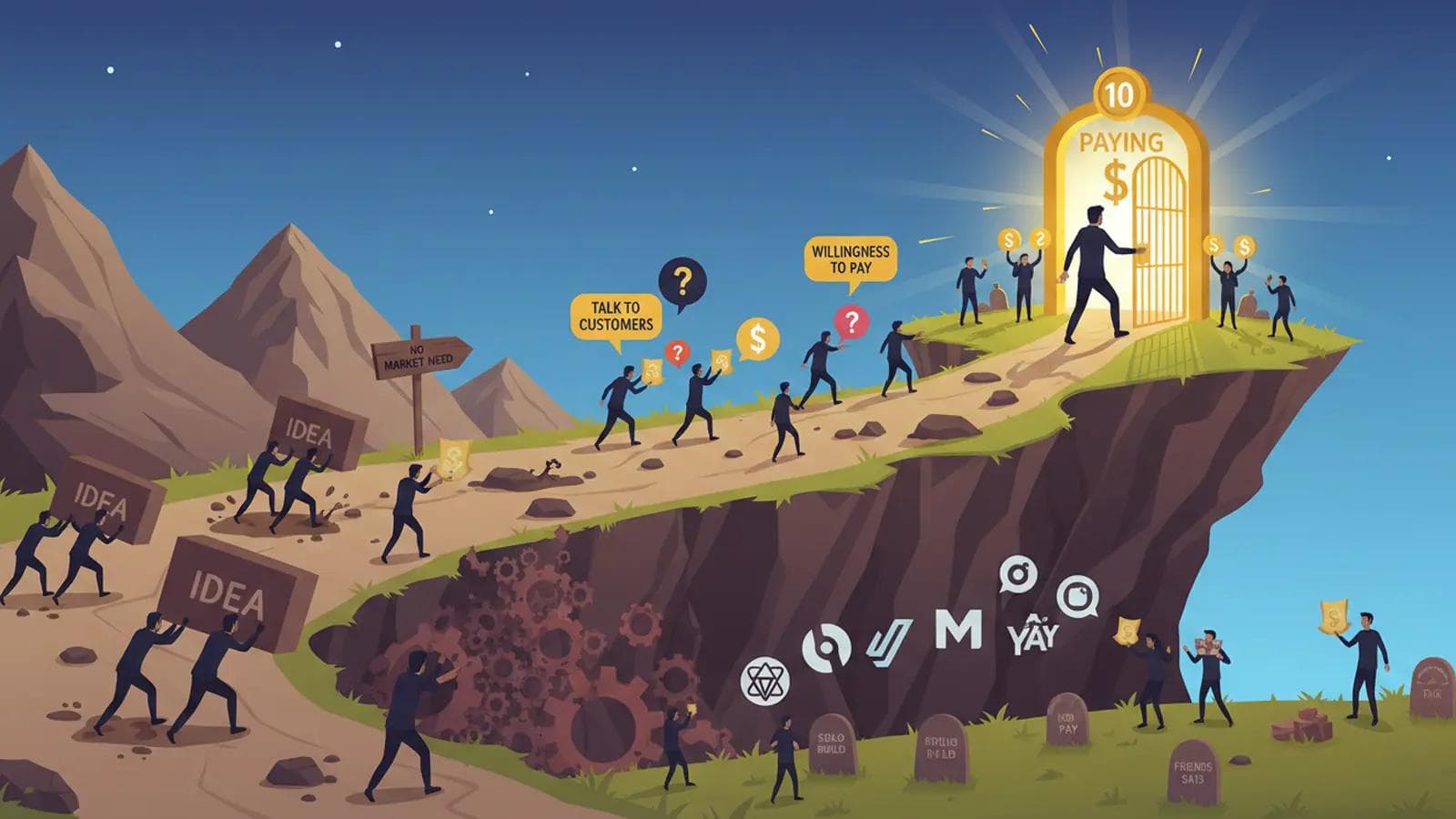
Introduction: You have "The Idea." It keeps you up at night. You're convinced it's going to change the world. You quit your job, spend six months and $50,000 building it, and launch to... crickets. Nobody buys it. This is the story of 90% of failed startups. They didn't fail because the idea was bad. They failed because they never asked the most important question: "Do people actually want this?" This guide shows you how to validate your business idea with real customers before you risk a single dollar.
The #1 Reason Startups Fail
According to CB Insights' analysis of 101 startup post-mortems, the #1 reason startups fail (42% of cases) is: "No market need." They built something nobody wanted. The solution wasn't the problem—the problem was the problem. Either the problem didn't exist, or it wasn't painful enough for people to pay to solve it.
The Validation Mindset: Your idea is not a "fact." It's a hypothesis. Your job as an entrepreneur is to test that hypothesis as quickly and cheaply as possible before you commit to building.
The 5-Step Validation Process (Before You Build Anything)
Step 1: Define Your Hypothesis (The "If-Then" Statement)
Don't just say "I have an idea for a meal-planning app." That's too vague. Turn it into a testable hypothesis.
The Formula: "If [target customer] has [specific problem], then they will [desired action] because [core value proposition]."
Example: "If busy working moms (target customer) struggle to plan healthy meals for their family (problem), then they will pay $15/month for an app that auto-generates meal plans and shopping lists (desired action) because it saves them 3+ hours per week (value proposition)."
This hypothesis is now testable. You have a clear target customer, a problem, an action, and a value.
Step 2: Talk to 10-20 Target Customers (The "Mom Test")
This is the most critical step, and it's where most entrepreneurs fail. They either:
- Skip it entirely (fatal mistake).
- Talk to the wrong people (friends and family who lie to protect your feelings).
- Ask the wrong questions (leading questions that confirm their bias).
The Mom Test (By Rob Fitzpatrick): The rule is: you should be able to ask your mom about your idea, and even if she loves you and wants to protect your feelings, the questions are so good that she can't lie.
Bad Questions (Leading/Hypothetical):
- "Would you use an app that helps you plan meals?"
- "If I built this, would you buy it?"
People will say "yes" to be polite. This data is worthless.
Good Questions (Past Behavior/Specifics):
- "Tell me about the last time you struggled to plan meals. Walk me through what happened."
- "What have you tried in the past to solve this problem? Why did it fail?"
- "How much time/money does this problem currently cost you per week?"
- "If I had a magic wand and could solve this perfectly, what would that look like?"
The Goal: You're not selling. You're learning. You want to understand:
- Is this problem real and painful?
- Have they actively tried to solve it (spent time or money)?
- How do they currently solve it (your competition)?
- What would make them switch to a new solution?
Step 3: Test Willingness to Pay (The "Smoke Test")
Talking is one thing. Paying is another. The ultimate validation is: will someone give you money?
Method 1: The Landing Page + Pre-Order
Build a simple 1-page website that describes your product/service (with mockups, not a real working product). End with a "Pre-Order Now" or "Join the Waitlist" button.
The Test: Drive 100-500 people to this page (using Facebook Ads, Reddit posts, or your personal network). Track:
- How many people click the "Pre-Order" button?
- How many actually enter their credit card?
The Validation Metric:
- If 5-10% of visitors pre-order or join a paid waitlist, you have strong validation.
- If less than 1% engage, your idea is not compelling enough. Go back to Step 1.
Example: Dropbox famously used a 3-minute explainer video as their "smoke test." They didn't have a working product. The video showed what it would do. Their beta waitlist exploded from 5,000 to 75,000 overnight. Validated.
Method 2: The "Concierge MVP"
This is a manual, behind-the-scenes version of your idea, done for 5-10 customers.
Example: You want to build an AI-powered resume-writing service. Before you build the AI, you manually write 10 resumes yourself for $50 each. If people pay and are happy, you've validated that the problem (need help with resumes) and the price point ($50) are real. Now you can build the tech.
Method 3: The "Pay Before It Exists" Test
This is the boldest move. Sell your product before it exists.
Example: "I'm building [Product X]. It will be ready in 6 weeks. The price will be $99, but if you pre-order today, it's $49. Are you in?"
If people say yes and hand you money, you have the ultimate validation. Now you're obligated to build it, which is great motivation.
Step 4: Analyze the Competition (The "Graveyard Test")
If you're the first person in history to think of this idea, that's not a good sign. It usually means there's no market. The existence of competitors is actually validation that the problem is real and people will pay to solve it.
The Two-Part Question:
- Who are your competitors (direct and indirect)?
- Why did previous attempts fail (or if they're succeeding, what gap are you filling)?
How to Research:
- Google: "[Your idea] competitors"
- Search Product Hunt, AngelList, Crunchbase for similar startups.
- Check Reddit, Quora, and niche forums. What are people complaining about with current solutions?
The Goal: You want to find a "gap." Maybe current solutions are too expensive, too complicated, or focused on enterprises when there's a need for small businesses. That gap is your opportunity.
Step 5: The "10 Paying Customers" Milestone
This is your final validation. Before you quit your job, before you raise money, before you build a "full" product, your goal is to get 10 paying customers for a scrappy, imperfect version of your idea (your MVP).
Why 10?
- 1-2 customers could be friends doing you a favor.
- 3-5 customers is progress but could be luck.
- 10 customers is a pattern. It's proof that there's a repeatable process to find people with this problem who will pay you to solve it.
The Challenge: If you can't get 10 people to pay you for a basic version, you will never get 10,000 people to pay for a polished version. The problem isn't your execution—it's your idea.
Red Flags That Your Idea Isn't Validated
- "Everyone I talked to loved it!" You talked to friends/family or asked leading questions.
- "I just need to build it first, then I'll find customers." No. Find customers first (even 5-10), then build.
- "My idea is so unique, there's no competition." This means there's no market. Competition is validation.
- "People said they'd use it, but they haven't paid yet." Talk is cheap. Validation is payment.
What If My Idea Fails Validation?
This is a gift. You just saved yourself 6-12 months and tens of thousands of dollars. Now you can pivot:
- Pivot the Problem: Maybe the problem you thought existed doesn't, but you discovered a different painful problem during your customer interviews.
- Pivot the Customer: Maybe busy moms don't need meal-planning, but busy gym owners do.
- Pivot the Solution: Maybe they don't need an app—they need a weekly email with a meal plan.
Failure at the validation stage is cheap. Failure after building is expensive.
Conclusion: Validate Fast, Fail Cheap
The Lean Startup methodology has one mantra: "Build-Measure-Learn." But the real secret is to measure and learn before you build. Talk to real customers. Test willingness to pay. Get 10 people to hand you money for an imperfect version. If you can do this, you have a real business. If you can't, you have a hobby (or a lesson learned). Validate first, build second.
Frequently Asked Questions
Go where your target customers already are. If you're targeting working moms, join Facebook groups for working moms. If you're targeting freelance designers, join Reddit communities or Slack groups for designers. Offer a $10 Starbucks gift card for a 20-minute call. Most people will say yes.
Ideas are worthless. Execution is everything. No one will "steal" your idea from a customer interview. And if they do, they'll fail too because they haven't done the validation work. Focus on learning, not protecting.
Charge more than you think. If your "final" product will cost $100, charge $80 for the MVP. If people won't pay 80% of your target price for a basic version, they won't pay 100% for a fancy version. Price is part of the validation test.
Written by Daily Motivation Team
Sharing motivational content to inspire your journey to success.
Related Articles
 manifestation
O Method Manifestation: A Complete Guide
Learn how the O Method manifestation works, why it's so effective, and exactly how to practice it for real results.
 stoic
stoicEpictetus Top 30 Quotes: The Discourses Made Accessible
Discover the top 30 Epictetus quotes from the Discourses and Enchiridion — timeless Stoic wisdom made simple and actionable.
 stoic
stoicModern Stoicism: How to Apply Ancient Wisdom in 2026
Discover how modern stoicism turns 2,000-year-old wisdom into a practical toolkit for calm, focus, and resilience in 2026.
 stoic
stoicDaily Stoic Meditation Guide: 10 Minutes Each Morning
Build a daily stoic meditation practice in just 10 minutes each morning — the exact ritual, sources, and mistakes to avoid.