
Proven Cold Email Templates That Get Replies
Tired of sending cold emails that get ignored? This guide reveals a proven 5-step framework for writing messages that actually get opened and repli...
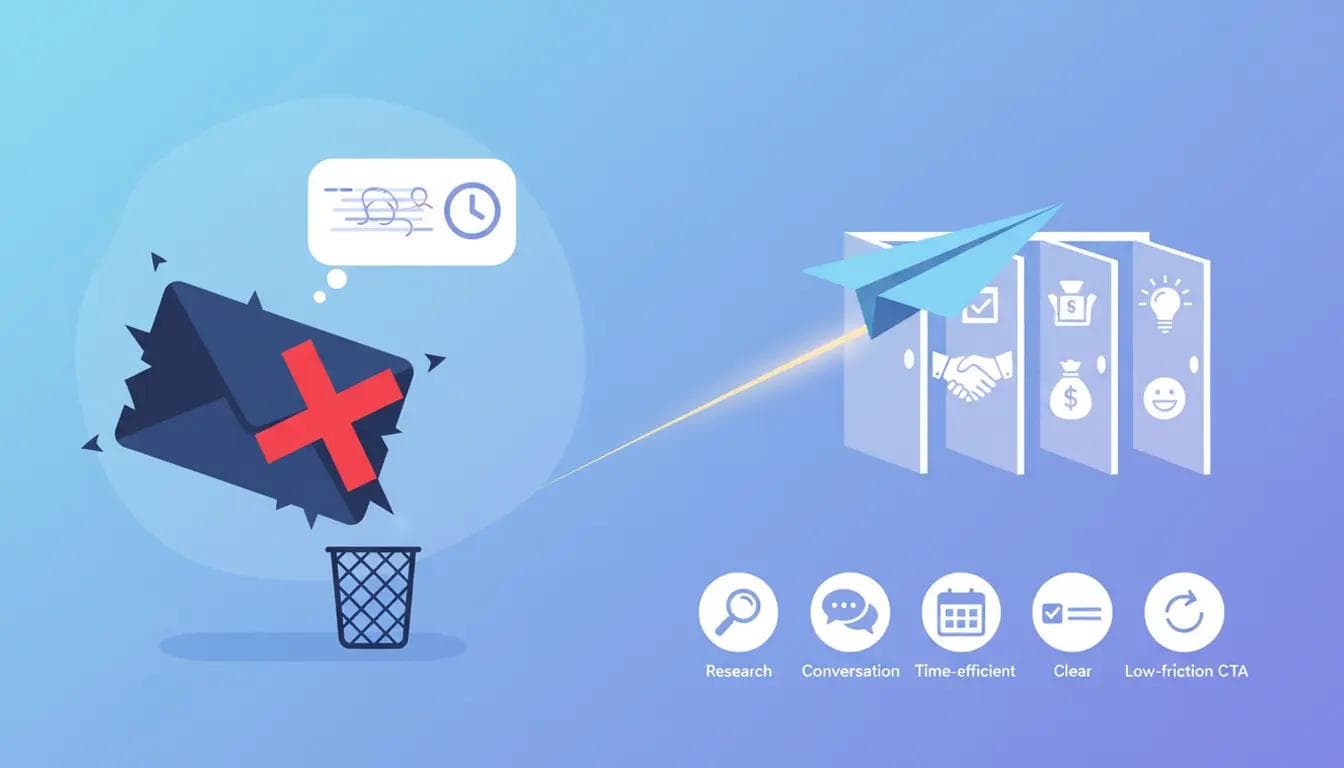
Your Cold Emails Are Being Ignored. Here's How to Fix It.
The average professional receives over 120 emails per day, and research shows most are deleted in under three seconds. So how do you make your message the one that breaks through the noise, avoids the trash folder, and actually gets a reply? You stop writing emails like everyone else.
Most advice on how to write cold emails is generic and outdated. It leads to selfish, long, jargon-filled messages that scream "I want something from you." This guide is different. We're throwing out the old playbook and giving you a proven, step-by-step framework built on respect, value, and precision. This is the exact method I used to land my first 10 paying customers with a 27% reply rate, and it can help you open doors you thought were permanently locked.
This isn't just about templates; it's about learning the strategy behind writing effective cold emails that build relationships and get results.
What is a Cold Email (And What It Isn't)?
A cold email is your first point of contact with someone you don't know, sent without any prior introduction. It's a proactive way to connect with potential customers, partners, mentors, or employers.
However, a successful cold email is NOT:
- Spam: Spam is generic, sent in bulk to an untargeted list, and often deceptive. Effective cold emailing is highly personalized, relevant, and sent one-to-one or to a small, curated list.
- A Sales Pitch: Its primary goal isn't to close a deal on the spot. The goal is to start a conversation. It's the first step, not the last.
- A Demand for Their Time: It doesn't ask for a 30-minute demo or a long phone call. It offers value first and proposes a simple, low-friction next step.
Understanding this distinction is the first step in mastering your cold email outreach strategy.
The Foundation: 3 Things You Must Do Before You Write
Great cold emails are won before you even type Hi [Name]. The quality of your preparation directly determines your success rate.
1. Define Your Ideal Prospect Profile (IPP)
Don't email everyone. Define exactly who you need to reach. Get specific:
- Industry: SaaS, E-commerce, Real Estate?
- Company Size: 10-50 employees? Fortune 500?
- Job Title: Head of Marketing? VP of Engineering? Founder?
- Pain Points: What specific problems does this person face daily that you can solve?
Action Step: Create a one-sentence IPP. For example: "I am targeting VPs of Sales at B2B SaaS companies with 50-200 employees who are struggling with lead generation quality."
2. Build a Hyper-Targeted List
Once you have your IPP, build a small, high-quality list. Quality over quantity always wins. Use tools like LinkedIn Sales Navigator, Apollo.io, or even manual Google searches to find 25-50 people who perfectly match your profile. Then, find their email addresses using tools like Hunter.io or RocketReach.
3. Conduct 3-Minute Research on Every Prospect
This is the non-negotiable step that separates the pros from the amateurs. For every single person on your list, spend three minutes finding a genuine, specific "hook." Look for:
- Recent LinkedIn posts or articles they've written.
- Interviews or podcasts they've appeared on.
- A recent company announcement (funding, product launch, new hire).
- A quote from them in a news article.
- Shared connections or alma mater.
This hook is the foundation of your personalization and proves your email isn't just another automated blast.
How to Write Cold Emails That Get Replies: A 5-Step Framework
Now that you've done the prep work, it's time to write. Follow this five-step process for every email you send.
Step 1: Craft an Irresistible Subject Line
The subject line has one job: get the email opened. It must be intriguing, personal, and short. Avoid clickbait or deceptive titles. Aim for under 50 characters to ensure it's fully visible on mobile devices.
Subject Line Formulas That Work:
- The Quick Question:
Question about [Their Project/Article] - The Referral:
[Referral Name] suggested I reach out - The Common Ground:
[Shared Connection/Interest] connection - The Value Prop:
Idea for [Their Company's Goal]
Before: Our #1 Marketing Automation Solution After: Question about the new HubSpot integration
The second one is specific, relevant, and creates curiosity without sounding like a sales pitch.
Step 2: Write a Hyper-Personalized Opening Line
This is where your 3-minute research pays off. The first sentence must prove this email was written specifically for them. It immediately builds rapport and earns you the right to their attention for another 15 seconds.
Opening Line Examples:
Hi [Name], just saw your post on LinkedIn about the challenges of remote team management – completely agree with your take on asynchronous communication.Hi [Name], I was really impressed by your recent talk at the SaaS North conference, especially your point on product-led growth.Hi [Name], I'm a huge admirer of how [Their Company] has navigated the recent supply chain issues mentioned in Forbes.
This single sentence changes the entire dynamic of the interaction.
Step 3: Present a Clear and Concise Value Proposition
Now that you have their attention, you have 2-3 sentences to connect their world to yours. This is not a feature list. It's a clear statement that shows you understand their problem and have a relevant solution. This is a critical part of how to write cold emails that convert.
Use the Problem-Agitate-Solution (PAS) framework in miniature:
- Problem: Briefly mention a pain point related to your opening hook. (
Managing async comms can be tough...) - Agitate: Hint at the negative consequences. (
...especially when it comes to keeping projects on track.) - Solution: Introduce your value in one sentence. (
We built a lightweight tool that integrates with Slack to help marketing teams at companies like yours cut down on project update meetings by 50%.)
Step 4: Use a Low-Friction Call-to-Action (CTA)
This is where most cold emails fail. They ask for too much, too soon. A busy executive is not going to book a 30-minute demo with a stranger based on one email. Your goal is to make saying "yes" as easy as possible.
CTA Comparison: Hard Ask vs. Soft Ask
- Hard Ask (Avoid):
Are you free for a 30-minute demo next week?Can we schedule a call to discuss this further?Let me know what time works for you to connect.- Soft Ask (Use This):
Is this something you're currently exploring?Would you be open to learning more?Mind if I send over a short, 2-minute video explaining how it works?
The soft ask gauges interest and requires a simple "yes" or "no" reply, dramatically increasing your chances of getting one. It's a fundamental part of a modern cold email strategy.
Step 5: Keep Your Signature Professional and Minimal
Your signature should build credibility, not distract. Don't include images, inspirational quotes, or five different social media links.
All you need is:
- Your Name
- Your Title & Company
- A link to your LinkedIn profile or company website
That's it. Keep it clean and professional.
Cold Email Templates That Actually Work
Here are a few templates that put our 5-step framework into practice. Remember to customize these heavily with your own research.
Template 1: The SaaS Sales Cold Email
Subject: Question about [Their Company]'s content strategy
Hi [Name],
I just read your latest blog post on [Topic], and I loved your insight on using data to inform content creation. It's clear you're building a content machine at [Their Company].
I see you're using [Tool] for your analytics. Many content leads I speak with find it challenging to translate that data into actionable, SEO-optimized briefs for their writers. We actually built a tool that plugs into your existing analytics and auto-generates content briefs based on your top-performing articles.
Is improving content workflow something on your radar right now?
Best,
[Your Name] [Your Title, Company] [LinkedIn Profile Link]
Template 2: The Link Building / SEO Outreach Email
Subject: Your article on [Topic]
Hi [Name],
I'm a long-time reader of the [Their Blog] blog. Your guide to [Topic] is one of the most comprehensive I've seen – I especially appreciated the section on [Specific Point].
While reading, I noticed you mentioned [Related Concept] but didn't have a resource linked for it. My team just published an in-depth, data-backed guide on that exact topic, including [Statistic or Finding]. It might be a helpful addition for your readers.
Would you be open to taking a look?
Cheers,
[Your Name] [Your Title, Company] [Website Link]
Template 3: The Networking / Mentor Request Email
Subject: Your journey from [Old Role] to [New Role]
Hi [Name],
I've been following your career path for a while, and I was incredibly inspired by your recent interview on the [Podcast Name] podcast. Your advice on making the transition from a technical role to a leadership position really resonated with me.
As a [Your Role] currently navigating a similar path, I'm working on improving my [Specific Skill]. Given your experience, I was hoping you might have a quick piece of advice or a resource you'd recommend for someone in my position.
Any insight you could share would be greatly appreciated.
Thank you,
[Your Name] [Your Title, Company] [LinkedIn Profile Link]
The Art of the Follow-Up: How to Double Your Reply Rate
Did you know that sending just one follow-up email can boost replies by over 65%? Most people give up after the first attempt. Your persistence, when done respectfully, will set you apart. This is a crucial part of any cold email outreach.
The Simple 2+1 Follow-Up Formula:
- First Follow-Up (2-3 days later): Reply to your original email. Keep it short and simple. The goal is to bump your message to the top of their inbox.
- Second Follow-Up (4-5 days after that): Reply to the same thread again. Add a new piece of value, like a relevant case study, a helpful article (not your own), or a new thought. Then, use a "break-up" line to close the loop gracefully.
Follow-Up Template:
Hi [Name],
Just wanted to gently bump this to the top of your inbox. Is this something that might be of interest?
Thanks,
[Your Name]
Break-Up Email Template:
Hi [Name],
I know you're busy, so I won't follow up on this again. If you're ever looking to improve [Their Goal], please don't hesitate to reach out.
All the best,
[Your Name]
7 Common Cold Email Mistakes to Avoid
Even with the best intentions, small mistakes can kill your reply rate. Here's what to avoid:
- Wall of Text: Keep paragraphs to 1-3 sentences. Make it scannable.
- Vague Subject Lines:
HelloorIntroductionwill be ignored. - Weasel Words: Avoid phrases like
I think,maybe, orperhaps. Be confident. - Unsolicited Attachments: Never attach files. This triggers spam filters and is a security risk.
- Poor Grammar/Typos: Proofread every email twice. Use a tool like Grammarly. grammarly-review-for-sales-teams
- It's All About You: Count the number of times you use "I" vs. "you." The "you" count should be higher.
- A Confusing CTA: Don't ask two questions in your CTA. Make one simple, clear request.
Mastering how to write cold emails is a skill that pays dividends for a lifetime. It's not about finding the perfect magic template; it's about shifting your mindset from asking to giving. By focusing on the recipient, providing genuine value, and respecting their time, you can turn cold outreach from a dreaded task into your most powerful tool for growth. For more tips on finding the right people to email, check out our ultimate-guide-to-sales-prospecting.
Frequently Asked Questions
A good reply rate for a highly targeted cold email campaign is typically between 5% and 20%. Anything below 1-2% suggests an issue with your list, subject line, or email copy. Rates above 20% are exceptional and usually involve deep personalization.
The ideal length for a cold email is between 50 and 125 words. This is short enough to be scanned quickly on a mobile device. Focus on being clear and concise, with short sentences and paragraphs.
Cold emailing is legal in most places, including the U.S. under the CAN-SPAM Act, provided you follow certain rules. These include not using deceptive subject lines, providing a clear way to opt-out, and including your physical address. In Europe, GDPR rules are stricter and require a 'legitimate interest' for contacting a business prospect.
A good rule of thumb is to send 2-3 follow-up emails in total, spaced a few days apart. Sending more than four emails without any response can be perceived as spammy. A final 'break-up' email can be an effective way to close the loop professionally.
Written by Daily Motivation Team
Sharing motivational content to inspire your journey to success.
Related Articles
 Creativity
Artistic Inspiration: A Complete Guide
Artistic inspiration isn't luck — it's a trainable skill. Learn 7 daily practices that keep ideas flowing.
 stoic
stoicStoic Quotes on Discipline: Where Stoicism Meets Self-Mastery
Discover powerful stoic quotes on discipline from Marcus Aurelius, Seneca, and Epictetus — plus how to apply them today.
 stoic
stoicBest Stoic Quotes for Hard Times: Wisdom for Modern Struggles
Powerful Stoic quotes for hard times from Marcus Aurelius, Seneca & Epictetus — wisdom that turns adversity into strength.
 stoic
stoicBest Stoic Quotes for Beginners: Where to Start Your Practice
Discover the best stoic quotes for beginners and a simple 7-day plan to turn ancient wisdom into daily practice.