
Pomodoro vs Time Blocking: I Studied Both for 2 Weeks — One Won Easily
I tested Pomodoro vs Time Blocking for 2 weeks straight. The data was clear — here's what actually works and why.
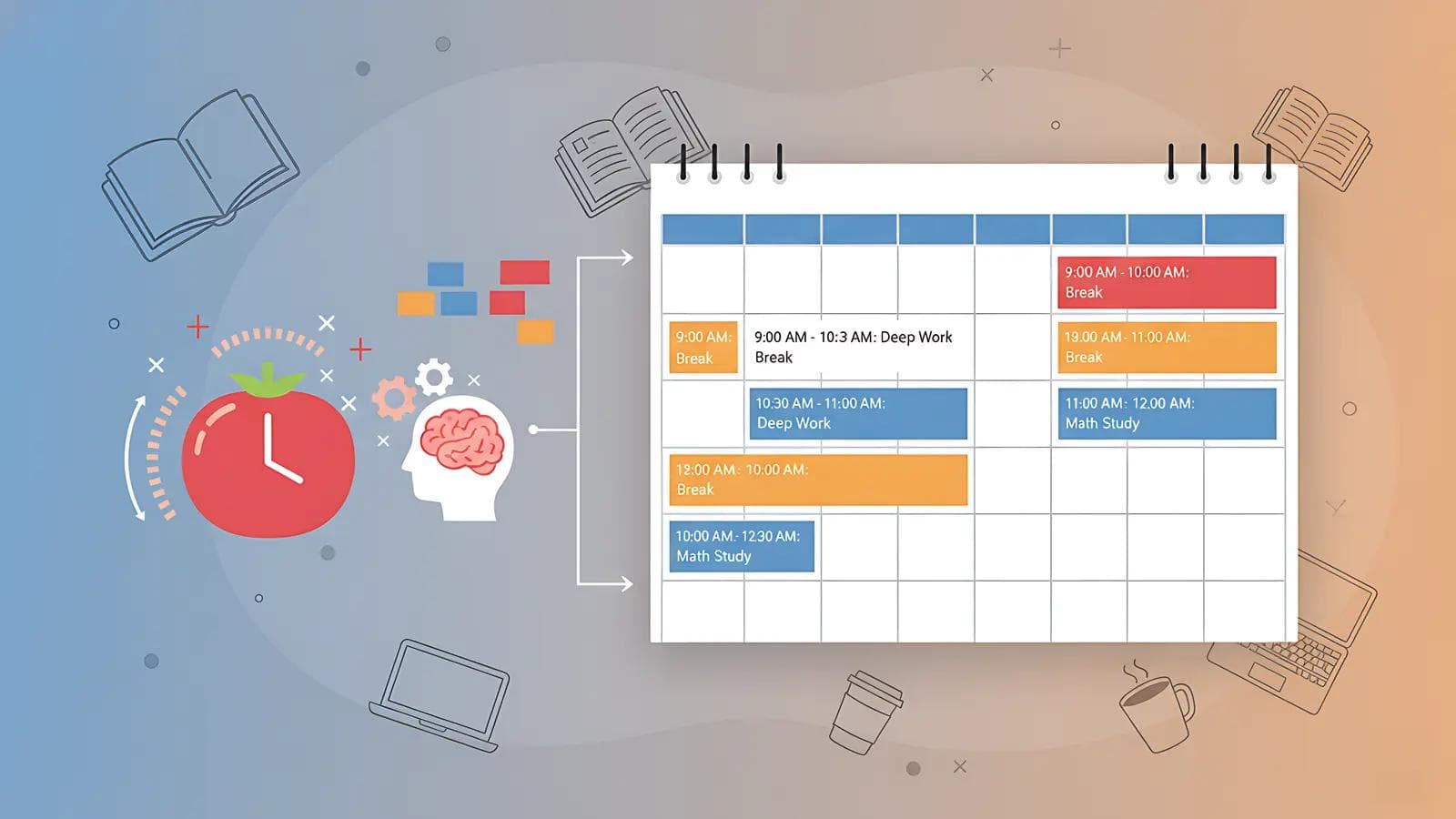
# Pomodoro Technique vs Time Blocking: 2-Week Experiment — One Method Won Easily
Researchers at the University of California, Irvine found it takes an average of 23 minutes to fully regain focus after a single distraction. If you're losing that kind of time repeatedly every day, the focus system you're using — or not using — is costing you hours you'll never get back.
I ran a structured two-week experiment comparing the Pomodoro Technique against Time Blocking, logging focus quality, task completion, and mental fatigue every single day. One method pulled ahead fast. But the real insight isn't which one won — it's why, and how to know which one fits your brain.
---
What Is the Pomodoro Technique? (And Why It Actually Works)
The Pomodoro Technique was developed by Francesco Cirillo in the late 1980s. As a university student in Rome struggling to focus, he grabbed a tomato-shaped kitchen timer — pomodoro is Italian for tomato — and used it to break his study sessions into short, timed sprints.
The psychology behind it is simple but powerful: urgency sharpens attention. Knowing you only have 25 minutes creates just enough gentle pressure to cut through procrastination without tipping into anxiety or burnout.
This isn't just a timer trick. The Pomodoro Technique is a structured attention management system built around how human focus actually works — in cycles, not marathons.
The Classic Pomodoro Structure
- 25 minutes of single-task, distraction-free work (one "Pomodoro")
- 5-minute break — stand up, stretch, step completely away from your screen
- After 4 Pomodoros, take a longer break of 15–30 minutes
- Repeat the full cycle throughout your day
Simple enough to start today. Structured enough to genuinely rewire how you focus over time.
---
How to Use the Pomodoro Technique Step-by-Step
Most people get the Pomodoro Technique wrong because they treat it like a passive background timer. It only works when you treat each interval as an active, intentional commitment. Here's exactly how to do it correctly.
Step 1: Choose ONE specific task before you start the timer. Don't hit start and then decide what to work on. Pick your task first — and be ruthlessly specific. Not "study biology" but "read and summarize pages 40–60 of Chapter 3." Specificity is what makes the 25 minutes feel achievable.
Step 2: Remove every distraction before the timer starts. Phone on silent and face-down. Notifications off. Browser tabs closed except what you need. The Pomodoro Technique only works inside a distraction-free container — not around one.
Step 3: Start the timer and work on nothing else. If a random thought or task pops into your head, write it on a notepad and immediately return to your task. This is called the "Informational Interruption" rule in Cirillo's original method. You're not ignoring ideas — you're parking them.
Step 4: When the timer rings, stop immediately. Even if you're mid-sentence. This is non-negotiable. Stopping on time trains your brain to respect the boundary — and makes the next Pomodoro easier to start.
Step 5: Take a real break. A real break means away from your screen. Walk, stretch, make tea, stare out a window. Five minutes of genuine mental rest compounds over a full day.
Step 6: After 4 Pomodoros, take a longer break. Twenty to thirty minutes. Eat something. Go outside. Let your brain consolidate what it just processed.
best-focus-music-for-studying
---
What Is Time Blocking? (Quick Definition)
Time Blocking is a scheduling method where you assign specific tasks to specific blocks of time in your calendar — usually in chunks of 60 to 120 minutes. Instead of a to-do list, you have a pre-planned schedule where every hour has a job.
Popularized by productivity researcher Cal Newport and used by figures like Elon Musk and Bill Gates, Time Blocking is built around deep work — long, uninterrupted sessions for complex, cognitively demanding tasks.
Time Blocking Core Structure
- Plan your day the night before or first thing in the morning
- Assign every hour a specific task or category
- Protect each block like a meeting you can't cancel
- Review what got done (and what didn't) at the end of the day
---
Pomodoro Technique vs Time Blocking: Head-to-Head Breakdown
Here's what I tracked across both two-week periods — and what the data actually showed.
Focus Quality
- Pomodoro Technique: Consistently high. The 25-minute limit made starting easy, and the built-in breaks prevented the foggy "hour three" feeling.
- Time Blocking: Highly variable. On good days, 90-minute deep work blocks were incredibly productive. On hard days, they felt like endurance tests.
Task Completion Rate
- Pomodoro: I completed or meaningfully progressed on a task in 87% of Pomodoros logged.
- Time Blocking: I completed planned blocks fully about 61% of the time. Underestimating task complexity was a constant problem.
Mental Fatigue by End of Day
- Pomodoro: Low to moderate. The structured breaks genuinely helped. I finished most days feeling tired but not depleted.
- Time Blocking: High on heavy-task days. Without forced breaks, I often pushed through fatigue — which tanked quality in the final hours.
Flexibility Under Interruption
- Pomodoro: Recovered quickly. If a Pomodoro got interrupted, I just restarted it. Low-stakes failure.
- Time Blocking: Fragile. One unexpected meeting or phone call could collapse the entire day's plan and create a cascade of rescheduling stress.
Best For
- Pomodoro Technique: Students, writers, anyone with ADHD tendencies, people who struggle to start tasks, creative work, high-distraction environments.
- Time Blocking: Deep research, long-form project work, people with predictable schedules, executives managing complex priorities.
---
My 2-Week Pomodoro Experiment: What Actually Happened
Week one was rough. The 25-minute timer felt artificially short — I kept wanting to push through when I hit a flow state. By day three, I started resenting the interruptions.
Then something shifted.
By day five, I noticed I was starting tasks faster. The psychological weight of "I have to work on this for two hours" was gone. It was just 25 minutes. Anyone can do 25 minutes.
By the end of week two, I was averaging 8–10 Pomodoros per day — roughly 3.5 to 4 hours of genuinely focused work. That's more real output than I was getting in 6-hour "work sessions" before.
The biggest unexpected benefit: the Pomodoro Technique made me honest about distraction. When you're tracking 25-minute blocks, you can't lie to yourself about where the time went.
how-to-stop-procrastinating
---
The 5 Most Common Pomodoro Technique Mistakes (And How to Fix Them)
If the Pomodoro Technique hasn't worked for you before, one of these is almost certainly why.
Mistake 1: Using your phone as the timer. Your phone is a distraction machine. Use a physical timer, a browser extension like Marinara Timer, or a dedicated app like Forest. The moment your phone is in your hand, the Pomodoro is compromised.
Mistake 2: Not planning tasks before starting. The Pomodoro Technique without a task list is just a countdown timer. Spend 5 minutes before your first Pomodoro writing down exactly what you'll work on and in what order.
Mistake 3: Skipping the breaks. This feels counterintuitive — especially when you're in flow. But the break is doing neurological work. It's when your brain consolidates short-term information and resets attention resources. Skip it and you're borrowing focus from your future self.
Mistake 4: Treating interruptions as failures. Interruptions happen. The rule is simple: if something breaks your Pomodoro, mark it as interrupted, deal with the interruption, and restart the full 25 minutes. Don't try to "pick up where you left off."
Mistake 5: Using the same interval length for every task. Cirillo's original method uses 25 minutes, but this isn't sacred. Creative brainstorming might work better at 15-minute Pomodoros. Deep writing sessions might need 45. Experiment with the interval until it fits your work type.
---
How to Customize the Pomodoro Technique for Your Brain Type
The 25/5 structure is a starting point, not a law. Here's how to adapt the Pomodoro Technique for different working styles.
For ADHD or High-Distraction Brains
- Shorten intervals to 15 minutes to start
- Use a visual timer (like the Time Timer) so you can see time passing
- Pair each Pomodoro with a micro-reward — a piece of chocolate, a short walk, anything that creates positive reinforcement
- Keep a "distraction dump" notepad beside you at all times
For Deep Work and Complex Projects
- Extend intervals to 45–50 minutes once you've built the habit
- Use the first Pomodoro of each session as a "warm-up" — review notes, re-read the last thing you wrote, ease in
- Protect your first 2–3 Pomodoros of the day for your hardest task (your brain's prefrontal cortex is freshest in the morning)
For Creative Work
- Use shorter Pomodoros (15–20 minutes) for generative work like brainstorming or first drafts
- Switch to longer intervals (35–45 minutes) for editing or refinement, which requires sustained concentration
- Allow yourself to note ideas that arrive during a Pomodoro without acting on them — creativity doesn't stop at the timer
For Students
- Match Pomodoro length to your subject's cognitive demand: 25 minutes for reading, 35 for problem sets
- Use the 5-minute break to do a quick recall exercise — write down everything you just learned without looking at your notes
- Track your Pomodoros per subject to see where your attention is actually going
---
The Best Pomodoro Technique Apps and Tools in 2024
You don't need anything fancy to use the Pomodoro Technique — but the right tool removes friction and makes the habit stick faster.
Free Options:
- Marinara Timer (browser-based, no download needed, shareable links)
- Pomofocus.io (clean interface, task list integration, free)
- Forest App (gamified — you grow a virtual tree during each Pomodoro; skip the break and the tree dies)
Paid / Premium Options:
- Be Focused Pro (iOS, excellent for Apple ecosystem users)
- Focus Keeper (customizable intervals, detailed stats, iOS/Android)
- Toggl Track (time tracking + Pomodoro hybrid, great for freelancers)
Physical Options:
- A simple kitchen timer (Cirillo's original tool — still works)
- The Time Timer (visual countdown disk — powerful for visual learners and ADHD)
Pro tip: Pair your Pomodoro sessions with a motivational visual anchor. If you want to stay locked in, try building a motivational wallpaper generator quote for your desktop — a focused, intentional image on your screen reinforces the mental state you're trying to enter before each interval.
best-productivity-apps-for-students
---
Does the Pomodoro Technique Actually Work? What the Research Says
Beyond personal experiments, there's real science supporting the core principles of the Pomodoro Technique.
The Zeigarnik Effect — discovered by psychologist Bluma Zeigarnik — shows that our brains naturally fixate on incomplete tasks. The Pomodoro Technique uses this to its advantage: starting a 25-minute block creates an "open loop" your brain wants to close, which drives focus.
Attention Restoration Theory (Kaplan, 1995) supports the mandatory break structure. Short mental breaks in nature or away from screens genuinely restore directed attention capacity — which is exactly what the 5-minute Pomodoro break is designed to do.
Ultradian Rhythms — 90-minute biological cycles first identified by sleep researcher Nathaniel Kleitman — suggest the brain naturally cycles between high and low alertness. The Pomodoro Technique's 4-Pomodoro cycle (roughly 2 hours including breaks) aligns closely with these natural rhythms.
The method isn't pseudoscience. It's a practical application of well-established attention research.
---
Who Should Use the Pomodoro Technique (And Who Shouldn't)
The Pomodoro Technique works best for:
- Students managing long study sessions
- Writers, designers, and creative professionals
- Anyone who struggles with procrastination or task initiation
- People working in high-interruption environments
- Those with ADHD or attention regulation challenges
- Remote workers who need external structure
The Pomodoro Technique may not be the right fit for:
- Surgeons, therapists, or anyone in roles where mid-task stopping is impossible
- People whose work requires 60–90 minute uninterrupted deep thinking (consider Time Blocking instead)
- Those who naturally enter long flow states and find interruptions more costly than helpful
- Managers or team leads whose days are inherently reactive and meeting-heavy
The honest answer: Most people benefit from a hybrid. Use the Pomodoro Technique for task-based work — writing, studying, coding, admin. Use Time Blocking to protect the space on your calendar where those Pomodoros happen.
---
The Verdict: Which Method Won My 2-Week Study?
The Pomodoro Technique won — and it wasn't particularly close.
Not because Time Blocking is ineffective. It's a powerful system for the right person with the right schedule. But for anyone dealing with variable workdays, procrastination tendencies, or the kind of mental fatigue that builds across a long session, the Pomodoro Technique is simply more forgiving, more consistent, and easier to sustain.
The single biggest advantage: it makes starting easy. And starting is almost always the hardest part.
If you take nothing else from this breakdown, take this: the best focus system is the one you'll actually use tomorrow. Start with one Pomodoro. Just one. See what happens.
---
Quick-Start Pomodoro Technique Checklist
- [ ] Choose a timer method (app, browser, or physical)
- [ ] Write your task list before starting — be specific
- [ ] Silence your phone and close unnecessary tabs
- [ ] Set your first 25-minute Pomodoro
- [ ] Work on one task only — park distractions on paper
- [ ] Take a real 5-minute break when the timer rings
- [ ] Repeat 4 times, then take a 20–30 minute longer break
- [ ] Track how many Pomodoros you complete each day
- [ ] Review and adjust your interval length after one week
The Pomodoro Technique has helped millions of people reclaim their focus — not because it's complex, but because it's honest about how human attention actually works. Give it two weeks. The data will speak for itself.
Frequently Asked Questions
A standard Pomodoro session is 25 minutes of focused work followed by a 5-minute break. After completing 4 Pomodoros, you take a longer break of 15–30 minutes. The interval can be adjusted — some people prefer 15 or 45-minute blocks depending on the task type.
Yes — the Pomodoro Technique is widely recommended for people with ADHD because the short, time-bound intervals reduce the overwhelm of open-ended tasks. Shortening intervals to 15 minutes and using a visual timer can make it even more effective for ADHD brains.
Popular free options include Pomofocus.io and Marinara Timer (both browser-based). Forest is a gamified app that grows a virtual tree during each Pomodoro. For paid options, Focus Keeper and Be Focused Pro offer detailed stats and customizable intervals.
The Pomodoro Technique is highly effective for studying. It prevents mental fatigue during long sessions, improves information retention through spaced review during breaks, and makes large study tasks feel more manageable by breaking them into 25-minute chunks.
Sustained attention naturally degrades after 20–30 minutes due to cognitive fatigue and the brain's limited capacity for directed focus. The Pomodoro Technique is designed around this limitation — by working in short sprints with mandatory breaks, you work with your brain's natural rhythm instead of against it.
Written by Daily Motivation Team
Sharing motivational content to inspire your journey to success.
Related Articles
 manifestation
O Method Manifestation: A Complete Guide
Learn how the O Method manifestation works, why it's so effective, and exactly how to practice it for real results.
 stoic
stoicEpictetus Top 30 Quotes: The Discourses Made Accessible
Discover the top 30 Epictetus quotes from the Discourses and Enchiridion — timeless Stoic wisdom made simple and actionable.
 stoic
stoicModern Stoicism: How to Apply Ancient Wisdom in 2026
Discover how modern stoicism turns 2,000-year-old wisdom into a practical toolkit for calm, focus, and resilience in 2026.
 stoic
stoicDaily Stoic Meditation Guide: 10 Minutes Each Morning
Build a daily stoic meditation practice in just 10 minutes each morning — the exact ritual, sources, and mistakes to avoid.