
Task Batching for Students: Beat Context Switching
Jumping between tasks kills focus. Understand context switching psychology and use the task batching method to master your time blocking.
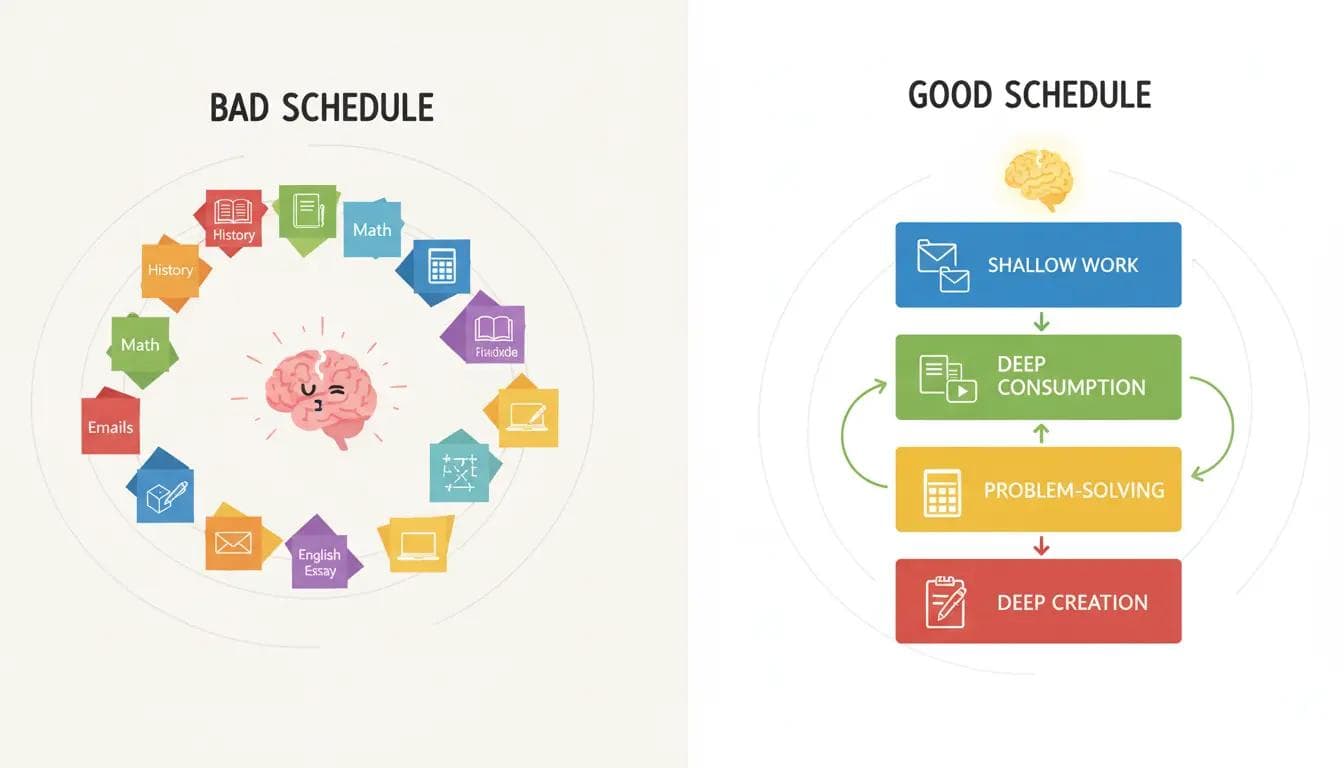
Introduction: Look at your to-do list for today. Does it look like this?
- Read Chapter 5 of History textbook.
- Do 10 math problems.
- Write outline for English essay.
- Reply to group project emails.
- Watch Biology lecture video.
This is a "mixed bag" of tasks, and it's the least efficient way to work. Why? Because every time you jump from "History" (reading/memorizing) to "Math" (logic/problem-solving), your brain is forced to "context switch."
This switching is not "free." It comes with a massive "cognitive cost" that drains your mental energy, destroys your focus, and makes you feel exhausted by 3 PM. This guide will teach you the "Task Batching" method, a simple system to group your work by type to achieve a state of deep, efficient flow.
What is 'Context Switching' (And Why It's Your Enemy)
Context switching is the process of "loading" and "unloading" different mental "programs" in your brain.
Think of your brain as a computer. "History" is one program. "Math" is another. You can't run them both at the same time. You have to close "History" (saving your place, remembering your thoughts) and open "Math" (loading the formulas, remembering the process). This "shutdown" and "startup" process burns time and mental RAM.
Psychologist Sophie Leroy coined the term "Attention Residue" to describe this. When you switch from Math to History, a residue of your attention stays stuck on the Math problem. You're not 100% focused on your reading. This is why "multitasking" is a myth. It's just rapid, high-cost context switching.
What is 'Task Batching'?
Task Batching is the simple, powerful solution. It's the practice of grouping similar, repetitive tasks together and completing them in one dedicated time block.
Instead of switching between types of work, you stay in one "mode" for a longer period. This minimizes "Attention Residue" and allows you to build momentum, leading to a "flow state" where your work feels effortless.
How to 'Task Batch' Your Study Schedule
First, stop organizing your to-do list by class. Start organizing it by cognitive mode.
Your study tasks generally fall into 4 "modes":
- 'Shallow Work' (Admin): Low-energy tasks. (Emails, scheduling, submitting assignments, organizing files).
- 'Deep Consumption' (Learning): High-focus input. (Reading dense textbooks, watching complex lectures, reviewing notes).
- 'Deep Creation' (Output): High-focus output. (Writing essays, coding projects, creating presentations).
- 'Problem-Solving' (Logic): High-focus analysis. (Math problems, physics sets, law case studies, accounting).
Now, let's "batch" that original to-do list:
Bad (Mixed) Schedule:
- 9-10 AM: Read History
- 10-11 AM: Do Math problems
- 11-12 PM: Reply to emails
- 12-1 PM: Write English essay
Good (Batched) Schedule:
- 9:00-9:30 AM: 'Shallow Work' Batch: Reply to all group project emails, organize all your files, submit all assignments due.
- 9:30-11:00 AM: 'Deep Consumption' Batch: Read History Chapter 5, then watch the Biology lecture video.
- 11:00 AM - 12:00 PM: 'Problem-Solving' Batch: Do all 10 math problems.
- (Lunch Break)
- 1:00-2:30 PM: 'Deep Creation' Batch: Write English essay outline and the first draft.
In the "Batched" schedule, you only context-switched 3-4 times. In the "Bad" schedule, you switched every hour, draining your battery.
The 'Macro-Batch' (Theme Days)
If your schedule is flexible, you can take this to the next level with "Theme Days."
- Monday: 'Consumption Day'. Do all your reading and lecture-watching for all your classes for the entire week.
- Tuesday: 'Creation Day'. Write all your papers and creative assignments.
- Wednesday: 'Problem Day'. Do all your problem sets and logic-based homework.
- Thursday: 'Admin & Review Day'. Handle all your emails, group projects, and review your notes from the week.
- Friday: (Review / Lighter work).
This is the ultimate way to achieve "flow," as you spend the entire day in one cognitive mode.
Why Task Batching Works (The Science)
- Minimizes 'Setup Cost': It takes mental energy to "get in the zone" for a task. By batching, you pay that "setup cost" once. (e.g., You only "load" your math brain once for a 90-minute session, not 3 times for 30-minute sessions).
- Builds Momentum (Flow State): The first 10 minutes of a task are always the hardest. By the 11th minute, you're in the groove. Batching allows you to stay in that groove for 60-90 minutes, producing your best work.
- Quarantines Distractions: By batching all your "Admin" (like email) into one block, you give yourself permission to ignore it the rest of the day. This protects your "Deep Work" blocks.
Conclusion: Be a 'Chef,' Not a 'Short-Order Cook'
A short-order cook is constantly context-switching—flipping pancakes, then frying eggs, then making toast. It's chaotic and stressful. A "Mise en Place" chef does all their "batching" first: they chop all the vegetables, prepare all the sauces, and then they start "cooking."
Treat your studies like a chef. Stop being a short-order cook, jumping from task to task. Batch your work. Protect your focus. Minimize your "setup" time, and maximize your "flow" time.
Frequently Asked Questions
You use "micro-batching." If you have a 2-hour study block between classes, don't try to do 3 different subjects. Dedicate that entire block to one type of task. (e.g., "This 2-hour block is only for my History essay.").
They are perfect partners. Time Blocking is the act of putting a "box" on your calendar (e.g., "9-11 AM: Study"). Task Batching is the act of deciding what to put in that box (e.g., "My 9-11 AM block will be an 'Admin & Email' batch.").
Most people have the most "Deep Work" energy in the morning. Use your morning for your 'Creation' or 'Problem-Solving' batches. Save your 'Shallow Work' (email) for the afternoon, when your focus is naturally lower.
Written by Daily Motivation Team
Sharing motivational content to inspire your journey to success.
Related Articles
 stoic
stoicStoic Wallpaper Collection: Marcus Aurelius Themed Phone Backgrounds
Turn your phone into a daily Stoic practice with Marcus Aurelius wallpapers designed to remind you of what actually matters.
 manifestation
O Method Manifestation: A Complete Guide
Learn how the O Method manifestation works, why it's so effective, and exactly how to practice it for real results.
 stoic
stoicEpictetus Top 30 Quotes: The Discourses Made Accessible
Discover the top 30 Epictetus quotes from the Discourses and Enchiridion — timeless Stoic wisdom made simple and actionable.
 stoic
stoicModern Stoicism: How to Apply Ancient Wisdom in 2026
Discover how modern stoicism turns 2,000-year-old wisdom into a practical toolkit for calm, focus, and resilience in 2026.