
Growth Mindset: The Ultimate Guide to Overcome a Fixed Mindset
Ever feel stuck? The difference between a growth mindset vs fixed mindset isn't just theory—it's the key to unlocking your true potential.
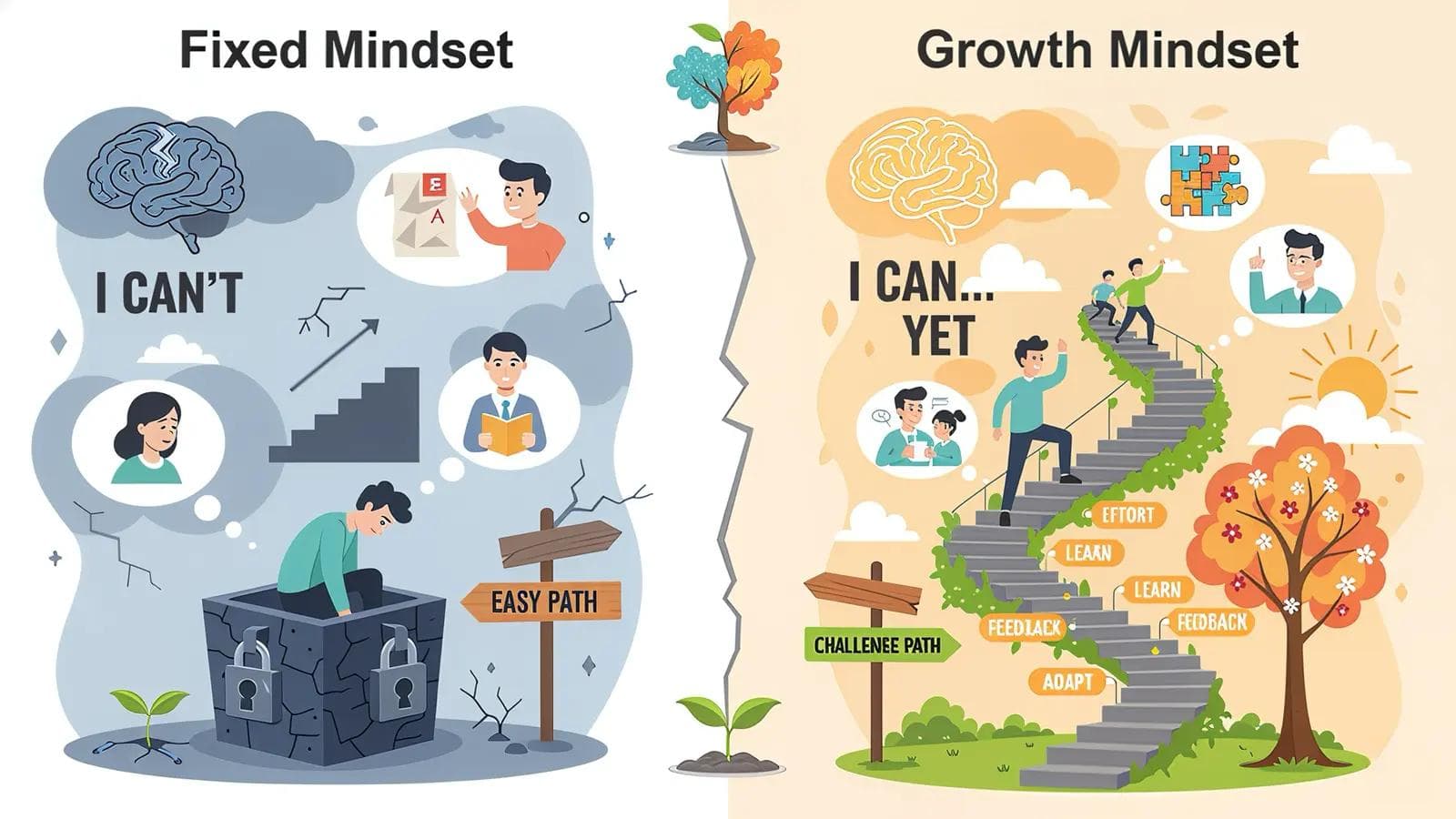
Growth Mindset vs Fixed Mindset: How Your Beliefs Control Your Success
Have you ever hit a wall on a difficult project and thought, "I'm just not smart enough for this"? Or watched a colleague succeed and felt a pang of envy, believing they just have a natural talent you lack? This feeling of being fundamentally limited is incredibly common, but it's also based on a powerful illusion.
Groundbreaking research from Stanford psychologist Dr. Carol Dweck shows that our success isn't determined by innate talent, but by our belief about that talent. This core belief system is your mindset, and understanding the critical growth mindset vs fixed mindset distinction is the first step to unlocking potential you never knew you had.
What is a Fixed Mindset? The Belief That You're "Stuck"
A fixed mindset, which Dweck calls an "entity theory," is the belief that your core qualities—like intelligence, personality, and talent—are static, unchangeable traits. You're born with a certain amount, and that's it. This creates a powerful need to constantly prove yourself.
The core belief is: "My abilities are set in stone. I'm either good at something, or I'm not."
This single belief has a cascade of consequences that can hold you back:
- Avoids Challenges: New challenges present a risk. If you fail, it proves you lack ability, so it's safer not to try at all.
- Gives Up Easily: Effort is seen as a sign of weakness. If you were truly smart or talented, you wouldn't need to try so hard. Setbacks are seen as proof of your limits.
- Ignores Useful Feedback: Criticism feels like a personal attack on your fundamental character. It's easier to dismiss the feedback than to confront the idea that you might not be perfect.
- Feels Threatened by Others' Success: When a peer succeeds, it serves as a painful reminder of what you're not. Their success diminishes your own.
A real-world example: Imagine a student who gets a C on their first calculus exam. With a fixed mindset, they conclude, "I'm just bad at math." They avoid harder problems, stop participating in class, and ultimately drop the course, cementing their belief.
What is a Growth Mindset? The Belief That You Can Improve
A growth mindset, or an "incremental theory," is the opposite. It's the belief that your abilities and intelligence can be developed through dedication, strategic effort, and learning from others. The hand you're dealt is just the starting point.
The core belief is: "My abilities can be cultivated through effort. I can learn and grow through practice."
This belief system fosters a love of learning and a resilience that is essential for great accomplishment:
- Embraces Challenges: Challenges are not threats, but opportunities. They are chances to stretch your abilities, learn something new, and grow.
- Persists Through Setbacks: Failure isn't a verdict on your ability. It's seen as a natural part of the learning process—a problem to be solved through different strategies and more effort.
- Learns from Criticism: Feedback is a gift. It's valuable information that provides a roadmap for improvement, not a judgment of your worth.
- Finds Inspiration in Others' Success: The success of others is seen as proof of what's possible. It provides lessons and motivation to reach for similar heights.
A real-world example: The same student gets a C on their calculus exam. With a growth mindset, they think, "This is a wake-up call. The way I was studying isn't working." They go to office hours, form a study group, and practice more problems. Their understanding deepens, and their grade improves.
The Core Differences: Growth Mindset vs Fixed Mindset Side-by-Side
Understanding the difference between a growth and fixed mindset becomes clearer when you see them in direct comparison across different situations. This isn't just theory; it dictates your daily actions and reactions.
On Facing a New Challenge
- Fixed Mindset: "Can I do this? Will I look stupid if I fail? I'd better stick to what I know I'm good at."
- Growth Mindset: "This looks like a great opportunity to learn something new. It might be hard, but I'll get better as I go."
On Putting in Effort
- Fixed Mindset: "If I have to try this hard, it must mean I'm not a natural. Effort is for people who don't have talent."
- Growth Mindset: "Effort is the engine of ability. The harder I work at this, the stronger my skills will become."
On Receiving Feedback or Criticism
- Fixed Mindset: "This person is attacking me. They're saying I'm not good enough. I'm going to ignore this or get defensive."
- Growth Mindset: "This feedback is valuable data. What can I learn from this to improve my process for next time?"
On Experiencing a Setback or Failure
- Fixed Mindset: "I failed. This proves I don't have what it takes. I should just give up now before I embarrass myself further."
- Growth Mindset: "I didn't succeed this time. What strategies didn't work? What can I try differently? Failure is a stepping stone, not a dead end."
How Does Your Mindset Impact Your Real-Life Results?
The debate of growth mindset vs fixed mindset isn't just academic; it has a profound and measurable impact on your life. Your default thinking patterns shape your career trajectory, your relationships, and even your health.
In Your Career and Professional Life
Professionals with a growth mindset are more likely to seek out challenging projects, which leads to faster skill development. They respond to constructive feedback from managers by improving their performance, not by becoming defensive. This makes them more likely to be promoted and to become effective leaders who develop talent in others.
Conversely, a fixed mindset can lead to career stagnation. An individual might turn down a promotion because they fear they aren't "management material," avoid learning a new software because they're "not a tech person," and see talented junior colleagues as threats rather than mentees.
In Your Personal Relationships
In relationships, a fixed mindset assumes that personalities are static. You might think, "My partner is just a messy person, and they'll never change." This leads to judgment and conflict rather than collaboration. You might also believe a relationship shouldn't require "work" if it's the "right one."
A growth mindset believes that people, and relationships, can evolve. You see conflict as an opportunity to understand each other better and develop stronger communication skills. You believe that effort, understanding, and working through problems together can make a good relationship great. building-stronger-relationships
The "Mindset Audit": A 3-Step Framework to Identify Your Default Thinking
You can't change your mindset until you recognize it in action. Many of us have a mix of both mindsets in different areas of our lives. This simple audit will help you identify your triggers for fixed mindset thinking.
Step 1: Identify a Recent Challenge Think of a specific situation in the last month where you felt stressed, challenged, or received criticism. It could be a difficult project at work, a disagreement with a partner, or a new fitness goal you struggled with.
Step 2: Analyze Your Internal Monologue Write down the thoughts that went through your head during that situation. Be brutally honest—no one else needs to see this. What was the "voice" in your head saying?
- Did it make sweeping judgments? ("I'm a failure," "I'll never be good at this.")
- Did it focus on innate traits? ("I'm just not creative," "He's a natural leader and I'm not.")
- Did it place blame? ("It's not my fault the instructions were unclear.")
Step 3: Categorize Your Thoughts Now, go through your list of thoughts and label each one: Fixed or Growth.
- Fixed thoughts judge and generalize. They create a sense of permanence and helplessness.
- Growth thoughts are curious and process-focused. They ask questions about strategy and effort ("What could I do differently?" "Who could I ask for help?").
This audit reveals your personal fixed-mindset triggers. Recognizing these patterns is the first and most crucial step toward consciously choosing a different response.
How Can You Actively Cultivate a Growth Mindset? (5 Practical Strategies)
Shifting from a fixed to a growth mindset is a conscious practice, not an overnight change. It involves changing your internal monologue and your habits. Here are five actionable strategies to begin today.
1. Add "Yet" to Your Internal Monologue
This is the simplest yet most powerful tool from Dweck's work. When you catch yourself thinking a fixed-mindset thought like, "I don't understand this," add the word "yet" to the end.
- "I'm not good at public speaking" becomes "I'm not good at public speaking yet."
- "I don't know how to solve this problem" becomes "I don't know how to solve this problem yet."
This tiny word reframes the statement from a permanent fact into a temporary state on a learning curve. It opens the door to future possibility and action.
2. Reframe "Failure" as "Data"
People with a fixed mindset see failure as a verdict. People with a growth mindset see it as valuable data. When you experience a setback, instead of judging yourself, get curious like a scientist.
Ask process-oriented questions:
- What specific actions did I take?
- What were the results of those actions?
- What worked well that I should do again?
- What didn't work that I should avoid or change next time?
This transforms a painful emotional experience into a practical, analytical one. It's no longer "I failed," but "My strategy failed, and now I have the data to build a better one."
3. Focus on Process, Not Just Outcome
Our society tends to praise results and innate talent ("You're so smart!" "You're a natural!"). This reinforces a fixed mindset. To build a growth mindset, you must learn to value and reward the process.
This means celebrating the effort, the strategies you try, the focus you maintain, and the persistence you show through difficulty. When you complete a project, don't just focus on the final result. Reflect on the hard work that got you there. This builds the mental muscle for tackling even bigger challenges. effective-goal-setting-strategies
4. Seek Out Constructive Criticism
While a fixed mindset avoids feedback, a growth mindset craves it. It's the fastest way to improve. Actively seek out feedback from people you trust.
Don't just ask, "How did I do?" Be specific:
- "What is one thing I could have done differently to make this presentation more impactful?"
- "When you review this report, could you highlight any areas where my logic is unclear?"
- "I'm trying to get better at [skill]. Did you notice any opportunities for me to improve in that area during the meeting?"
This frames feedback as a collaborative tool for growth, not a judgment of your worth.
5. Learn About Neuroplasticity
The core idea of a growth mindset isn't just positive thinking; it's backed by neuroscience. Neuroplasticity is the brain's ability to form and reorganize synaptic connections, especially in response to learning or experience.
When you challenge yourself, learn new skills, and persist through mistakes, you are literally rewiring your brain. Your brain isn't a fixed organ; it's more like a muscle that gets stronger with use. Understanding this scientific fact makes the growth mindset vs fixed mindset concept tangible and believable.
Conclusion: Your Mindset is a Choice, Not a Sentence
The single most important thing to remember in the growth mindset vs fixed mindset framework is that you have a choice. Your mindset is not a permanent part of your personality. It is a set of beliefs that can be examined, challenged, and changed.
By recognizing your fixed-mindset triggers, reframing your internal monologue, and focusing on the process of learning and effort, you can consciously cultivate a growth mindset. This shift won't just make you more successful—it will transform your relationship with challenges, turning them from obstacles to be feared into opportunities to be embraced.
Frequently Asked Questions
A student with a fixed mindset who fails a test thinks, 'I'm bad at this subject.' A student with a growth mindset thinks, 'I need to change my study strategy for the next test.' The focus shifts from identity to action.
Yes, it's very common. A person might have a growth mindset about their athletic abilities, believing they can improve with practice, but a fixed mindset about their intelligence, believing they are 'not a math person.' The goal is to recognize fixed-mindset triggers and apply growth principles more broadly.
While a growth mindset is generally more beneficial for learning and resilience, a fixed mindset can feel comfortable when you are succeeding. However, it becomes a significant liability when you face inevitable challenges, setbacks, or criticism, as it offers no healthy way to cope with them.
Developing a growth mindset is an ongoing practice, not a destination. You can start applying its principles immediately by using strategies like adding 'yet' to your thoughts. Consistent, conscious effort over weeks and months will help make it your default way of thinking.
Written by Daily Motivation Team
Sharing motivational content to inspire your journey to success.
Related Articles
 stoic
stoicStoic Quotes on Discipline: Where Stoicism Meets Self-Mastery
Discover powerful stoic quotes on discipline from Marcus Aurelius, Seneca, and Epictetus — plus how to apply them today.
 stoic
stoicBest Stoic Quotes for Hard Times: Wisdom for Modern Struggles
Powerful Stoic quotes for hard times from Marcus Aurelius, Seneca & Epictetus — wisdom that turns adversity into strength.
 stoic
stoicBest Stoic Quotes for Beginners: Where to Start Your Practice
Discover the best stoic quotes for beginners and a simple 7-day plan to turn ancient wisdom into daily practice.
 manifestation
3 6 9 Method: A Complete Guide
Learn how the 3 6 9 method rewires your focus and turns daily journaling into a powerful manifestation ritual.