
Build Self Discipline Without Willpower
Tired of relying on willpower that fails? Discover a proven system to build self-discipline by designing your life for automatic success.
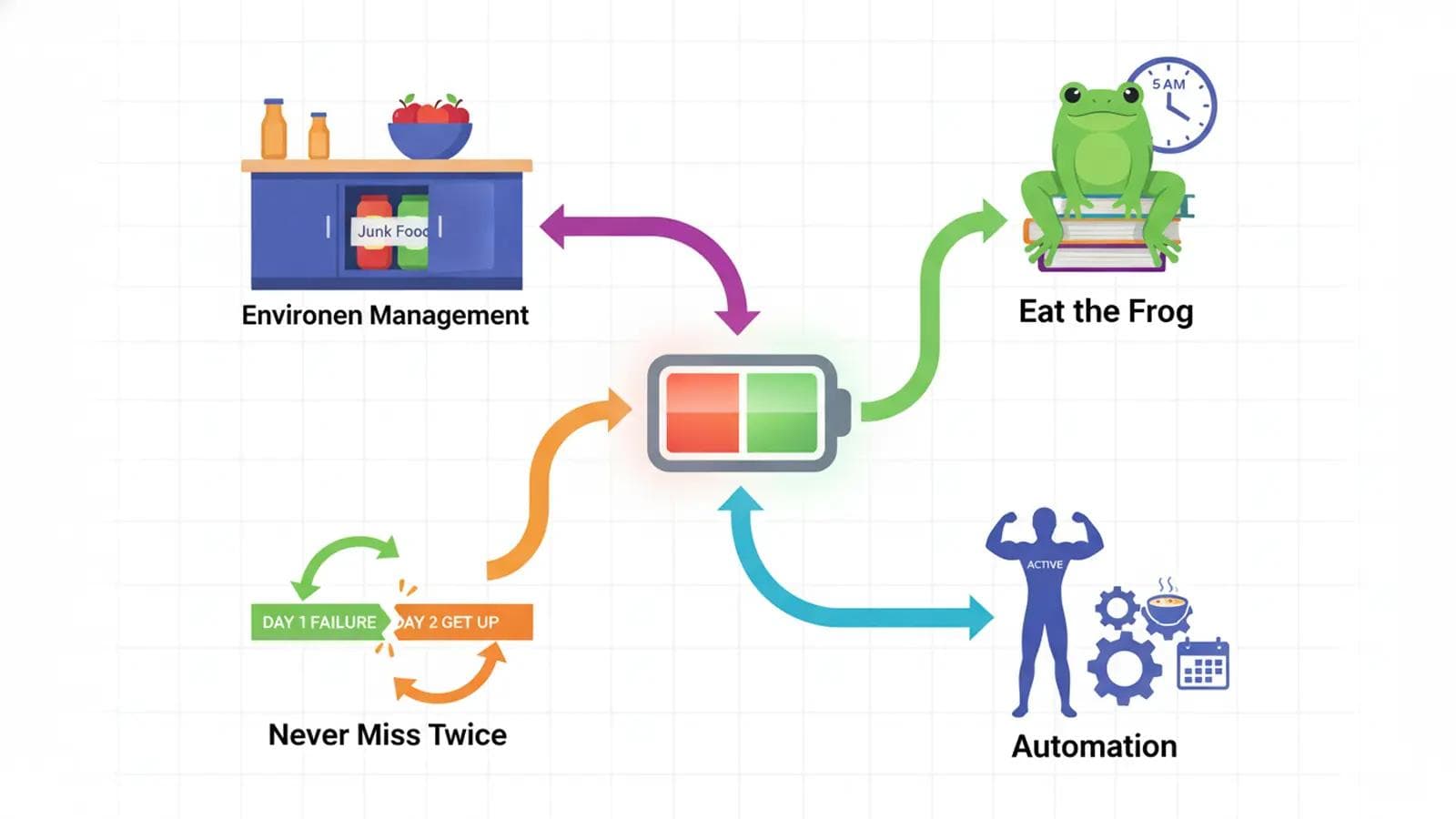
You Don't Have a Discipline Problem, You Have a Willpower Problem
Ever promised yourself you'd start fresh on Monday? You'll wake up early, hit the gym, eat a salad, and finally tackle that big project. But when Monday morning arrives, the snooze button wins, and the cycle of frustration begins again. You feel like you lack the 'iron self-discipline' you see in others.
Here's the secret: Truly disciplined people don't have more willpower than you. They have better systems. They understand that willpower is a myth—a finite, unreliable resource that drains with every decision you make, from choosing your outfit to resisting a donut.
This guide will teach you how to build self discipline by getting rid of the need for willpower. We'll introduce a simple, proven framework that relies on intelligent design, not brute force. It's time to stop fighting yourself and start building a life where the right choice is the easy choice.
Why Does Willpower Always Fail? The Science of Self-Control
For decades, we've been told that self-control is like a muscle. The more you use it, the stronger it gets. This is only half true. In the short term, willpower acts more like a phone battery. This concept is known as ego depletion.
Every decision you make, big or small, drains this battery:
- Resisting the urge to check social media
- Choosing a healthy lunch over pizza
- Forcing yourself to focus on a boring spreadsheet
- Dealing with a difficult coworker
By the end of the day, your battery is in the red, which is why you're far more likely to skip the gym or order takeout after a stressful day at work. You haven't become 'weaker'; you've just run out of mental energy.
Willpower vs. Systems: A Quick Comparison
Understanding the difference is the first step to improving your self-discipline.
- Willpower-Based Approach:
- Relies on 'brute force' and motivation.
- Is highly unpredictable and depletes quickly.
- Leads to feelings of guilt and failure when it runs out.
- Example: "I will force myself to not eat the cookies in the pantry."
- System-Based Approach:
- Relies on preparation and environment design.
- Is consistent and requires minimal energy to maintain.
- Makes desired behaviors automatic and easy.
- Example: "I will not buy cookies at the grocery store, so the decision is already made."
This entire guide is about shifting from the first approach to the second.
The A.C.E. System: Your Framework for Building Lasting Self-Discipline
To make this practical, we'll use a simple three-part framework called the A.C.E. System. It's a reliable method for how to build self discipline from the ground up.
- Architect: Intelligently design your physical and digital environments to make good habits effortless and bad habits difficult.
- Commit: Focus on identity-based habits and tiny actions (processes) instead of daunting, outcome-based goals.
- Execute: Protect your mental energy by making smart decisions about when and how you tackle your most important tasks.
Let's break down each step.
Step 1: Architect Your Environment for Automatic Success
This is the most critical step. If you get this right, you'll need almost zero willpower. The goal is to create a path of least resistance that leads directly to your desired behavior.
How to Perform a 'Friction Audit'
Friction is anything that stands between you and taking action. We need to decrease friction for good habits and increase it for bad ones.
To build a workout habit:
- Decrease Friction: Lay out your gym clothes the night before. Put your running shoes by the door. Create a workout playlist in advance. Pack your gym bag and leave it in the car.
- Increase Friction: If you scroll on your phone in bed, leave your phone to charge in another room overnight. If you watch too much TV, unplug it and put the remote in a drawer.
To build a healthy eating habit:
- Decrease Friction: Pre-chop vegetables for the week. Put a bowl of fresh fruit on the counter. Keep a water bottle on your desk at all times.
- Increase Friction: Don't buy junk food. If you have it, move it to a high shelf or the back of the pantry. Delete food delivery apps from your phone.
Your Action Step: Choose one habit you want to build. Write down three ways you can decrease the friction to perform it and three ways you can increase the friction for the competing bad habit.
Digital Decluttering: Taming Your Distractions
Your digital environment is just as important as your physical one. Your phone is a slot machine designed to steal your attention and drain your willpower.
Here are some specific strategies for developing self-discipline in a digital world:
- Curate Your Home Screen: Remove all social media, news, and email apps from your main home screen. Move them into a folder on the second or third page. This forces a moment of intention before you open them.
- Turn Off Notifications: Go into your settings and turn off all notifications except for calls and messages from people. No app needs to buzz you.
- Use Grayscale: Most phones have an accessibility setting to turn the screen to grayscale. This makes your phone significantly less appealing and breaks the dopamine loop of colorful icons.
- Set App Timers: Use built-in features (like Screen Time on iOS or Digital Wellbeing on Android) to set daily time limits for distracting apps.
Step 2: Commit to a Process, Not a Goal
Goals are about the future. Discipline is about what you do right now. A subtle shift in focus from outcomes to identity is one of the most powerful discipline strategies you can adopt.
The Problem with Outcome-Based Goals
An outcome goal is something like, "I want to lose 20 pounds" or "I want to write a book."
These goals are problematic because they are distant and your day-to-day actions feel disconnected from the reward. You don't see results after one workout or one writing session, making it easy to quit. It also creates a 'pass/fail' mentality that is terrible for long-term progress.
How to Build an Identity-Based Habit
Instead of the outcome, focus on the type of person you want to become.
- Instead of "I want to lose 20 pounds," your new identity is "I am a healthy and active person."
- Instead of "I want to write a book," your new identity is "I am a writer."
This changes the fundamental question you ask yourself. Instead of "Do I have the motivation to work out?" you ask, "What would a healthy person do right now?"
The answer is usually obvious. A healthy person would probably take the stairs, add a side salad, or go for a walk. A writer would write one page, even if it's not perfect. This framework makes small, daily decisions feel like a vote for your new identity.
The 2-Minute Rule: How to Start with Zero Motivation
To make your new identity stick, you must start small. So small, it's impossible to say no. This is the 2-Minute Rule, popularized by James Clear in Atomic Habits.
Whatever your new habit is, scale it down to a version that takes less than two minutes to complete.
- "Read every day" becomes "Read one page."
- "Go for a run" becomes "Put on my running shoes."
- "Meditate for 20 minutes" becomes "Sit and breathe for 60 seconds."
- "Clean the kitchen" becomes "Put one dish in the dishwasher."
The point isn't to get results with these tiny actions. The point is to master the art of showing up. You are building the habit of consistency, which is the foundation of all self-discipline. Once you've shown up, you can often do more. And if not, you still cast a vote for your new identity. For more on this, check out our guide to habit-formation-techniques.
Step 3: Execute with Intention (Protecting Your Energy)
Once you've designed your environment and committed to a process, the final step is to manage your daily energy and focus. This is where you apply simple rules to ensure your limited willpower is used on what truly matters.
How to Identify and 'Eat Your Frog' Every Morning
Your willpower battery is freshest in the morning. Therefore, the most important rule of daily execution is to do your most important, difficult, or dreaded task first.
This concept is called 'Eating the Frog,' from a quote by Mark Twain: "If it's your job to eat a frog, it's best to do it first thing in the morning. And if it's your job to eat two frogs, it's best to eat the biggest one first."
Your 'frog' is that one task you're procrastinating on, but which has the greatest potential impact on your progress. By tackling it at 9 AM, you've already secured a major win for the day. Everything else feels easy in comparison.
A 3-Step Process to Find Your Frog:
- List: At the end of each day, write down the 3-5 most important things you need to do tomorrow.
- Identify: Look at the list and ask, "If I could only do one thing on this list today, which one would have the biggest impact?" That's your frog.
- Isolate: Commit to working on that one task, and only that task, without distraction, as the first thing you do when you start your workday.
The Power of 'Decision Stacking' to Avoid Fatigue
Remember ego depletion? We can fight it by reducing the number of decisions we have to make each day. This is 'decision stacking'—making choices in advance so your future self doesn't have to.
- Meal Prep: Decide what you'll eat for the week on Sunday. This eliminates the daily "what's for dinner?" decision fatigue.
- Plan Your Day: As mentioned above, planning your next day the night before is a powerful form of decision stacking.
- Create a 'Uniform': People like Steve Jobs and Mark Zuckerberg famously wore the same outfit every day to eliminate one trivial decision from their morning.
Every decision you automate is a little bit of willpower you save for the tasks that truly require it. This is a core part of how to build self discipline for the long haul.
What Happens When You Fail? The Art of the 'Reset'
Building self-discipline is not a perfect, linear process. You will have bad days. You will skip a workout. You will eat the cake. You will procrastinate.
Failure is not the problem. The problem is thinking that one failure means you should give up entirely.
This is where most people go wrong. They have an 'all-or-nothing' mindset. They miss one day at the gym and think, "Well, I've ruined my streak. I'll start again next week." This is a destructive loop.
Instead, adopt the cardinal rule of habit-building: Never Miss Twice.
Missed a workout today? Fine. It happens. But you are not allowed to miss tomorrow. Ate junk food for lunch? Make sure your dinner is healthy. Procrastinated all morning? 'Eat your frog' after lunch.
One mistake is an outlier. Two mistakes is the beginning of a new (bad) habit. By focusing on getting back on track immediately, you stop the downward spiral before it begins. This approach requires self-compassion, not self-criticism. It's a vital skill for anyone learning how to build self discipline that lasts. For more on this, see our article on effective-goal-setting-strategies.
How Long Does It Really Take to Build Self-Discipline?
You've probably heard the myth that it takes 21 days to form a new habit. Research has shown this to be a vast oversimplification. A 2009 study from University College London found that it took, on average, 66 days for a new behavior to become automatic.
But even that number is just an average. The range in the study was from 18 to 254 days. The time it takes depends on the person, the behavior, and the circumstances.
Here's the truth: Self-discipline is not a destination you arrive at. It's not a course you complete. It is a practice. It's a lifelong process of designing your environment, managing your energy, and quickly course-correcting when you get off track.
Don't focus on the finish line. Focus on today. Use the A.C.E. system to make a small, 1% improvement. Cast one vote for the person you want to become. That is how you build real, lasting self-discipline.
Frequently Asked Questions
The fastest way is to stop relying on willpower and instead change your environment. Make your desired habits easy and obvious (e.g., put running shoes by the door) and your bad habits difficult and hidden (e.g., unplug the TV). This 'environment design' creates discipline automatically.
Absolutely. Self-discipline is not an innate personality trait; it's a skill that can be developed through practice. It involves learning to manage your energy, build effective systems, and create an environment that supports your goals, rather than just using 'brute force' willpower.
Start with one very small, 'impossible-to-fail' habit using the 2-Minute Rule. For example, instead of 'read more,' commit to reading one page per day. The goal is to build the skill of consistency first. Once you master showing up, you can gradually increase the difficulty.
While there are many ways to categorize it, a useful framework identifies three types: 1) Active Discipline (taking action, like working out), 2) Reactive Discipline (resisting temptation, like not eating junk food), and 3) Proactive Discipline (building systems, like meal prepping, to avoid needing the other two).
Written by Daily Motivation Team
Sharing motivational content to inspire your journey to success.
Related Articles
 Creativity
Artistic Inspiration: A Complete Guide
Artistic inspiration isn't luck — it's a trainable skill. Learn 7 daily practices that keep ideas flowing.
 stoic
stoicStoic Quotes on Discipline: Where Stoicism Meets Self-Mastery
Discover powerful stoic quotes on discipline from Marcus Aurelius, Seneca, and Epictetus — plus how to apply them today.
 stoic
stoicBest Stoic Quotes for Hard Times: Wisdom for Modern Struggles
Powerful Stoic quotes for hard times from Marcus Aurelius, Seneca & Epictetus — wisdom that turns adversity into strength.
 stoic
stoicBest Stoic Quotes for Beginners: Where to Start Your Practice
Discover the best stoic quotes for beginners and a simple 7-day plan to turn ancient wisdom into daily practice.