
How to Build Self Discipline: The Loop for Lasting Motivation
Tired of willpower failing? Discover a proven system to build self-discipline that lasts, even when motivation fades. It starts with one small step.
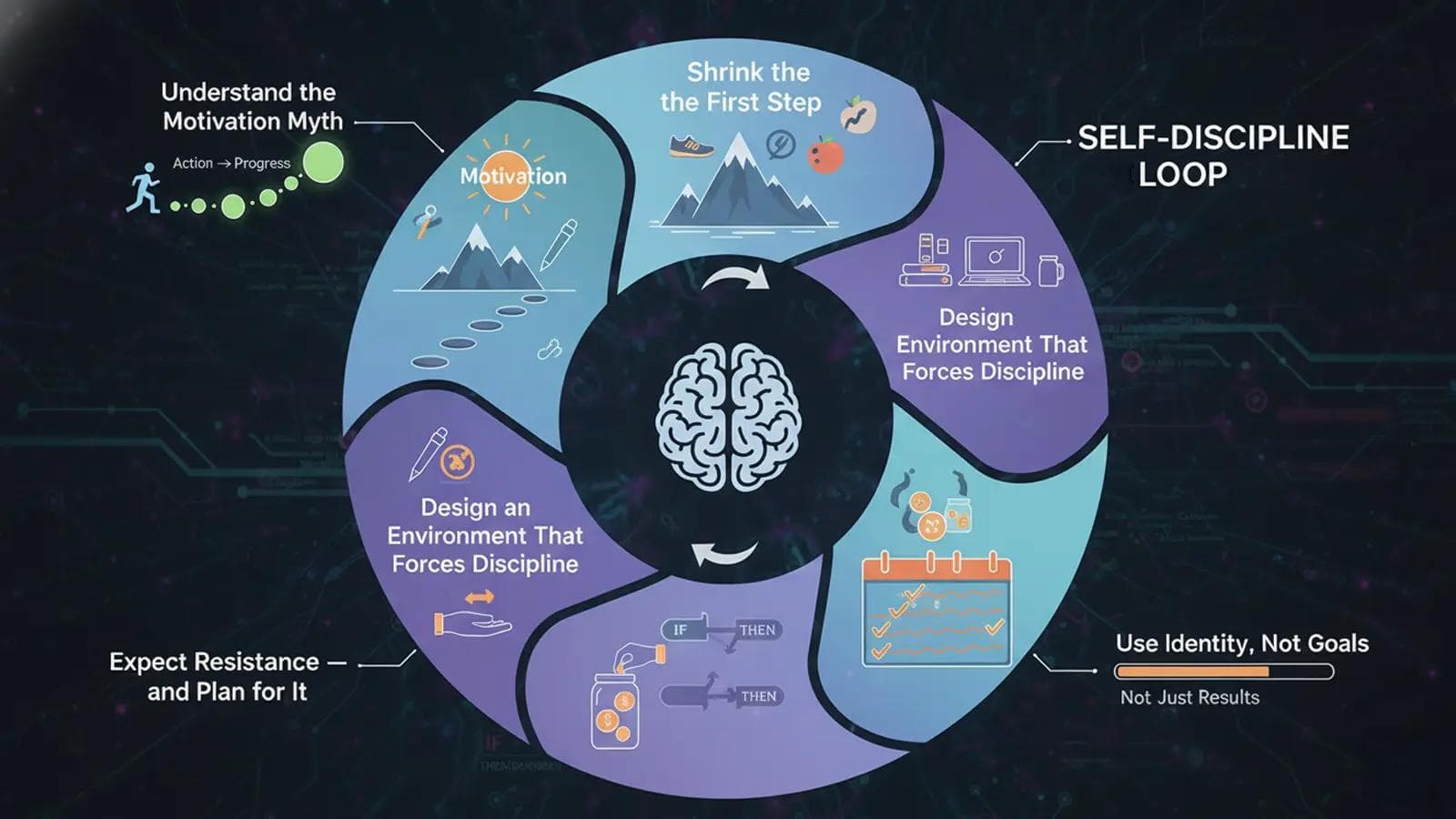
# How to Build Self-Discipline: A Science-Backed System That Actually Works
Did you know that over 90% of New Year's resolutions fail by February? You promise yourself you'll wake up earlier, exercise daily, or finally launch that side project, but a few weeks later, you're back to square one. If this sounds familiar, it's not because you're lazy—it's because you're relying on motivation, the most unreliable tool for success.
I used to be the king of procrastination, waiting for a magical burst of inspiration that rarely came. The truth is, motivation is a fleeting emotion, not a strategy. Real, lasting change comes from building a system. This guide will teach you how to build self-discipline not as a rigid, joyless chore, but as a powerful, self-sustaining flywheel that generates its own momentum. Forget willpower; let's build a machine.
What Is Self-Discipline (And Why Is It So Hard to Build?)
Self-discipline is the ability to take action regardless of your emotional state. It's the bridge between your goals and your accomplishments. While motivation is about wanting to do something, discipline is about doing it even when you don't want to.
So, why is it so difficult? Our brains are wired for immediate gratification. The prefrontal cortex, responsible for long-term planning and impulse control, is easily overpowered by the limbic system, which craves comfort and dopamine hits now. Developing self-discipline is the process of strengthening that prefrontal cortex, much like exercising a muscle.
Motivation vs. Discipline: The Critical Difference
Understanding this distinction is the first step. Relying on one over the other is like choosing between a paper boat and a steel ship for a long voyage.
- Motivation:
- Source: Emotional and external (e.g., watching an inspiring video).
- Reliability: Low. It comes and goes without warning.
- Duration: Short-term. It fades quickly when faced with obstacles or boredom.
- Discipline:
- Source: Intentional and internal (a commitment to a system).
- Reliability: High. It's a skill you build and can deploy on command.
- Duration: Long-term. It strengthens with use and becomes a part of your identity.
The key takeaway: Stop waiting to feel like it. Action must come first.
How to Build Self-Discipline From Scratch: The 4-Step Discipline Flywheel
Forget the myth that you need to feel inspired before you act. Neuroscience shows the opposite is true: Action → Progress → Motivation. Each small action creates a feeling of progress, which releases dopamine and generates the very motivation you were waiting for. This is the core of the Discipline Flywheel, a system designed to make consistent action almost effortless.
Step 1: The Micro-Action (The Spark)
Most people fail because their first step is a giant leap. They aim for a 90-minute gym session or writing a full chapter, which triggers overwhelming resistance. The solution is to shrink the first step until it's too small to fail.
This is the 2-Minute Rule, popularized by James Clear. Find the smallest possible version of your desired habit—one that takes less than 120 seconds to complete.
- “Go for a 5-mile run” becomes “Put on your running shoes and step outside.”
- “Write 1,000 words” becomes “Open your document and write one sentence.”
- “Meditate for 20 minutes” becomes “Sit on your cushion and take three deep breaths.”
- “Eat a healthy diet” becomes “Add one piece of fruit to your breakfast.”
This isn't just a mind trick. It leverages a powerful cognitive bias called the Zeigarnik Effect, where our brains crave completion. Once you've started a task, even in a tiny way, your brain will push you to continue. The hardest part is starting; the Micro-Action makes starting ridiculously easy.
Step 2: The Progress Signal (The Fuel)
Once you've taken a Micro-Action, you need to acknowledge it. This is the crucial feedback loop that trains your brain to associate action with reward. Without this step, your efforts feel invisible and your momentum stalls.
How to create progress signals:
- Use a Habit Tracker: Don't just do the habit; mark it off. Seeing a chain of successful days is incredibly motivating. Use a simple notebook, a calendar, or an app. The physical act of checking a box provides a small dopamine hit.
- Verbalize Your Win: Say it out loud. After you put on your running shoes, say, “I did it. I’m a person who shows up.” This reinforces your new identity.
- Focus on Reps, Not Results: In the beginning, the goal isn't to lose 20 pounds; it's to not miss a workout for two weeks. Celebrate the consistency, not the outcome. The outcomes will follow the consistency. For more on this, check out our guide on building-healthy-habits.
This step is essential for improving self-discipline because it makes the effort feel worthwhile long before you see the major results.
Step 3: The Systemic Reinforcement (The Engine)
Your environment is more powerful than your willpower. Willpower is a finite resource that gets depleted throughout the day (a concept known as ego depletion). A well-designed system makes the right choice the easiest choice.
Design an environment that forces discipline:
- Increase Friction for Bad Habits: Want to stop scrolling on your phone at night? Leave your phone charging in another room. Want to eat less junk food? Don't buy it in the first place. Make your vices inconvenient.
- Decrease Friction for Good Habits: Want to go to the gym in the morning? Lay out your gym clothes the night before. Want to drink more water? Keep a full water bottle on your desk at all times. Make your virtues effortless.
- Use Habit Stacking: Anchor your new desired habit to an existing one. The formula is: “After [Current Habit], I will [New Habit].”
- “After I brush my teeth, I will do two minutes of stretching.”
- “After I pour my morning coffee, I will write one sentence in my journal.”
This automates your decision-making, saving your precious willpower for when you truly need it. If you struggle with putting things off, our article on how-to-stop-procrastinating can provide deeper strategies.
Step 4: The Identity Shift (The Unstoppable Momentum)
This is the final, most powerful stage where building self-discipline becomes second nature. Every action you take is a vote for the type of person you want to become.
When you consistently put on your running shoes (Micro-Action), track your progress (Progress Signal), and lay out your clothes the night before (Systemic Reinforcement), you're not just trying to be a runner. You are becoming one.
Your internal monologue shifts from “I have to force myself to run” to “I am a runner. This is what I do.”
This identity-based approach is the ultimate goal. You no longer need to negotiate with yourself every day. Your actions align with your identity, and the need for brute-force discipline fades away. It becomes automatic.
Why Does My Self-Discipline Fail? 3 Common Discipline Killers
Even with the best system, you will face setbacks. Understanding why discipline fails is key to getting back on track quickly. Here are the three most common culprits:
- Decision Fatigue: Our ability to make good choices is finite. If you spend all morning making hundreds of small, unimportant decisions (what to wear, what to eat for breakfast, which email to answer first), you'll have less mental energy left to resist temptation or tackle a difficult task later. Solution: Automate and simplify. Plan your meals, outfits, and top priorities the day before.
- An Unclear 'Why': Discipline without a compelling reason is just a chore. If you don't have a deep, emotional connection to your goal, you won't have the fuel to push through discomfort. Solution: Write down why you want to achieve your goal. What will it bring to your life? How will you feel? Read this 'why' statement every single day.
- All-or-Nothing Thinking: This is the perfectionist's trap. You miss one day at the gym and think, “Well, I’ve ruined it. I might as well give up completely.” This is a destructive mindset. Solution: Embrace the “Never Miss Twice” rule. Anyone can make a mistake. But disciplined people get back on track immediately. One bad meal doesn't ruin a diet. One missed workout doesn't erase your progress. The next right action is all that matters.
Advanced Techniques for Unbreakable Discipline
Once you've mastered the basics, you can incorporate these advanced strategies to make your discipline even more robust.
Willpower vs. Systems: A Quick Comparison
Understanding this is key to leveling up. Willpower is about fighting a battle every day. Systems are about winning the war before the battle even begins.
- Willpower-Based Approach:
- Relies on brute force and mental effort.
- Is easily depleted by stress, hunger, and fatigue.
- Feels like a constant struggle against your own nature.
- Example: Trying not to eat the cookies on the counter.
- Systems-Based Approach:
- Relies on preparation and environment design.
- Conserves mental energy for high-impact tasks.
- Feels automated and effortless over time.
- Example: Not buying cookies in the first place, so there's no temptation to fight.
Practical Strategies to Implement:
- Pre-commitment: Make a decision for your future self now, while you're thinking clearly. This could be pre-paying for a block of fitness classes, setting a financial penalty with a friend if you fail to meet a deadline (using a site like Beeminder), or using an app that blocks distracting websites for a set period.
- Temptation Bundling: Pair an action you want to do with an action you need to do. For example, you only allow yourself to listen to your favorite podcast while you're on the treadmill. Or you only get to watch your favorite Netflix show while you're doing the ironing.
- Accountability Partner: Share your goals with someone and schedule regular check-ins. The simple act of knowing you have to report your progress to someone else is a powerful motivator and a core discipline technique.
Your Journey to Building Self-Discipline Starts Now
Learning how to build self-discipline isn't about becoming a robot or punishing yourself. It's about designing a life where you consistently do the things that matter most to you, creating a profound sense of pride and accomplishment.
Stop waiting for motivation. Start with a single Micro-Action, right now. Put on your running shoes. Open that document. Add one vegetable to your shopping list. That tiny spark is all you need to start the flywheel spinning.
By focusing on small actions, celebrating progress, designing your environment, and shaping your identity, you will build a system that makes success not just possible, but inevitable. The journey won't be perfect, but with this framework, you'll always know how to get back on track and keep moving forward. You have what it takes. Start now.
Frequently Asked Questions
A lack of self-discipline often isn't a character flaw, but a result of relying on unreliable motivation, setting goals that are too large, or operating in an environment filled with friction. It can also stem from decision fatigue or not having a clear 'why' behind your goals.
To build self-discipline in 30 days, focus on consistency over intensity. Choose one key habit, apply the 2-Minute Rule to start, track your progress daily without breaking the chain, and design your environment to make it easy. The goal is to build the system and identity first.
While there are many frameworks, five key pillars are: 1. Awareness (recognizing your weaknesses), 2. Commitment (having a clear goal and 'why'), 3. Action (starting small and consistently), 4. Systems (designing your environment for success), and 5. Resilience (getting back on track after a setback).
Yes, absolutely. Self-discipline is like a muscle. Every time you choose a long-term goal over short-term gratification, you strengthen your prefrontal cortex. Techniques like mindfulness, consistent habit-building, and managing decision fatigue actively train your brain to become more disciplined over time.
Written by Daily Motivation Team
Sharing motivational content to inspire your journey to success.
Related Articles
 Creativity
Artistic Inspiration: A Complete Guide
Artistic inspiration isn't luck — it's a trainable skill. Learn 7 daily practices that keep ideas flowing.
 stoic
stoicStoic Quotes on Discipline: Where Stoicism Meets Self-Mastery
Discover powerful stoic quotes on discipline from Marcus Aurelius, Seneca, and Epictetus — plus how to apply them today.
 stoic
stoicBest Stoic Quotes for Hard Times: Wisdom for Modern Struggles
Powerful Stoic quotes for hard times from Marcus Aurelius, Seneca & Epictetus — wisdom that turns adversity into strength.
 stoic
stoicBest Stoic Quotes for Beginners: Where to Start Your Practice
Discover the best stoic quotes for beginners and a simple 7-day plan to turn ancient wisdom into daily practice.